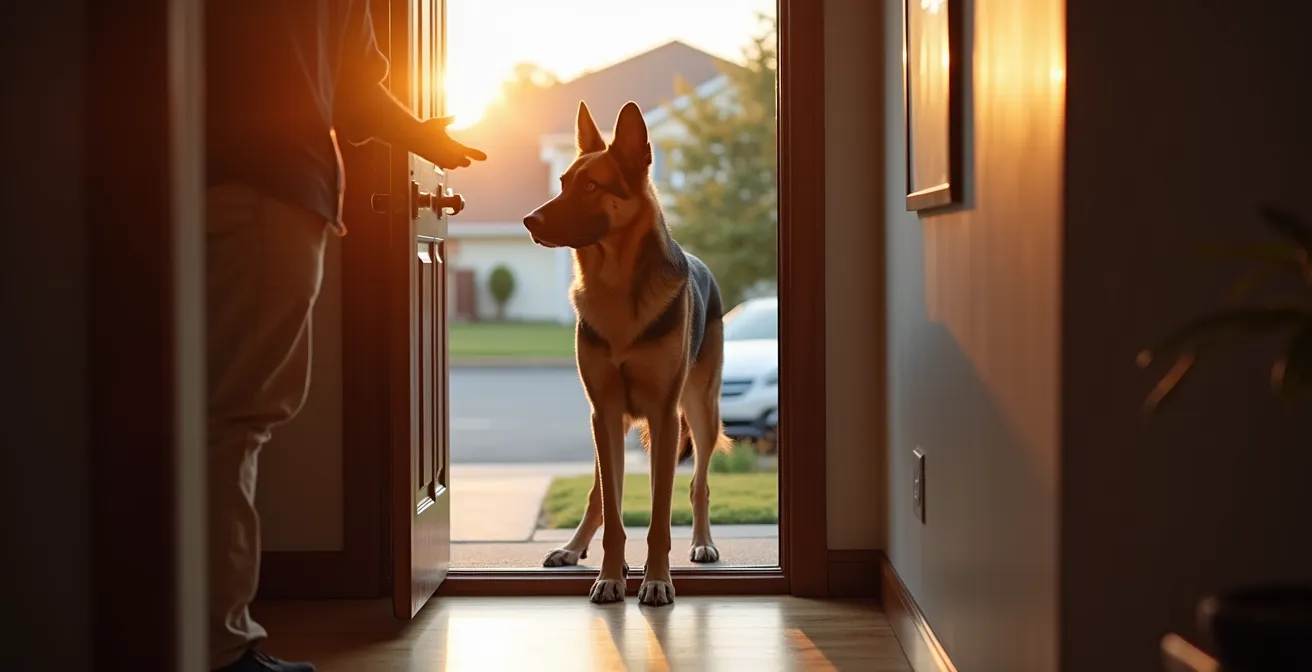
Contrary to popular belief, “Sit” and “Shake” are low-priority. Your dog’s survival depends on impulse control commands that prevent accidents before they happen.
- Focus on preventative cues like “Wait” at doors and “Leave It” for street hazards.
- Prioritize reliable attention and loose-leash walking over complex obedience like a competition “Heel.”
Recommendation: Re-evaluate your training time: shift focus from impressive tricks to building a robust safety system.
Many dog owners proudly show off a perfect “shake a paw” while their dog simultaneously lunges into the street at a passing bicycle. This disconnect is the single greatest risk in modern dog ownership. The market is saturated with advice on teaching a dozen polite behaviors, from “Sit” to “Roll Over,” treating training as a performance. This approach is fundamentally flawed. It prioritizes social niceties over survival instincts, creating dogs that are “polite” in the living room but dangerously unreliable in the real world.
The standard advice focuses on the “big five” commands: Sit, Stay, Come, Down, and Leave It. While some are valuable, they are often taught without a clear understanding of risk management. The true purpose of training is not to create a circus animal, but to install a reliable safety system that prevents accidents before they occur. It’s about mitigating hazards, not collecting tricks. The most impressive commands are not the ones people see, but the ones that prevent the accidents no one ever knows happened.
This guide reframes the entire concept of “essential” commands. We will deconstruct common training myths and rebuild your approach based on an effort-to-impact ratio, focusing on preventative cues that offer the highest safety return on your training investment. We will explore the critical commands for impulse control, the underrated power of attention, and the ultimate emergency overrides that function when all else fails. It’s time to stop training for politeness and start training for survival.
For those who prefer a different kind of visual break, the following video offers a classic piece of internet culture. It serves as a lighthearted moment before we dive into the core training protocols.
To help you navigate this critical shift in training philosophy, this article is structured to build your dog’s safety system from the ground up. We will begin with the most common daily hazards and progress toward advanced, life-saving interventions.
Summary: The Hierarchy of Commands That Actually Save Lives
- The “Wait” Command: Preventing Door Dashing and Street Accidents
- Leave It: How to Stop Your Dog From Eating Street Trash?
- Why “Heel” Is Unnecessary for 90% of Pet Owners?
- The “Look at Me” Cue: Regaining Attention in High Distraction
- Why Your Dog Sits in the Kitchen But Not on the Grass?
- Redirecting vs. Ignoring: Which Stops Puppy Biting Faster?
- The “Emergency Word”: A Cue You Only Use Once a Year
- The Recall Whistle: Why It Works Better Than Your Voice in Wind?
The “Wait” Command: Preventing Door Dashing and Street Accidents
The front door, car door, and street curb represent the most frequent and highest-risk boundaries in a dog’s life. A dog that bolts through an open door is seconds away from becoming a statistic. In fact, expert trainer Brandon McMillan confirms that door dashing is one of the main reasons dogs get lost, injured, or killed. The “Wait” command is not about politeness; it is a direct tool for hazard prevention. It establishes an invisible barrier that the dog respects until given a specific release cue.
Unlike “Stay,” which often implies a longer duration and specific posture, “Wait” is a temporary pause of forward momentum. It’s an impulse control exercise that teaches the dog to automatically stop at any threshold until cleared for passage. This single skill prevents bolting into traffic, jumping out of the car prematurely, and knocking over guests at the door. It is a foundational preventative cue that should be practiced daily until it becomes an automatic, unthinking response.
Training “Wait” involves creating a powerful association between the threshold and pausing. This is achieved through consistent repetition and clear criteria. The goal is for the dog to offer the behavior without being asked, making the doorway itself the cue to stop. This is the essence of proactive safety training: building reliable habits that function without constant micromanagement.
- Prerequisites: Begin by ensuring your dog has a basic “Sit” command. This will be the starting position for the exercise.
- Touch the Knob: With your dog in a sit a few feet from the door, reach out and touch the doorknob. If they remain seated, reward them. If they move, say nothing and reset.
- Crack the Door: Once they are steady, start opening the door just an inch or two. Immediately close it if they lunge forward. The door closing is the consequence; your hand moving away is the signal of a mistake.
- Increase the Opening: Gradually increase how wide and how long you open the door. Your dog must hold the “Sit” position. Reward calm behavior.
- Practice with Distractions: Once the door can be fully open, add distractions. Have someone ring the doorbell or walk past outside. The dog must learn that the “Wait” protocol applies regardless of what is happening on the other side.
- Add the Release Cue: Only when the dog is reliably waiting at the open door should you add a release cue like “Okay” or “Free.” This tells them the waiting period is over.
This command transforms a daily point of danger into a routine exercise in self-control, forming the first layer of your dog’s safety system.
Leave It: How to Stop Your Dog From Eating Street Trash?
A walk should be a source of enrichment, not a high-stress minefield of discarded chicken bones, toxic antifreeze puddles, and other hazardous materials. The “Leave It” command is your primary defense against ingestion-related emergencies. It is not a request; it is a non-negotiable directive that means “do not touch that item with your mouth under any circumstances.” A weak “Leave It” is as useless as no command at all. Its power lies in its absolute authority, a concept we can call command integrity.
The biggest mistake owners make is repeating the command. Chanting “Leave it, leave it, leave it” as your dog inches closer to the object teaches them that the cue is merely background noise. It erodes the command’s power and trains the dog to ignore you until you physically intervene. A strong “Leave It” is taught with a clear, binary outcome: the dog either moves away from the object immediately upon hearing the cue once, or you use physical management (like leash pressure) to ensure compliance. There is no middle ground.
To build this level of reliability, training must progress from low-value to high-value temptations in a controlled setting. Starting with a piece of kibble on the floor and progressing to a piece of steak is how you build the neural pathway for self-control that will function when your dog finds something truly tempting on the street.
Case Study: The 3-Second Rule
To preserve command integrity, many professional trainers implement a “3-Second Rule.” If the dog does not respond to the “Leave It” cue within three seconds, the handler immediately escalates to physical management, such as using gentle leash pressure to guide the dog away or body blocking to prevent access. They do not repeat the command. This method prevents “command poisoning” by ensuring the cue is always associated with a decisive action, dramatically improving success rates in real-world scenarios where a single second can mean the difference between safety and a vet visit.
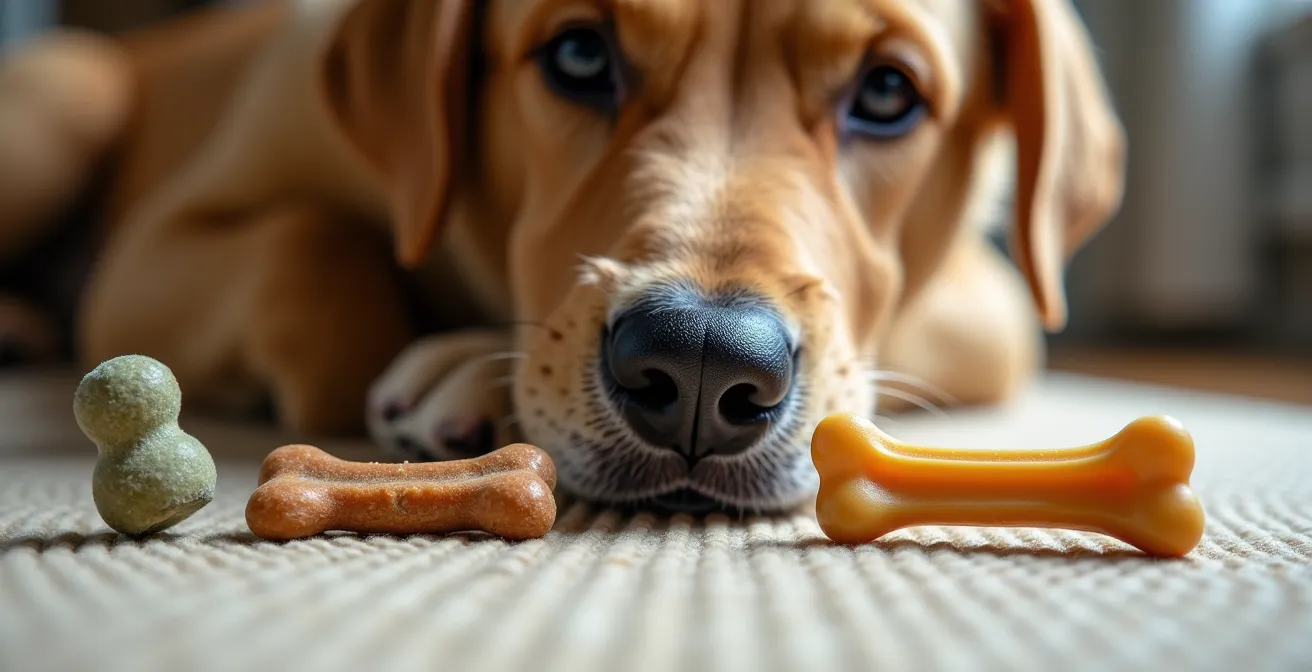
As this training setup shows, success depends on a systematic increase in difficulty. You cannot expect a dog to ignore a dead squirrel if they haven’t first learned to ignore a dry biscuit. Each successful repetition strengthens the dog’s ability to override their scavenging instinct, which is the ultimate goal.
By investing time in building an authoritative “Leave It,” you are not just teaching a command; you are installing a critical piece of safety software that protects your dog from a world of unseen dangers.
Why “Heel” Is Unnecessary for 90% of Pet Owners?
The “Heel” command, in its formal competition sense, requires a dog to walk in perfect alignment with the handler’s left knee, with their head up and attention focused. It is a visually impressive feat of precision obedience. It is also an almost completely useless skill for the average pet owner in terms of real-world safety. The time and effort required to train a competition-level heel have a very low effort-to-impact ratio for everyday safety.
The primary safety goal on a walk is simple: prevent the dog from pulling you into traffic, lunging at other dogs or people, and creating a dangerous situation. A dog walking on a loose leash—anywhere in a 180-degree arc around you without tightening the lead—accomplishes this goal with 100% effectiveness. As dog trainer Alexandra Bassett, CPDT-KA, notes, a dog that isn’t pulling prevents the vast majority of situations where an emergency command would even be needed. The focus should be on teaching “Loose Leash Walking,” not a rigid “Heel.”
Loose leash walking is a state, not a position. It teaches the dog that a tight leash means “stop moving forward,” and a loose leash means “we can continue.” This simple rule is easier to teach, less stressful for the dog, and far more practical for navigating crowded sidewalks, sniffing interesting smells (a key part of canine enrichment), and enjoying a relaxed walk. The following table breaks down the practical differences.
This direct comparison highlights why loose leash walking is the superior choice for pet owners. The data is clear, as shown in this practical comparison from the American Kennel Club.
| Aspect | Competition Heel | Loose Leash Walking |
|---|---|---|
| Position Required | Dog’s head even with knee | Anywhere without pulling |
| Stress Level | High (constant correction) | Low (natural movement) |
| Real-World Application | Limited (shows/competition) | Universal (all situations) |
| Training Difficulty | Very High | Moderate |
| Safety Benefit | Moderate | High (prevents pulling into danger) |
Don’t train for the show ring; train for the street. A dog that walks politely on a loose leash is infinitely safer than one who can perform a perfect but momentary heel before lunging at a squirrel.
The “Look at Me” Cue: Regaining Attention in High Distraction
A dog that is not paying attention to you cannot follow a command. Before you can ask for a “Wait,” “Leave It,” or “Come,” you must first have your dog’s focus. The “Look at Me” or “Watch Me” cue is the foundational tool for this. It is a pattern interrupt that cuts through distractions and re-orients the dog’s brain back to you. This is not just about getting eye contact; it’s about regaining control of the situation before it escalates. In high-distraction environments, the handler who controls the dog’s attention controls the dog.
This command acts as a preface to any other safety cue. If your dog is fixated on another dog across the street, yelling “Come!” is likely to fail. However, a sharp “Look at Me!” can break that fixation, giving you the split second of attention needed for the recall command to actually work. Mastering this requires consistent practice, but it’s an efficient investment. In fact, research from Gallant dog training shows that dogs often need just 10-15 minutes of practice, 2-3 times daily for about two weeks, to build a reliable attention command.
The process of teaching this command is often called “charging the cue,” meaning you are building a powerful, positive association with the phrase. It should predict a high-value reward, making it more compelling for the dog to look at you than at the distraction. This skill is your volume knob in a noisy world, allowing you to turn down the environmental distractions and turn up your own relevance.
Action Plan: Charging the “Look at Me” Cue
- Lure to the Nose: Start in a quiet room. Hold a high-value treat near your dog’s nose to get their initial attention.
- Bring to Your Face: Slowly bring the treat from their nose up towards your own face, stopping between your eyes. Their eyes will follow the treat.
- Mark and Reward Eye Contact: The instant your dog’s eyes meet yours, say your cue (“Watch me!”) and immediately give them the treat and enthusiastic praise.
- Increase Duration and Distance: Gradually increase the time they must hold eye contact before getting the reward, and practice from further away.
- Generalize to New Environments: Once reliable indoors, take the exercise to the backyard, then the sidewalk, and finally to a park. Systematically increase the level of distraction to proof the behavior.
Without attention, you have no control. Make a reliable “Look at Me” cue your absolute priority, and you will find every other aspect of safety training becomes dramatically easier.
Why Your Dog Sits in the Kitchen But Not on the Grass?
This is one of the most common frustrations for dog owners: “He knows this command perfectly at home!” The problem isn’t defiance; it’s a fundamental misunderstanding of how dogs learn. Dogs are poor generalizers. They are contextual learners who associate commands with a complete environmental picture, not an abstract rule. When you teach “Sit” in the kitchen, your dog isn’t just learning the word “Sit.” They are learning: “When this human says ‘Sit’ on this linoleum floor, with the refrigerator humming, and the smell of kibble in the air, I should put my bottom on the ground.”
When you then go to the park and say “Sit,” the entire picture has changed. The surface is different (grass vs. linoleum), the sounds are new (birds, traffic), and the smells are overwhelming (other dogs, squirrels). From the dog’s perspective, you are asking for a completely new behavior in an unfamiliar context. The command has not been generalized. This phenomenon of contextual failure is why a “perfect” command at home can completely fall apart at the first sign of distraction or a change in location.
The solution is a systematic Generalization Plan. This involves changing one variable at a time—location, surface, distractions, your body position—and re-teaching the command in each new context. This process methodically teaches your dog that the cue “Sit” means the same thing whether they are on carpet, grass, or concrete, and whether you are standing, sitting, or kneeling.
Case Study: The Generalization Plan in Action
To overcome contextual learning, professional trainers use a systematic plan. For a “Sit” command, they might start in the kitchen. Once reliable, they move to the living room (new room, new flooring). Then the porch (inside-outside boundary). Then the quiet backyard (new surface, more smells). Finally, they practice at the front of the house and then in a low-distraction park. As noted in AKC training guides on reliable commands, by changing only one variable at a time, the dog learns that the command is a universal rule, not a trick tied to a specific “picture.” This is the only way to build commands that are truly reliable everywhere.
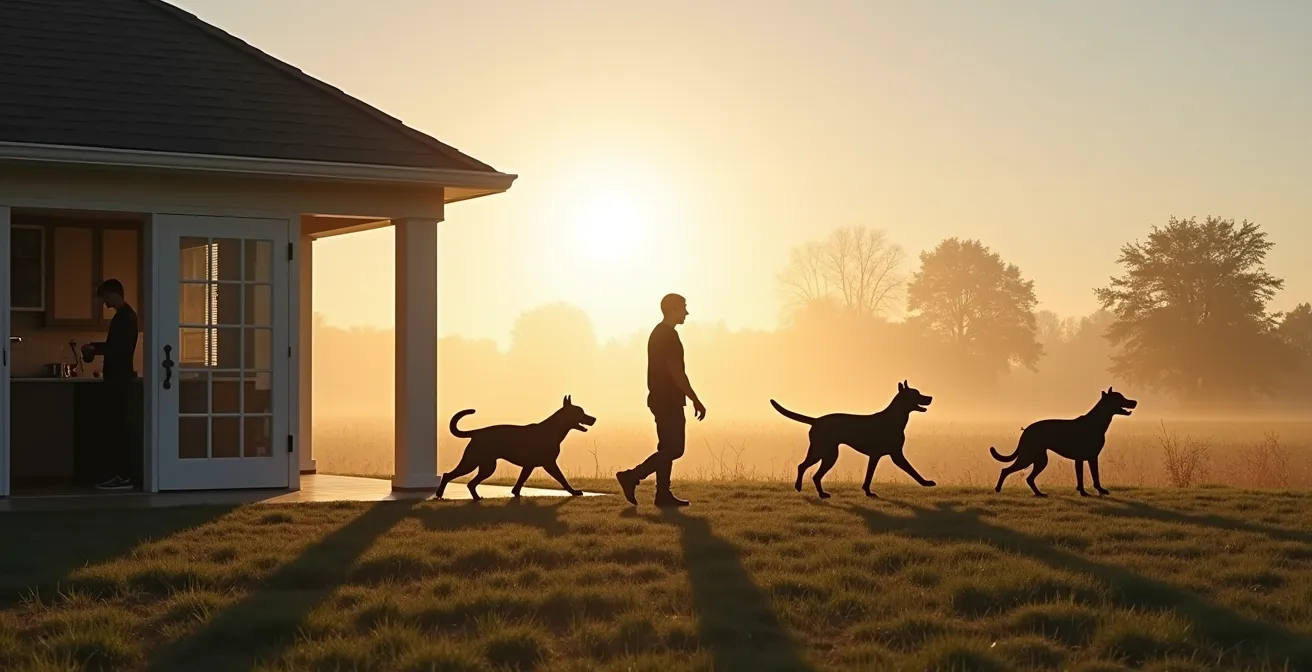
This visualization perfectly captures the journey of generalization. A command is not truly “known” until it has been successfully performed across a wide spectrum of environments, moving from the sterile indoor setting to the complex and distracting outdoor world.
Stop blaming your dog for being “stubborn.” Instead, take responsibility for teaching them that your commands apply everywhere. True reliability is not taught; it is built, one context at a time.
Redirecting vs. Ignoring: Which Stops Puppy Biting Faster?
Puppy biting, or “play biting,” is a normal developmental behavior. However, if not managed correctly, it can become a genuine safety issue. The two most common pieces of advice are to ignore the behavior or to redirect the puppy onto an appropriate toy. The question isn’t about which method is “faster,” but which is correct for the specific motivation behind the bite. Misdiagnosing the reason for the biting will lead to ineffective and frustrating training sessions.
Ignoring the behavior, often by yelping “Ouch!” and withdrawing all attention, is the correct approach for attention-seeking nips. If a puppy learns that a gentle nip on the hand makes the fun human stop playing, they will quickly learn to inhibit that behavior. However, ignoring a puppy that is biting due to over-arousal, frustration, or teething pain is completely ineffective. In these cases, the biting is not a bid for attention but a physical release of internal pressure. Ignoring it will likely cause the puppy to bite harder in an attempt to get a response.
For arousal or pain-related biting, redirection is the correct protocol. This involves proactively shoving an appropriate chew toy into the puppy’s mouth the moment you anticipate a bite. You are not just offering an alternative; you are teaching a new default behavior: “When I feel this way, I should bite this toy, not human skin.” This requires management and foresight, keeping toys readily available during all interactions.
It’s not about which is ‘faster’, but which is ‘correct’ for the situation. Ignoring is for attention-seeking nips, while Redirection is for over-arousal or teething pain.
– Dr. Natalia Rozas, CPDT, Dog Training Excellence Guide
Effective puppy training is about being a good diagnostician. Observe your puppy, understand the “why” behind the bite, and apply the correct technique for that specific motivation. This targeted approach will resolve the issue far more effectively than a one-size-fits-all strategy.
Key Takeaways
- Prioritize Prevention: Focus training time on commands that prevent accidents (Wait, Leave It) rather than those that react to them.
- Protect Command Integrity: A command’s power comes from its absolute meaning. Never repeat a safety cue; enforce it after the first utterance to prevent the dog from learning to ignore it.
- Generalize or Fail: A command is not truly learned until it has been proofed in multiple locations and contexts. Training at home is only the first step.
The “Emergency Word”: A Cue You Only Use Once a Year
Your standard recall, “Come,” is a daily-use command. You use it to call your dog in from the yard, to move them to another room, or to come for dinner. Because of its frequent and often low-stakes use, its reliability can degrade over time. It becomes part of the background noise of life. For a true, life-or-death emergency—your dog bolting towards a busy road—you need a different tool. You need an “Emergency Word,” a pristine, untainted recall cue that cuts through panic, prey drive, and all other distractions.
This is your nuclear option. It’s a unique word or phrase (ideally not in English, to avoid accidental use) that the dog has only ever heard in association with a “jackpot” reward—something incredibly high-value that they get at no other time. Think cooked steak, a can of tuna, or liverwurst. The training builds an unbreakable, Pavlovian association: hearing this word predicts the single greatest food reward imaginable. This makes the cue more powerful than the temptation of chasing a squirrel or a ball that has rolled into the street.
The cardinal rule of the Emergency Word is to protect its integrity at all costs. It is never used for mundane tasks like bath time or leaving the dog park. You might only use it for real once a year, or even once in a dog’s lifetime. Its power is directly proportional to its rarity and the value of its associated reward. To maintain it, you conduct brief, high-energy practice sessions once a month, always delivering the jackpot.
Case Study: Real-World Emergency Recall Success
The effectiveness of this protocol is well-documented by trainers. According to reports from training clients at Preventive Vet, owners see remarkable results. One owner successfully recalled their dog who bolted to chase children on sleds. Another prevented their dog from running into a busy intersection after a squirrel, just three weeks after starting the protocol. The key in every success story is the unbreakable positive association that overrides even the most intense instinctual drives.
This is the final layer of your safety system. While preventative commands are your first line of defense, a perfectly trained Emergency Word is the reactive tool that can avert a tragedy when prevention fails.
The Recall Whistle: Why It Works Better Than Your Voice in Wind?
Even the best-trained verbal recall has limitations. The human voice carries poorly over long distances, gets lost in high winds, and is distorted by environmental noise. Most critically, the human voice is loaded with emotion. In a panic, your voice goes up in pitch, and your tone becomes tight and fearful. A dog can read this panic, and it can cause them to hesitate or even run away, associating the recall with a scary situation.
A recall whistle bypasses all of these problems. It offers a consistent, emotionally neutral, and highly effective signal. Firstly, the high frequency of a “silent” dog whistle cuts through wind and ambient noise far more effectively than the human voice. As professional dog trainers confirm, a whistle simply carries further, making it superior for distance work or in challenging weather conditions. This physical property alone makes it a more reliable tool.
Secondly, the whistle’s pitch is always the same. It is a pure, clean signal, devoid of the panic, fear, or frustration that taints your voice in an emergency. The dog learns to associate this specific, neutral tone with a reward, without the emotional baggage of a frantic verbal cue. This makes their response faster and more reliable. Training a whistle recall follows the same principles as a verbal recall—start close, use high-value rewards, and gradually increase distance and distractions—but the final result is a more robust and dependable safety tool.
Think of the whistle as a specialized piece of equipment designed for one job: a reliable recall under adverse conditions. Just as you’d use a specific tool for a specific task in any other field, the whistle is the professional-grade tool for long-distance safety.
Your next training session is an opportunity. Don’t waste it on another “paw.” Start building your dog’s safety system today by implementing the “Wait” command at your front door.