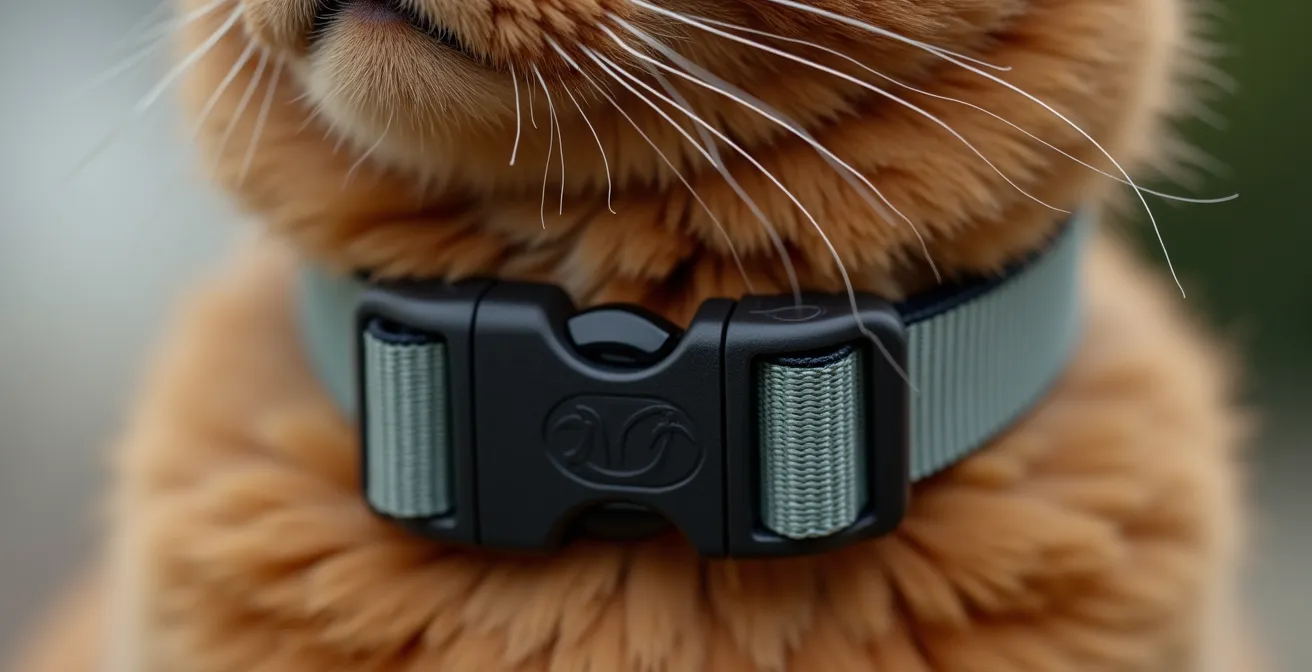
True cat safety isn’t found in a single collar, but in a balanced system that manages the conflicting risks of snagging versus the loss of identification.
- The breakaway buckle’s release tension is a critical engineering specification, not a generic feature; too low and the collar is lost, too high and it’s a hazard.
- Silent, snag-proof identification (like embroidered collars) often presents a lower physical risk than traditional, noisy hanging tags which can act as a hook.
Recommendation: Build a “safety stack” for your cat: start with a permanent microchip as the ultimate backup, add a properly fitted breakaway collar with embedded ID for immediate contact, and consider a lightweight tracker appropriate for your cat’s environment and the collar’s release threshold.
For any cat owner, the collar represents a fundamental dilemma: the need for identification versus the terrifying risk of strangulation. The standard advice is simple and ubiquitous: always use a breakaway collar for a cat that goes outdoors. This single piece of technology is marketed as the definitive solution, designed to snap open under pressure and save a cat from a life-threatening entanglement. But this simple solution presents a more complex problem. If the collar breaks away, so does the ID tag, the bell, and the expensive GPS tracker attached to it. Your cat is safe from choking, but is now lost and anonymous.
This creates a paradox where the primary safety feature becomes a major security liability. Many owners, frustrated by lost collars, are tempted to switch to more secure, non-breakaway options, inadvertently reintroducing the very danger they sought to avoid. The conversation often stagnates at this binary choice: safety or security? This article moves beyond that simplistic debate. We will not just ask *if* you should use a breakaway collar, but *how* to build a complete safety system around it.
The key is to think like a risk analyst. Instead of viewing the collar as a single object, we must see it as an integrated system where every component—from the buckle’s release tension and the type of ID tag to the weight of a tracker—presents its own set of trade-offs. We will analyze the engineering behind these components, assess their specific failure points, and provide a framework for making informed decisions that truly balance your cat’s safety with your peace of mind.
This guide will deconstruct the components of a modern cat collar system, providing the data and context needed to manage each risk effectively. Follow along to learn how to select, fit, and equip a collar that is not just a decoration, but a meticulously planned piece of safety equipment.
Summary: Breakaway Collars: A Deep Dive into Feline Safety and Security
- Why Cheap Breakaway Buckles Open Too Easily?
- The “Two Finger” Rule: How to Fit a Collar That Won’t Get Stuck on a Jaw?
- Tag Noise or Silence: Does a Bell Help or Harm Wildlife?
- Embroidered Collars vs. Hanging Tags: Which Is Safer?
- How to Cut a Collar Safely in a Choking Emergency?
- Collar Attachment: Preventing Snags While Ensuring Signal Strength
- Oral Chews vs. Collars: Which Is Safer for Families With Toddlers?
- GPS vs. Bluetooth Trackers: Why AirTags Aren’t Enough for Lost Dogs?
Why Cheap Breakaway Buckles Open Too Easily?
The core component of a safety collar is the breakaway buckle, but not all are created equal. The term “breakaway” is not a regulated standard, leading to vast inconsistencies in performance. The fundamental issue lies in the release tension—the specific amount of force required to open the buckle. For a collar to be effective, this tension must exist in a narrow, optimal window. If the release tension is too low, the collar will fall off during normal activities like scratching or playing, rendering it useless for identification. If it’s too high, it fails to release in a genuine emergency, creating a deadly hazard.
Inexpensive, mass-produced collars often have poorly calibrated or inconsistent release mechanisms. This is not just a matter of durability but of core function. Comprehensive research shows that breakaway collars typically release between 2.5 to 5.5 pounds of pressure. A 2.5-pound threshold might be too low for an active, larger cat, leading to constant loss, while a 5.5-pound threshold might be too high for a lightweight kitten to break free from a snag.
Reputable manufacturers invest in engineering and testing to hit a specific, reliable target. This commitment to a precise tension threshold is a key differentiator between a cheap accessory and a piece of safety equipment.
Case Study: The Lupine Pet Engineered Buckle
To address this inconsistency, Lupine Pet partnered with the renowned zipper and buckle manufacturer YKK to design a custom safety buckle. Their goal was to establish a reliable 5 lb release threshold. Extensive internal testing demonstrated this specific tension was the ideal balance, preventing accidental release during a cat’s vigorous daily activities while ensuring the collar would consistently break away when a cat’s body weight was applied during a dangerous snag.
Without a reliable mechanism, a breakaway collar offers a false sense of security. It is crucial for owners to understand that the price difference often reflects a significant gap in research, development, and testing that directly impacts the safety and reliability of the product.
The “Two Finger” Rule: How to Fit a Collar That Won’t Get Stuck on a Jaw?
A collar’s safety is as dependent on its fit as it is on its buckle. A collar that is too loose is a significant hazard. It can easily snag on branches, fences, or furniture. Even more alarmingly, a cat can get its front leg caught through a loose collar while scratching, leading to panic and serious injury. A common and devastating accident occurs when a cat attempts to groom or remove a loose collar and gets its lower jaw trapped underneath, which can cause fractures, panic, and suffocation.
The universally accepted guideline for proper fit is the “two-finger rule.” As emergency veterinarian Dr. Laura Playforth of Vets Now clinics advises, “You should be able to comfortably slide one or two fingers under the collar when your cat is wearing it.” This provides enough space for comfort and movement without leaving a dangerous gap for snagging a jaw or limb.

However, this rule should be seen as a starting point, not an absolute. The anatomy of cats varies significantly, meaning the two-finger rule requires intelligent application. A slender Siamese may need a snugger fit than a British Shorthair with its characteristically wider head and jowls. Research into dynamic fit emphasizes the need to check the collar’s tightness not just when the cat is relaxed, but also when it tenses its neck muscles, as this action can significantly change the effective circumference and create unexpected slack.
A properly fitted collar is a critical element of the safety system. It minimizes the risk of self-entanglement, ensuring that the breakaway buckle remains the primary failure point only in the event of an external snag, as it was designed to be.
Tag Noise or Silence: Does a Bell Help or Harm Wildlife?
For decades, the tiny bell on a cat’s collar has been the go-to solution for owners hoping to protect local wildlife. The logic is simple: the jingle alerts birds and small mammals to the approaching predator, giving them a chance to escape. While well-intentioned, the effectiveness and potential downsides of this approach are more complex. Scientific studies show bells provide a statistical reduction, not complete prevention, in predation. Some cats learn to move silently despite the bell, and some prey animals may not associate the sound with danger.
Furthermore, there is a debate about the impact of the constant noise on the cat itself. While there is no definitive proof of harm, some behaviorists argue that the perpetual jingling so close to a cat’s sensitive ears could be a source of chronic stress or irritation. It can also alert larger predators or aggressive animals to your cat’s location, potentially putting them at risk.
A more modern, science-backed alternative focuses on a bird’s primary sense: vision. Birds have highly developed color vision, and bright, unnatural colors can act as a clear warning signal. This has led to the development of brightly colored fabric collar covers.

These fabric “scrunchies” fit over a standard breakaway collar and use bold, contrasting colors and patterns that are highly visible to birds. Research has shown these visual deterrents can be significantly more effective than bells at reducing the number of birds caught by domestic cats, without creating any noise. This approach transforms the collar from a potential auditory nuisance into a silent, visual alarm, aligning safety for wildlife with the comfort of the cat.
Embroidered Collars vs. Hanging Tags: Which Is Safer?
Once a collar is chosen and properly fitted, the next critical decision is how to display identification. The traditional hanging tag has been the standard for generations, but it introduces a significant, often overlooked, safety risk. A hanging tag, especially one attached with a dangling S-hook or a large split ring, acts as a perfect hook. It can get caught on crate wiring, heating vents, or even a cat’s own claws during grooming, creating leverage that can either trigger the breakaway buckle (losing the ID) or, in the case of a faulty buckle, become a point of entrapment.
An increasingly popular and safer alternative is the embroidered collar. With this option, the owner’s phone number and the cat’s name are stitched directly onto the fabric of the collar. This creates a completely silent and snag-proof form of identification. However, this method also has a trade-off: in an emergency, a person may need to get very close to a frightened or injured cat to read the number, which can be difficult and potentially dangerous.
The following table breaks down the key safety considerations for each type of identification.
| Feature | Embroidered Collar | Hanging Tag |
|---|---|---|
| Snag Risk | Low – flush with collar | High – acts as hook with leverage |
| Emergency Legibility | Harder to read on frightened animal | Can be read from safer distance |
| Durability | Permanent, won’t fall off | Can detach if collar releases |
| Noise Level | Silent | Creates jingling sound |
A modern solution is to create a hybrid system that leverages the benefits of multiple technologies. This approach treats identification not as a single item but as a layered strategy. For maximum safety, you can use an embroidered collar as the primary, snag-proof ID. For additional information (like medical needs or secondary contacts), a flat-lying QR code tag can be added. These tags sit flush against the collar, minimizing the snag risk while providing a wealth of information to anyone with a smartphone. This creates a robust, low-profile, and highly effective identification system.
How to Cut a Collar Safely in a Choking Emergency?
Even with a perfectly fitted breakaway collar, there is always a minuscule risk of malfunction or a scenario where the collar becomes dangerously tight without enough force to trigger the release. In such a choking emergency, every second counts, and knowing how to remove the collar quickly—with or without tools—can be lifesaving. Fumbling with a buckle on a panicking animal is difficult, and you may not have scissors readily available.
Before resorting to cutting, there are several techniques to attempt a rapid release. First, try to remain calm to avoid escalating your cat’s panic. If you can get a grip on the collar, twisting it can sometimes provide enough leverage on the D-ring to force the buckle apart. Alternatively, a sturdy, flat object like a key can be inserted into the buckle’s seam and used to pry it open. If the buckle is completely stuck but there is some slack, you may be able to carefully slide the collar forward over the cat’s head. These methods can be faster than searching for cutting tools.
However, the most reliable method in a true crisis is to cut the collar. The BC SPCA recommends that pet owners keep a pair of trauma shears in their home’s first-aid kit. These specialized scissors are designed to cut through tough materials like nylon, leather, and even denim quickly and safely, with a blunted tip to prevent injury to the skin. They provide a level of certainty that household scissors cannot match. After any such incident, it is critical to assess the cat for breathing difficulties or tissue damage around the neck and seek immediate veterinary care.
Action Plan: Emergency Collar Release Without Scissors
- Twist the D-Ring: Firmly grasp the collar on either side of the buckle and twist. This can use the metal D-ring as a lever to apply focused pressure and break the plastic buckle.
- Use a Key as a Pry Bar: Insert the tip of a sturdy key into the seam where the two parts of the breakaway buckle connect and twist to pry them apart.
- Attempt a Head-Slip Removal: If the buckle will not release but you can create some slack, carefully and gently try to slide the entire collar forward over your cat’s ears and off its head.
- Post-Removal Assessment: Once the collar is off, check your cat’s neck for any swelling or cuts. Monitor their breathing and check for pale or blue-tinged gums, which signals a lack of oxygen.
- Recognize Emergency Signs: If your cat is having any difficulty breathing, is making raspy sounds, or seems weak or disoriented after the incident, this constitutes a medical emergency requiring immediate veterinary attention.
Collar Attachment: Preventing Snags While Ensuring Signal Strength
The rise of GPS and Bluetooth trackers has added another layer of complexity to the cat collar safety system. While these devices offer incredible peace of mind, they also introduce new variables: weight, size, and positioning, all of which can impact both safety and performance. An improperly attached tracker can become a significant snag hazard, completely negating the benefit of a breakaway collar. It can also compromise the device’s ability to receive a clear satellite or Bluetooth signal.
Weight is a primary concern. The device must be light enough for the cat to wear comfortably without affecting its natural movement. According to industry analysis, most GPS trackers for cats weigh between 0.6 to 1.2 ounces. Heavier devices can cause discomfort and are more likely to generate enough force during normal activity to accidentally trigger a sensitive breakaway buckle. The tracker’s weight must be considered in relation to the buckle’s release tension to prevent unintended collar loss.
The position of the tracker on the collar is a critical trade-off between signal quality and safety. The ideal position for GPS reception is on the dorsal side (the top/back of the neck), where the device has a clear view of the sky. This position also happens to be the safest, as it’s the least likely to get caught on objects or entangled with the cat’s limbs.
The following table, based on tracker performance reviews, analyzes the impact of different positions.
| Position | Signal Quality | Snag Risk | Comfort |
|---|---|---|---|
| Dorsal (top of neck) | Excellent GPS reception | Lowest | Good weight distribution |
| Ventral (under chin) | Poor signal | Highest | Uncomfortable weight |
| Lateral (side) | Moderate | Moderate | Can rotate position |
A tracker should always be attached via a secure, low-profile holder that keeps it flush with the collar, rather than dangling. This minimizes its potential as an “entanglement vector.” By carefully selecting a lightweight tracker and positioning it dorsally in a secure holder, you can maximize signal strength while minimizing the additional risk it introduces to the collar system.
Oral Chews vs. Collars: Which Is Safer for Families With Toddlers?
The concept of “collar safety” extends beyond physical risks like snagging; it also encompasses chemical safety, particularly in households with young children. For decades, flea and tick collars have been a popular and affordable method of parasite control. However, many of these collars work by releasing low levels of pesticides, such as tetrachlorvinphos (TCVP) and propoxur, which coat the pet’s fur. While this kills parasites, it leaves a chemical residue that can be harmful to humans.
Toddlers and young children are uniquely vulnerable to this exposure. Their frequent hand-to-mouth behaviors and close physical contact with family pets create a direct pathway for ingesting these chemicals. The Natural Resources Defense Council has long raised alarms about this issue, stating that these pesticides, even at low levels, can pose a risk to a child’s developing brain and nervous system. In a formal report, the NRDC highlights that “Children’s developing bodies are more susceptible to toxic pesticides… [which] hamper a child’s brain development.”
In response to these concerns, regulatory bodies have taken action. A risk assessment by the U.S. Environmental Protection Agency (EPA) found that propoxur flea collars left enough chemical residue on a pet’s fur to transfer to children through normal petting. This led to agreements with manufacturers to phase out these products. Similarly, the EPA has also found that TCVP collar residue poses neurological risks to toddlers’ developing brains.
Children’s developing bodies are more susceptible to toxic pesticides. Studies suggest these poisons, even at low levels of exposure, hamper a child’s brain development.
– Natural Resources Defense Council, NRDC Flea Control Products Report
For families with young children, oral parasite preventatives (chews or tablets) offer a significantly safer alternative. These medications work systemically within the pet’s body, eliminating the risk of external chemical transfer to children and the home environment. When considering a flea collar, a risk-based analysis must include not only the safety of the pet but also the health of the most vulnerable humans in the household.
Key Takeaways
- A breakaway collar’s primary function is to fail; its value is in its release, which means any attached items, including ID, are designed to be lost.
- The “two-finger” fit rule is a guideline, not a law. It must be adapted to your cat’s specific breed, size, and neck structure to be truly safe.
- Visual deterrents, like brightly colored collar covers, are often more effective at protecting wildlife than traditional bells and do not pose a potential auditory stressor for your cat.
- A multi-layered “safety stack”—combining a permanent microchip with a snag-proof collar ID—provides a more resilient system than relying on a single point of identification.
GPS vs. Bluetooth Trackers: Why AirTags Aren’t Enough for Lost Dogs?
When a breakaway collar performs its function and is lost, the tracking technology attached to it becomes paramount. The choice between a GPS tracker and a Bluetooth tracker (like an AirTag) is not just a matter of price or features; it’s a strategic decision based on fundamentally different technologies and use cases. While this topic often centers on dogs, the principles are even more critical for cats, who are more likely to lose collars and hide in close proximity when lost.
GPS trackers operate like a phone, using satellite signals to pinpoint location and a cellular connection to transmit that data to your smartphone. This allows for real-time tracking over unlimited distances, as long as the device has battery and can connect to a cellular network. They are the definitive solution for finding a pet that has roamed far away. However, they are larger, heavier, require frequent charging, and come with a monthly subscription fee.
Bluetooth trackers, in contrast, have no subscription fee and boast a battery life of up to a year. They are incredibly small and lightweight, making them ideal for cats. However, their function is entirely different. An AirTag does not have its own location system; it works by anonymously pinging nearby Apple devices. Its range is limited to the Bluetooth radius of those devices (typically 30-100 feet). It excels at finding your keys in the house but is not a real-time, long-range tracking system. It can only tell you the “last known location” where it came into contact with another device in the network.
| Feature | GPS Tracker | Bluetooth (AirTag) |
|---|---|---|
| Range | Unlimited with cellular signal | 30-100 feet typically |
| Battery Life | 2-7 days | Up to 1 year |
| Weight | 0.9-3.5+ ounces | 0.39 ounces |
| Monthly Cost | $5-15 subscription | None |
| Indoor Tracking | Poor/Limited | Good within range |
This is where the “safety stack” concept becomes crucial for cat owners. Given the high probability of a breakaway collar being lost, attaching an expensive GPS unit that requires a monthly fee may not be a practical or sustainable strategy. A more resilient approach, recommended by many pet safety experts, is a tiered system. The foundation is a permanent microchip. The second layer is a breakaway collar with a lightweight Bluetooth tracker. If the cat loses its collar while hiding in a neighbor’s yard, the Bluetooth device provides a highly effective way to pinpoint its location for that “last mile” search. It balances the high risk of collar loss with a practical, affordable method for recovery in the most common “lost cat” scenarios.
Your cat’s safety depends on a system of thoughtful choices, not a single purchase. Start today by re-evaluating your current setup—from buckle to tag to tracker—as an interconnected safety system and identify the weakest link you can strengthen.