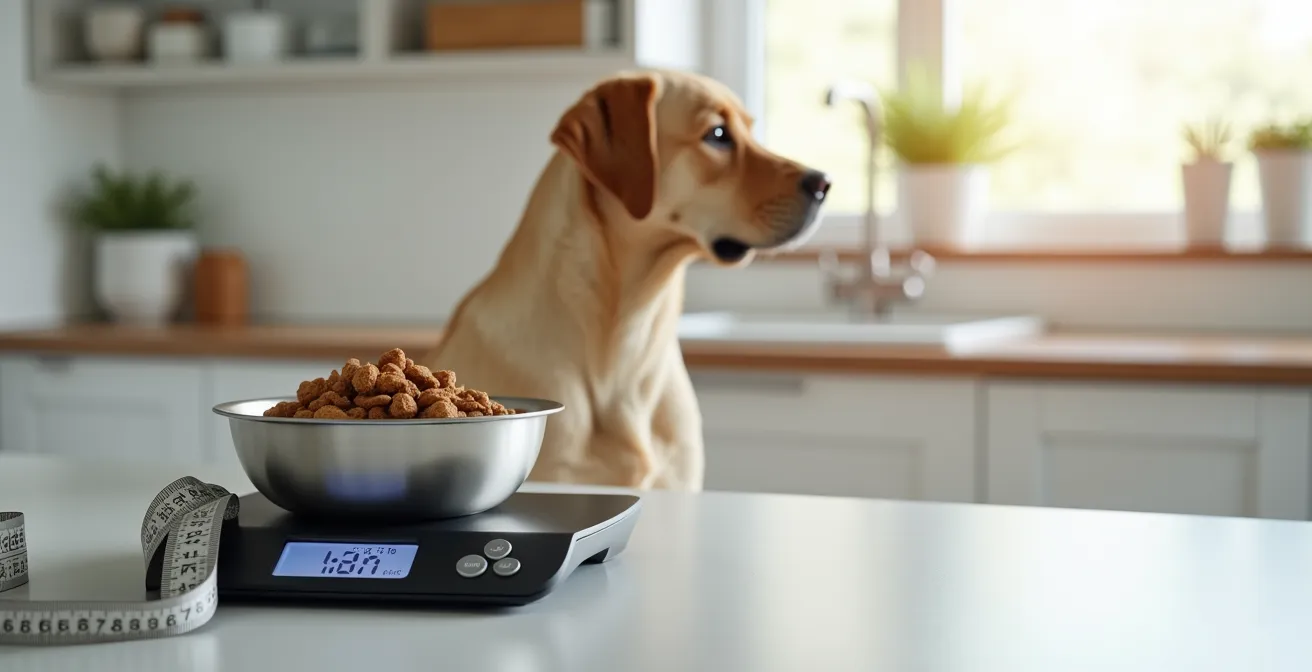
The feeding guide on a dog food bag is a primary contributor to pet obesity because it’s an imprecise estimate that fails to account for your dog’s true, individual metabolic reality.
- Post-neutering metabolic rates can drop by up to 25%, requiring immediate and significant portion reduction that bag guides ignore.
- Using a measuring cup instead of a kitchen scale introduces a daily caloric surplus of 15-30%, leading to a potential weight gain of 5-10 lbs per year.
Recommendation: Abandon the measuring cup in favor of a digital kitchen scale and calculate your dog’s daily caloric needs based on their actual body condition, activity level, and neuter status, not a generic bag chart.
You follow the instructions meticulously. You measure out the exact number of cups recommended on the dog food bag, ensuring your beloved companion receives what you believe is a perfectly portioned meal. Yet, despite your diligence, you notice the undeniable truth: your dog is gaining weight. This frustrating scenario is one I encounter daily in my practice. The owner is compliant, but the results are counterproductive, leading to confusion and guilt.
Well-meaning advice often suggests these guides are “just a starting point,” an unhelpful platitude that fails to address the core of the issue. The problem is not the guide itself, but the underlying assumption that feeding a dog is an act of approximation. It is not. It is an act of strict caloric mathematics. The bag provides one flawed variable for a complex metabolic equation that it cannot possibly solve. It is designed for an intact, active, “average” dog that rarely exists in a typical household.
This guide will deconstruct that equation. As a weight management veterinarian, my approach is mathematical and uncompromising. We will not estimate; we will calculate. We will quantify the errors introduced by common variables—from the physiological changes of spaying and neutering to the profound inaccuracy of the very cup you measure with. We will provide the precise calculations and protocols necessary to take control, achieve your dog’s ideal body condition, and maintain it for life.
For those who prefer a condensed overview, the following video from the Purina Institute offers insights into the foundations of canine well-pet nutrition, complementing the detailed calculations we are about to undertake.
To navigate this precise approach to canine weight management, we will systematically address each variable that influences your dog’s caloric needs. The following sections break down the key factors that the bag’s feeding chart overlooks, providing you with the data-driven tools to correct your dog’s diet accurately.
Summary: The Mathematical Failures of Generic Dog Food Feeding Guides
- Why Spaying/Neutering Reduces Caloric Needs by 25%?
- Kitchen Scale vs. Measuring Cup: The Accuracy Difference That Sheds Pounds
- Active or Sedentary: Which Label Fits Your Weekend Warrior Dog?
- The “Hidden 10%” Rule: How Treats Sabotage Weight Loss Plans
- When to Reduce Portions During Winter Months?
- When to Use K9 Electrolytes Instead of Plain Water?
- Hypothyroid Weight Gain: Why Dieting Doesn’t Work Without Medication?
- Homemade Pet Food: The Nutrient Gap That Risks Malnutrition
Why Spaying/Neutering Reduces Caloric Needs by 25%?
The single most significant, predictable, and frequently ignored metabolic event in a pet’s life is sterilization. The hormonal changes following a spay or neuter procedure are not trivial; they fundamentally and permanently alter the body’s energy requirements. Continuing to feed a newly neutered dog according to its “pre-surgery” needs or, even worse, the generic bag guide, is a guaranteed path to obesity. The metabolic shift is not a myth; it is a quantifiable, physiological event that demands immediate dietary intervention.
Scientific evidence confirms this metabolic slowdown. For instance, a detailed study on Beagles post-spaying documented a clear reduction in their maintenance energy requirement (MER). The research confirms that the body simply becomes more efficient, burning fewer calories at rest. While the exact percentage varies slightly between studies and species, the clinical consensus is a necessary caloric reduction of approximately 25-30%. This is not a “slight adjustment”; it is a massive change in the caloric equation that must be implemented immediately post-operation to prevent the rapid onset of weight gain.
Your Action Plan: Metabolic Recalibration Protocol Post-Surgery
- Reduce caloric intake by a non-negotiable 25-30% immediately after spaying/neutering. Do not wait for weight gain to begin.
- Monitor body condition score (BCS) weekly for the first 2-3 months. Use a standardized 9-point chart, aiming for a 4 or 5.
- Track actual food intake using a food diary or app. This includes all meals, treats, and chews, measured in grams.
- Adjust portions based on the individual metabolic response and weekly BCS checks, not on appetite or begging behavior.
- Make ongoing, data-driven adjustments to maintain a lean body condition for the remainder of the dog’s life.
Ignoring this crucial adjustment is the first major error in caloric calculation. The dog’s body has fundamentally changed, and its diet must change with it, with mathematical precision.
Kitchen Scale vs. Measuring Cup: The Accuracy Difference That Sheds Pounds
If the post-neuter metabolic shift is the first great error, then the single greatest source of daily caloric surplus is the measuring cup. Using a scoop or cup to portion kibble is an act of gross approximation, not measurement. The variability in kibble size, shape, and density between—and even within—brands makes volume-based measurement incredibly unreliable. This seemingly innocuous tool is, in reality, a primary engine of the pet obesity epidemic.
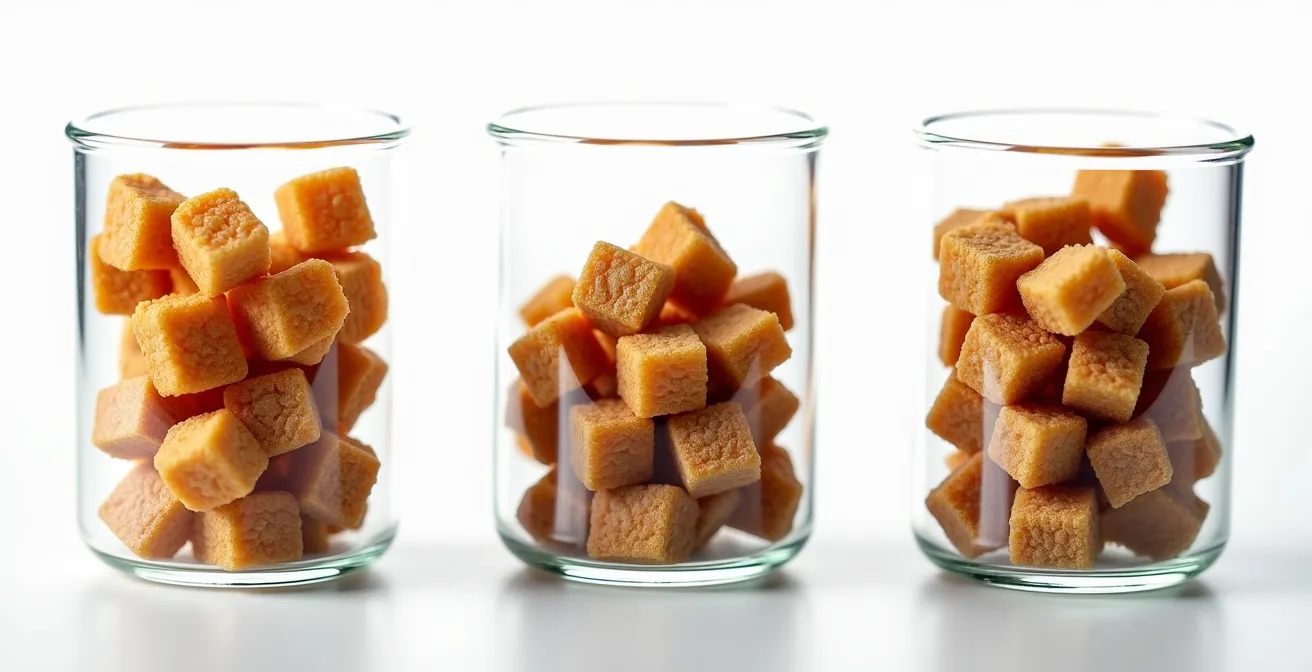
As the image above demonstrates, kibble is not a uniform substance. Some are light and airy, others small and dense. A “cup” of one food can contain significantly more or fewer calories than a “cup” of another. This variance isn’t a small rounding error; it’s a massive, quantifiable source of caloric inaccuracy that accumulates over time, resulting in steady weight gain. The only clinically acceptable method for portioning food is by weight, using a digital kitchen scale.
The difference in accuracy is not subtle. The data clearly shows that switching from a measuring cup to a kitchen scale is one of the most impactful changes an owner can make. An analysis from the an accuracy comparison by the Tufts Veterinary Medical Faculty illustrates the stark reality of this measurement error.
| Method | Accuracy | Daily Calorie Variation | Annual Weight Impact |
|---|---|---|---|
| Kitchen Scale (grams) | ±2% | 10-20 calories | 0.5-1 lb gain |
| Measuring Cup | ±15-30% | 50-100 calories | 5-10 lb gain |
| Visual Estimation | ±40% | 150+ calories | 15+ lb gain |
A 20% overage, day after day, is not a small mistake; it is the mathematical formula for obesity. The measuring cup must be retired permanently. Your dog’s health depends on the precision that only a scale can provide.
Active or Sedentary: Which Label Fits Your Weekend Warrior Dog?
The labels “active” and “sedentary” on dog food bags are clinically useless without quantification. What constitutes an “active” dog? A 30-minute leash walk? An hour at the dog park? A full day of hiking? For most dogs, activity levels are not constant; they fluctuate dramatically between weekdays and weekends. This is the “Weekend Warrior” paradox: a largely sedentary dog with short bursts of high activity. Feeding for the highest activity level leads to caloric surplus on rest days, while feeding for the lowest level creates a deficit on active days.
The solution is not to guess, but to calculate and adjust. This requires a two-part approach: establishing a baseline Resting Energy Requirement (RER) for sedentary days, and then applying a specific activity factor for high-exertion days. A dog’s energy needs do increase with exercise, but perhaps not as much as owners assume. For example, some guidelines suggest that dogs covering 5 km per day increase energy requirements by only 7-15%. This is a far cry from doubling their food portion after a long walk.
Instead of feeding a static amount, you must adopt a dynamic calorie cycling protocol. This means you feed a precise baseline amount on most days and strategically increase the portion on days you know will involve significant, sustained activity. This prevents the slow creep of weight gain from overfeeding on sedentary days.
- Calculate baseline resting calories: Use a standard RER formula (RER = 70 * (body weight in kg)^0.75) and apply a factor of 1.2-1.4 for a typical neutered indoor pet. This is your “weekday” amount.
- Add activity calories: For high-activity days (e.g., a multi-hour hike), add a 15-25% caloric bonus to the baseline amount.
- Track activity accurately: Use a GPS collar or app to track both the duration and intensity of exercise to make informed adjustments.
- Pre-load calories: Adjust the portion the evening *before* or the morning of an anticipated high-activity day, not after.
- Monitor and refine: Use the monthly Body Condition Score to fine-tune your percentages. If the dog is losing condition, your activity bonus may be too low; if it’s gaining, it’s too high.
This method transforms the vague notion of “activity level” into a manageable, data-driven variable in your dog’s overall caloric equation.
The “Hidden 10%” Rule: How Treats Sabotage Weight Loss Plans
Treats, chews, and table scraps are the saboteurs of even the most carefully calculated diet plan. Owners often meticulously measure meals but fail to account for the “extra” calories, viewing them as tokens of affection rather than significant caloric inputs. This is a critical mathematical error. From a metabolic standpoint, a calorie is a calorie, whether it comes from kibble or a “small piece” of cheese. The failure to include these calories in the daily total creates a consistent and often substantial caloric surplus.
The veterinary nutritional guideline is strict and unambiguous: treats should not exceed 10% of a dog’s total daily caloric intake. This is not a casual suggestion; it is an absolute mathematical limit. For a 40-pound dog requiring 650 calories per day, this means the entire “treat budget” is just 65 calories. A single dental chew or a small handful of training treats can easily exceed this limit, nullifying any dietary restriction and halting weight loss. Human food is particularly dangerous due to its high caloric density; a single ounce of cheddar cheese can contain over 100 calories, completely derailing the day’s budget.
The key to managing this is twofold: accounting and substitution. First, every single item that passes the dog’s lips must be accounted for in the daily caloric total. Second, and more effectively, is to replace high-calorie food rewards with non-caloric rewards. Affection is not measured in calories. Play, praise, and interaction are powerful rewards that strengthen the human-animal bond without contributing to weight gain.

By shifting the reward system from food-based to interaction-based, you remove a major source of uncontrolled calories from the equation and foster a healthier relationship with your pet.
When to Reduce Portions During Winter Months?
A common misconception is that dogs need more food in the winter to “stay warm.” For the vast majority of modern, indoor-living companion dogs, the opposite is true. Winter often corresponds with a significant decrease in outdoor activity. Shorter days, inclement weather, and less time spent at parks or on trails mean a lower daily caloric expenditure. The dog’s internal metabolism has not changed, but the “calories out” side of the equation has dropped. If the “calories in” side remains static, weight gain is the inevitable result.
This is a simple issue of energy balance. A dog that goes from a 60-minute walk every summer evening to a 15-minute chilly walk in the winter is burning far fewer calories. The centrally heated home provides a thermoneutral environment, meaning the dog isn’t expending significant extra energy to maintain body temperature. Therefore, the diet must be adjusted downwards to match the reduced activity level. The time to reduce portions is not when you notice weight gain, but proactively, as soon as the seasonal activity patterns begin to change.
Implementing a seasonal adjustment protocol is a critical component of year-round weight management. This proactive approach prevents the slow, seasonal creep of pounds that are much harder to lose later.
- Begin monthly BCS checks in early autumn: This allows you to track trends and act before a significant change occurs.
- Reduce portions by 5-10% when outdoor activity decreases: As daily walk times shorten or outdoor play sessions cease, implement this initial reduction.
- Monitor weight weekly during the transition: The shift to a more sedentary indoor season can cause rapid changes. Weigh your dog weekly to catch any upward trend immediately.
- Avoid overheating the home: An excessively warm thermoneutral environment further reduces the calories your dog needs.
- Increase portions only if needed: Only increase food intake if the Body Condition Score drops below the ideal range of 4/9. Do not increase food based on perceived cold or begging.
This data-driven approach, based on observed activity and body condition rather than assumption, ensures your dog enters spring with a lean, healthy body, not with “winter weight” to lose.
When to Use K9 Electrolytes Instead of Plain Water?
The marketing of K9 sports drinks and electrolyte supplements has created a perceived need that, for the vast majority of dogs, is entirely unnecessary and potentially counterproductive to weight management. The question is not which electrolyte to use, but whether one is needed at all. For typical pet dogs, even those who are active “weekend warriors,” plain water is perfectly sufficient for hydration. The body is exceptionally good at maintaining its own electrolyte balance under normal conditions.
True electrolyte supplementation is a clinical tool, not a daily supplement. It is medically necessary only in specific, extreme circumstances. These include cases of prolonged, continuous, strenuous activity—think competitive sled dogs or search-and-rescue dogs working for hours without a break—or in clinical situations involving significant fluid loss from severe vomiting or diarrhea, as directed by a veterinarian. For a dog going on a one-hour hike, plain water is not only adequate, it is ideal.
Furthermore, many commercial K9 electrolyte products can actively sabotage weight loss plans. They are often formulated with sugars (dextrose, maltodextrin) as a quick energy source. While this might be useful for an elite canine athlete, for a pet dog, it is simply a source of hidden, unnecessary calories. Giving a dog a sugar-laden “sports drink” after a routine walk can easily negate the caloric benefit of the exercise itself. It’s a classic case of marketing creating a problem that it then purports to solve, all while adding empty calories to your dog’s diet.
Unless your dog is a professional athlete or under veterinary care for dehydration, the answer is simple: stick to plain, fresh water. It’s calorie-free and exactly what their body needs.
Hypothyroid Weight Gain: Why Dieting Doesn’t Work Without Medication?
In some cases, an owner can do everything right—measure food with a scale, account for every treat, adjust for activity—and the dog still gains weight or fails to lose it. When precise caloric math fails, we must look for a broken variable within the metabolic equation itself. The most common culprit is hypothyroidism, a condition where the thyroid gland doesn’t produce enough hormones to maintain a normal metabolic rate. Trying to diet a hypothyroid dog without medical treatment is like trying to row a boat with a hole in it; your efforts are futile against a fundamental systemic failure.
A hypothyroid dog’s metabolism is running in slow motion. The “calories out” side of the equation is drastically reduced, far beyond what can be explained by activity or neuter status. The dog becomes lethargic, mentally dull, seeks heat, and gains weight despite a normal or even reduced appetite. This is not a simple dietary problem; it is a medical disease. Caloric restriction alone will not solve it and can lead to malnutrition as you chase an ever-decreasing metabolic rate.
It is imperative that diseases associated with weight gain, such as hypothyroidism and hyperadrenocorticism (Cushing’s disease), are ruled out by a veterinarian before embarking on any serious weight loss plan. This requires a physical exam and specific blood tests. Once a diagnosis of hypothyroidism is confirmed, the solution is straightforward: daily administration of a synthetic thyroid hormone (levothyroxine). This medication effectively replaces the missing hormone, “fixes” the metabolic rate, and turns the weight loss problem back into a solvable caloric equation. Only then will dietary management and exercise be effective.
Attempting a diet without addressing the underlying medical condition is not only ineffective but can be detrimental. Always consult a veterinarian when weight gain seems inexplicable or resistant to your best efforts.
Key Takeaways
- Bag feeding guides are inaccurate averages; post-neutering metabolism drops by up to 25%, demanding an immediate, non-negotiable portion reduction.
- The single most effective change for weight management is replacing the imprecise measuring cup (up to 30% error) with a digital kitchen scale for gram-perfect accuracy.
- Treats are a major source of unaccounted calories and must be strictly limited to less than 10% of the total daily caloric intake to prevent diet sabotage.
Homemade Pet Food: The Nutrient Gap That Risks Malnutrition
While often pursued with the best of intentions, formulating a homemade diet without professional guidance introduces a level of complexity and risk that far exceeds that of commercial foods. If portioning commercial food is basic arithmetic, creating a balanced homemade diet is multivariable calculus. The potential for error is enormous, not just in caloric content but, more critically, in essential nutrients. An imbalanced homemade diet is a direct route to malnutrition, even in a dog that appears to be at a healthy weight.
The caloric calculation itself is fraught with peril. According to research from the Pet Food Institute, the variable fat content in common ingredients can cause a 30-40% calorie miscalculation. The difference in leanness between two cuts of ground beef or the skin-on vs. skin-off chicken breast can completely derail the day’s caloric budget. Unlike a commercial diet with a guaranteed analysis, every batch of a homemade diet is a new equation with new variables, making consistency nearly impossible without rigorous analysis.
However, the greater danger lies in the nutrient gap. Simply feeding a mix of meat, grains, and vegetables is not a complete diet. Dogs have specific requirements for amino acids, vitamins, and minerals (especially the calcium-to-phosphorus ratio) that are difficult to meet without precise formulation and supplementation. Simply reducing the portion of an imbalanced homemade diet to induce weight loss exacerbates the problem, creating an even more profound nutrient deficit.
As the Pet Food Institute expertly cautions, the risk of unguided dietary changes is significant. Their advice underscores the necessity of professional consultation.
It is important for pet lovers to consult with their veterinarian when determining a weight-loss plan before simply feeding less of the pet’s regular food, as this can deprive dogs or cats of important nutrients
– Pet Food Institute, Keeping Your Pet at a Healthy Weight Guide
Unless you are working directly with a board-certified veterinary nutritionist to formulate and regularly test a recipe, the risks of a homemade diet far outweigh the perceived benefits. Stick to a high-quality commercial food and focus on what you can control: precise portioning.
Frequently Asked Questions about Canine Nutrition and Hydration
When do dogs actually need electrolytes vs plain water?
Electrolytes are only necessary for continuous strenuous activity exceeding 60-90 minutes, or in cases of clinical dehydration from vomiting/diarrhea as directed by a vet. For all other scenarios, plain water is sufficient and superior.
Can commercial K9 electrolytes sabotage weight loss?
Yes, many commercial products contain hidden sugars and calories that add significant and unnecessary caloric load to a dog’s daily intake, potentially negating the benefit of exercise.
What’s a calorie-free alternative to commercial electrolytes?
For dogs engaged in extreme, prolonged activity where electrolytes are truly warranted, a veterinarian may recommend a specific protocol. For most pets, this is unnecessary. A calorie-free DIY option under veterinary guidance might involve a tiny pinch of salt and a potassium salt substitute mixed with water, but this is rarely needed.