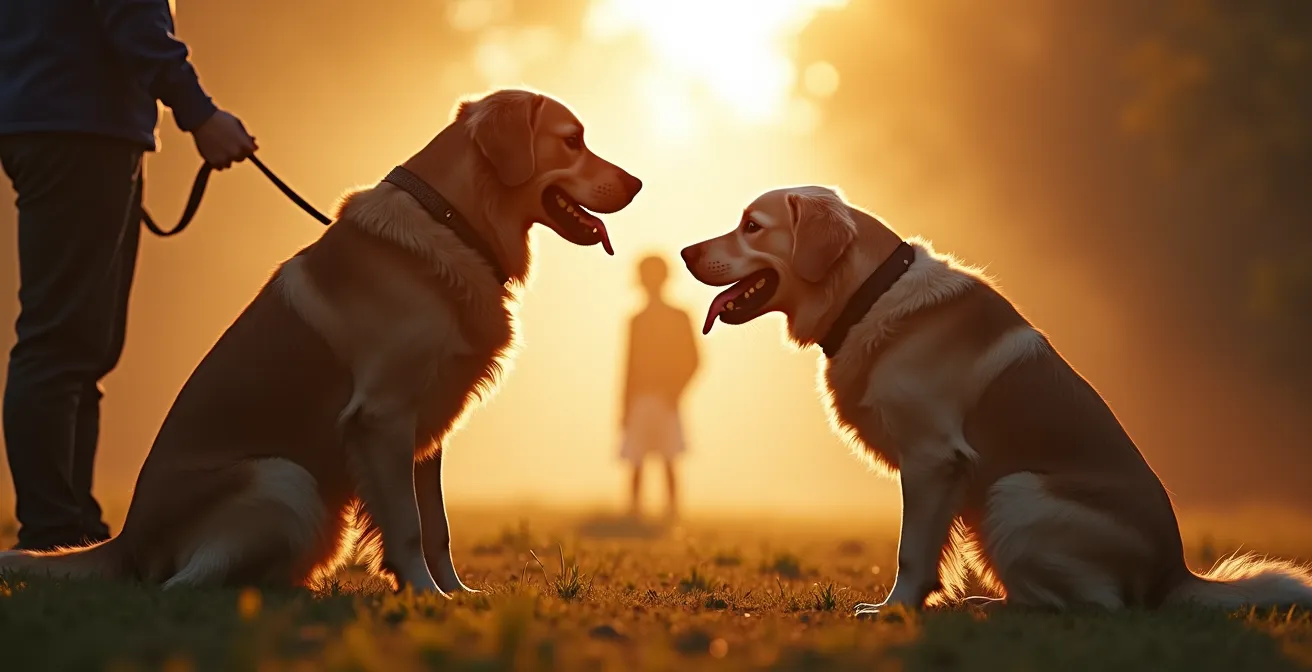
Forcing a fearful dog to confront a trigger does not build resilience; it inflicts neurological harm and erodes trust.
- “Flooding” a dog’s senses overwhelms their brain, shutting down learning centers and reinforcing the fear pathway.
- Systematic desensitization and counter-conditioning (DSCC) works by keeping the dog “sub-threshold,” allowing the brain to build new, positive associations with the trigger.
Recommendation: Abandon all forms of forced exposure. Instead, adopt a consent-based, gradual approach that empowers your dog and systematically changes their emotional response from fear to neutrality or joy.
You love your dog, but their intense, irrational fear—of the vacuum cleaner, strangers, or the car—is maddening. A common, well-intentioned but dangerously flawed piece of advice often emerges: “Just make them face it. They’ll get used to it.” This approach, known as flooding, feels intuitive to humans. We believe that by proving a trigger is harmless through forced, prolonged exposure, the fear will simply vanish. Many owners, desperate for a solution, will hold their dog near a roaring vacuum or force them into a car, hoping for a breakthrough.
But what if this method is not just ineffective, but is actively damaging your dog’s brain, worsening the fear, and potentially creating aggression? The critical difference between helping and harming your dog lies in understanding two diametrically opposed behavioral concepts: systematic desensitization and flooding. The first is a delicate, scientific process of changing an emotional response. The second is a psychological shortcut that almost always leads to a dead end of trauma and a shattered bond. This is not about being “soft” on a dog; it’s about understanding the non-negotiable laws of how their brain processes fear.
This guide will dissect these methods from a behaviorist’s perspective. We will move beyond simple labels to explore the science of fear, using the “Stress Bucket” model to illustrate why some dogs “suddenly” react. Through practical, real-world examples, you will learn to identify the subtle signs of distress and implement humane, effective protocols that build confidence instead of crushing it.
To understand these principles in action, this article will explore several common fear-related scenarios. The following summary outlines the practical applications and core scientific concepts we will cover to help you transform your dog’s fear into confidence.
Summary: Desensitization vs. Flooding in Practice and Theory
- How to Use ThunderShirts and Audio Tracks for Storm Anxiety?
- Touch Gradient: Teaching Your Dog to Accept Paw Handling for Nail Trims
- From Vomit to Joy: Conditioning a Dog to Ride in the Car
- Why Your Dog Freezes When You Put the Harness On?
- The Treat-Retreat Game: Helping Shy Dogs Approach Visitors
- Why “Flooding” a Fearful Dog Makes Aggression Worse?
- The Stress Bucket: Why Your Dog Explodes on the Last Block of the Walk?
- Leash Reactivity: Is It Fear, Frustration, or Aggression?
How to Use ThunderShirts and Audio Tracks for Storm Anxiety?
Storm anxiety is a common and distressing issue, for which owners often seek a quick fix. While tools like pressure wraps (e.g., ThunderShirt) and calming audio tracks can be effective, they are not magic bullets. Their success hinges on proper conditioning—associating them with safety and calm *before* the storm arrives. Simply putting a shirt on a panicking dog for the first time during a thunderstorm can actually poison the tool, making it another predictor of a scary event. This is a micro-version of flooding, where a new, strange sensation is added to an already high-stress environment.
The correct approach is a synergistic one, using desensitization and counter-conditioning (DSCC). You must build a positive classical association with these tools during times of peace. The ThunderShirt should predict wonderful things, like meals or play. The storm sounds, played at a nearly inaudible volume, should be paired with high-value treats or activities. Over time, the volume is increased so gradually that the dog’s nervous system never tips into a state of fear. The goal is to keep the dog sub-threshold, where their brain is capable of learning a new emotional response.

This setup illustrates a ‘safe space’ protocol. The dog is already calm and wearing the conditioned pressure wrap while engaging with a positive stimulus. This proactive approach rewires the dog’s association with storm-related triggers from panic to manageable expectation. Below is a systematic protocol to achieve this.
Your Action Plan: A 5-Step Protocol for ThunderShirt and Audio Conditioning
- Begin conditioning the ThunderShirt indoors during calm weather by putting it on before meals and removing it after eating to create a positive association.
- Practice “dress rehearsals” with the shirt on while playing calming audio or storm sound tracks at a barely audible volume (e.g., level 1-2 on a typical device).
- Gradually increase the audio track volume by one increment per week, ensuring the dog remains calm and engaged in a positive activity (like a puzzle toy) while wearing the ThunderShirt.
- Create a “storm protocol” routine: at the first sign of a storm, put the ThunderShirt on, move to the designated safe room, begin the audio at the highest successfully practiced volume, and provide a high-value, long-lasting chew like a frozen Kong.
- Implement an emergency protocol if a storm arrives unexpectedly: skip training, focus on management with white noise, use the ThunderShirt only if it’s already well-conditioned, and provide high-value chews to help self-soothe.
Touch Gradient: Teaching Your Dog to Accept Paw Handling for Nail Trims
The struggle over nail trims is a classic battleground where owners often resort to force. Restraining a dog that fears having its paws handled is a form of flooding. The dog is not learning to accept the procedure; it is learning helplessness and that its struggles are futile. This approach guarantees that every future nail trim will be a fight, as you are confirming the dog’s belief that the event is terrifying and something to be resisted at all costs. It fills their “Stress Bucket” and can lead to defensive aggression.
A humane and effective alternative is to use a combination of desensitization to the tools and a touch gradient for handling. This involves breaking down the process into microscopic steps and only proceeding when the dog is comfortable. A key innovation in this area is the introduction of consent-based training. This revolutionary idea shifts the dynamic from a dictatorship to a partnership, giving the dog control over the procedure.
The “Consent Test” Protocol in Practice
Professional trainers report significant success using a “start button” behavior, where a dog voluntarily places their paw in the handler’s open palm to initiate a handling session. This simple action transforms the traditionally stressful nail trim into a cooperative activity. Critically, dogs learn they can end the session at any time by withdrawing their paw, which gives them a sense of control over the process. A documented case showed a dog that was previously aggressive during nail trims becoming completely cooperative within six weeks of consistent practice using this consent-based approach, demonstrating the power of agency in reducing fear.
The timeline for this process requires immense patience. You are not just trimming nails; you are undoing a history of fear and rebuilding trust. The process must be separated into two tracks: getting the dog comfortable with being handled, and getting them comfortable with the tools themselves (clippers, dremel). Rushing either track will result in setbacks.
| Training Component | Typical Duration | Progress Markers |
|---|---|---|
| Sight of clippers/dremel | 1-2 weeks | Dog remains relaxed when tool is visible |
| Sound of tool | 2-3 weeks | No startle response to tool sounds |
| Touch without pressure | 2-3 weeks | Voluntary paw placement maintained |
| Gentle pressure on paw | 3-4 weeks | Relaxed body, soft eyes during handling |
| Mock trimming motion | 1-2 weeks | No withdrawal during practice clips |
| Actual nail trim | Ongoing | Completes full trim calmly |
From Vomit to Joy: Conditioning a Dog to Ride in the Car
Car-related distress in dogs is a complex issue, as it can stem from either physical motion sickness or psychological anxiety. Owners often misdiagnose the problem, attempting to “tough it out” by forcing a dog on long drives, which is a classic flooding tactic that only exacerbates the issue. If a dog is anxious, forcing them into a car confirms their fear that the car is a metal trap leading to scary places (like the vet). If they are nauseous, it simply makes them feel sick repeatedly. In both cases, the dog’s emotional and physical state worsens.
The first crucial step is diagnosis. True motion sickness is a physiological issue with the inner ear, most common in puppies, while anxiety is an emotional response. According to a large-scale Finnish study from the University of Helsinki, which found 72.5% of dogs showing at least one form of anxiety, fear-based issues are extremely prevalent. Distinguishing between the two is paramount because the treatments are different. Medication from a veterinarian can be highly effective for motion sickness, but it will not resolve fear-based anxiety.
The Destination Reward System Success
For anxiety, the key is counter-conditioning: changing the car’s meaning from “vet trip” to “adventure.” A documented case study showed a border collie with severe car anxiety who was successfully conditioned using the “9 out of 10” rule. The owner ensured that 90% of car trips ended at the dog’s favorite beach or hiking trail, with only 1 in 10 trips being to neutral or necessary destinations. After 8 weeks of this consistent protocol, the dog began voluntarily jumping into the car and showing excitement at the sight of car keys. The key was maintaining this overwhelmingly positive ratio, which systematically rewired the dog’s prediction about car rides.
Before beginning any training, use this checklist to help determine the likely cause of your dog’s distress. If signs point to motion sickness, or if the dog exhibits extreme panic, a veterinary consultation is the mandatory first step.
- Motion Sickness Indicators: Excessive drooling within 5 minutes of the car moving, vomiting regardless of trip duration, symptoms improve with anti-nausea medication prescribed by a vet, puppy is under 1 year old (inner ear not yet fully developed).
- Anxiety Indicators: Symptoms (panting, trembling, whining) start *before* the car moves, attempts to escape or hide in the car, symptoms persist even during very short, slow trips in the neighborhood.
- Diagnostic Test: Have the dog sit in a stationary car for 10 minutes with the engine off. If anxiety symptoms appear, the root cause is likely fear, not motion sickness.
- Veterinary Intervention is Necessary If: The dog consistently vomits, symptoms do not improve after 4 weeks of consistent, gentle training, or the dog shows extreme panic responses (thrashing, frantic escape attempts).
Why Your Dog Freezes When You Put the Harness On?
A common and widely misunderstood behavior is the dog that “freezes” when an owner brings out the harness. The dog stands stiff, looks away, and seems to shut down. Owners often interpret this as stubbornness or sulking. They proceed to force the harness onto the immobile dog, believing the promise of a walk will make it all okay. This interpretation is dangerously wrong. The freeze response is not defiance; it is an involuntary fear response, just like fight or flight. It signals that the dog is overwhelmed and has gone over its emotional threshold.
When you put the harness on a dog that is frozen, you are actively ignoring a clear communication of extreme stress. You are flooding them with the very trigger they are trying to cope with through stillness. This action teaches the dog that their subtler signals are ignored, which can force them to escalate to more overt behaviors like snapping or running away in the future.
The freeze response is a critical piece of information—a clear signal that the dog is over its threshold and the current step in the process is too intense.
– Ines Gaschot, Understanding Reactivity Thresholds in Dogs
The solution is to stop and listen to what the freeze is telling you. The harness itself, or the process of putting it on, has become a poisoned cue, likely due to past discomfort (poor fit, pinching) or being rushed. You must re-train the entire harnessing procedure using desensitization and counter-conditioning, breaking it down into tiny, rewardable steps. The goal is to transform the dog from a passive recipient into an active, willing participant.
This process of teaching voluntary cooperation looks like this:
- Place the harness on the floor. Mark and reward your dog with a high-value treat for simply looking at it, then for sniffing it voluntarily.
- Hold the harness up. Reward your dog for any interaction with it.
- Hold the neck loop open and use a treat to lure your dog’s nose, then head, through the opening. Do not force it. Reward the slightest voluntary movement.
- Gradually build the duration your dog is comfortable keeping their head in the loop before you even think about fastening a buckle.
- Once the dog is comfortable with the harness being on, practice in different rooms to generalize the positive association before ever clipping on a leash.
The Treat-Retreat Game: Helping Shy Dogs Approach Visitors
When a shy or fearful dog encounters a new person, the owner’s first instinct is often to encourage interaction. They might hold the dog while the visitor tries to pet them, or have the visitor offer a treat directly. While well-intentioned, this is a form of social flooding. It forces the dog into a proximity it finds terrifying, removing its most crucial coping mechanism: the ability to create distance. Forcing interaction, even with the lure of a treat, puts the dog in a state of conflict and can increase their fear of visitors over time.
A far more effective and humane strategy is the “Treat-Retreat” game. This brilliant technique, focused on consent and empowerment, changes the entire dynamic. Instead of luring the dog *toward* the scary person, the visitor tosses a treat *away* from them, behind the dog. This allows the dog to approach the visitor at their own pace, investigate, and then be rewarded by moving away to a safer distance to eat the treat. It puts the dog in control. They learn that they can approach the stranger and the good thing (the treat) happens when they create distance again. This builds confidence, not conflict.

Equally important is managing the visitor’s behavior. Most humans are conditioned to interact with dogs in ways that are threatening to a fearful animal: direct eye contact, leaning over, reaching out. You must coach your guests to become “safe” stimuli by behaving in a deliberately non-threatening manner.
Instruct your visitors to follow this script for all interactions with a shy dog:
- Enter the home calmly and completely ignore the dog. No talk, no touch, no eye contact.
- Sit down on the floor or a low chair to appear smaller and less intimidating.
- Keep your body angled sideways, never facing the dog directly.
- Toss high-value treats to the side or behind the dog, without looking at them.
- Speak in a calm, quiet voice only to the human owner.
- If the dog chooses to approach and sniff, remain perfectly still. Do not reach out to pet them. Let the dog gather information on their own terms.
Why “Flooding” a Fearful Dog Makes Aggression Worse?
We’ve discussed “flooding” as a flawed technique, but to truly understand why it’s so damaging, we must look at the neuroscience of fear. Flooding is the act of exposing a dog to a fear-inducing stimulus at full intensity and preventing escape, under the false belief that they will “realize it’s not so bad.” Forcing a dog terrified of thunderstorms to stay in a room with loud thunder sounds, or holding a dog that fears strangers while they are petted, are acts of flooding.
This approach does not teach the dog that the trigger is safe; it triggers a massive, involuntary physiological response. The dog’s body is overwhelmed with stress hormones like adrenaline and cortisol. This is the “fight, flight, or freeze” response in action. Crucially, during this neurological hijack, the thinking, learning part of the brain (the prefrontal cortex) functionally shuts down. The emotional, reactive part of the brain (the amygdala) takes complete control. A dog in this state is biochemically incapable of learning anything new. They are simply surviving. With behavioral research indicating that 26.2% of dogs suffering from general fearfulness, using a method that backfires is a significant welfare concern.
Neurological Impact of Flooding vs. Gradual Desensitization
During flooding exposure, the stress response triggers a massive release of adrenaline and cortisol. These hormones cause involuntary physiological responses like increased heart rate and rapid breathing. As confirmed by a comparison of training methodologies, the prefrontal cortex (responsible for learning and decision-making) shuts down while the amygdala (fear center) becomes hyperactive. This neurological state makes rational learning impossible and actually strengthens the fear pathway in the brain. In stark contrast, gradual desensitization keeps the dog at a sub-threshold level, where they notice the trigger but remain calm. In this state, the learning centers of the brain stay online, allowing new, positive associations to form and effectively overwriting the fear response.
When escape (flight) is removed as an option, a flooded dog is left with two choices: freeze (shut down) or fight. If the freezing and other subtle stress signals are ignored, the dog may learn that the only way to make the scary thing stop is to escalate to aggression—growling, snapping, or biting. Flooding, therefore, doesn’t just fail to treat fear; it often creates aggression where none existed before.
The Stress Bucket: Why Your Dog Explodes on the Last Block of the Walk?
Have you ever had a walk where your dog was perfectly fine until, on the very last block, they suddenly exploded in a frenzy of barking and lunging at another dog? This seemingly “out of nowhere” reaction is one of the most misunderstood aspects of dog behavior. It’s not random; it’s a case of the “Stress Bucket” overflowing. Imagine your dog starts the day with an empty bucket. Each minor stressor—the sound of the garbage truck, a squirrel dashing by, a person with a hat, the tension on the leash—adds a little bit of water to the bucket. None of these individual events are enough to cause an overflow (a reaction).
But stress is cumulative. The stress hormone cortisol doesn’t just vanish after the trigger is gone. The final dog they see on the walk isn’t the *cause* of the reaction; it is simply the final drop of water that makes the full bucket overflow. The dog isn’t reacting to that one dog; they are reacting to the cumulative stress of the entire day or walk. Flooding a dog with triggers, as discussed previously, is like holding a firehose over this bucket.
Cortisol can take 24-72 hours to leave a dog’s system, meaning that stress from yesterday directly contributes to today’s ‘unexplained’ reaction.
– Will Bangura, M.S., CBCC-KA, CPDT-KA, Understanding Thresholds and Canine Body Language
This has profound implications for training. It means managing your dog’s overall stress level is just as important as working on specific triggers. If your dog’s bucket is already half-full before you even begin a desensitization session, your chances of success are dramatically reduced. Proactive stress management involves two components: reducing the number of stressors your dog is exposed to daily (e.g., shorter walks in quieter areas) and, crucially, incorporating “draining” activities that lower cortisol levels. These are calming, species-appropriate activities like sniffing, chewing, and licking.
By actively managing your dog’s Stress Bucket, you create a buffer that allows them to handle everyday encounters without reacting. A daily management protocol might look like this:
- Morning: Start the day with 10 minutes of scent work (hiding treats) or a puzzle feeder before any walks to engage their brain calmly.
- Pre-walk: Scatter-feed their breakfast in the yard for 5 minutes to encourage sniffing and lower arousal before heading out.
- During the walk: Actively monitor for early stress signals (mouth closing, stiff body, focused staring) and proactively increase distance from triggers.
- Post-walk: Provide a lick mat or frozen Kong for 20 minutes of dedicated calming decompression time.
- Evening: Schedule quiet time with no visitors or high-energy stimulation to allow the nervous system to rest.
Key Takeaways
- Stop Forcing, Start Listening: Flooding causes neurological harm and erodes trust. Your dog’s fear signals (freezing, looking away) are vital information, not defiance.
- Work Sub-Threshold: True learning only happens when your dog is calm. Identify the distance or intensity where your dog notices a trigger but is not anxious, and work there.
- Manage the Stress Bucket: A dog’s reactivity is the sum of all their daily stressors. Proactively lower their overall stress with calming activities like sniffing and chewing to prevent explosive reactions.
Leash Reactivity: Is It Fear, Frustration, or Aggression?
Leash reactivity—barking, lunging, and growling at other dogs or people while on leash—is a direct and dramatic overflow of the Stress Bucket. However, not all reactivity is the same. To effectively address it, you must first diagnose the underlying motivation. Lumping it all together as “aggression” is a common mistake that leads to ineffective or harmful training strategies. The three primary drivers are fear, frustration, and, more rarely, true aggression.
Fear-based reactivity is the most common. The dog feels trapped by the leash and unable to create the distance they need to feel safe. Their explosive display is a desperate, distance-creating behavior designed to make the scary thing go away. Frustration-based reactivity often looks similar but has an opposite goal. The dog desperately *wants* to greet the other dog or person but is prevented by the leash. This barrier frustration builds until it erupts in a tantrum. Finally, true offensive aggression is characterized by a confident, stiff posture and a deliberate intent to cause harm, and it is far less common than the other two motivations.
The Barrier Frustration Phenomenon
Research on barrier frustration highlights how leashes can create reactivity where none would exist otherwise. In controlled studies, dogs that were friendly and social during off-leash interactions showed intense reactive displays when the same meetings occurred on-leash. The leash creates an approach-avoidance conflict: the dog wants to investigate but feels trapped and restricted from performing natural greeting rituals. This conflict results in a spike of frustration that manifests as barking and lunging. This explains why many owners lament, “He’s friendly off-leash!” Understanding this distinction is crucial for selecting appropriate training protocols that focus on teaching calm behavior behind a barrier, rather than punishing a social impulse.
Observing your dog’s body language is the key to an accurate diagnosis. Each motivation has a different physical and vocal signature. Punishing a fearful dog will only increase their fear, while punishing a frustrated dog can lead to that frustration turning into genuine aggression. Understanding the “why” behind the bark is the first step toward a quiet, calm walk.
| Motivation | Body Posture | Vocalizations | Movement Pattern |
|---|---|---|---|
| Fear-based | Low body, weight shifted back, ears pinned | High-pitched barking, whining | Backing up, trying to increase distance |
| Frustration-based | Forward-leaning, high tail, pulling hard | Repetitive barking, yipping sounds | Lunging forward, wanting to decrease distance |
| Aggressive | Stiff body, raised hackles, hard stare | Deep growling, snarling | Still or slow, deliberate movement forward |
| Barrier frustration | Bouncing, play bow attempts | High arousal barking, whimpering | Circular movement, redirected biting onto leash |
Your dog’s fear is real, but it is not a life sentence. By rejecting the harmful myth of flooding and embracing the patient, scientific, and humane process of desensitization and counter-conditioning, you can do more than just manage behavior—you can truly change your dog’s mind. You can replace terror with tolerance, and tolerance with confidence. Begin today by observing your dog’s most subtle signals, managing their daily stress, and committing to working *with* them, not against them. Your journey to a more confident dog and a stronger bond starts with empathy and understanding.