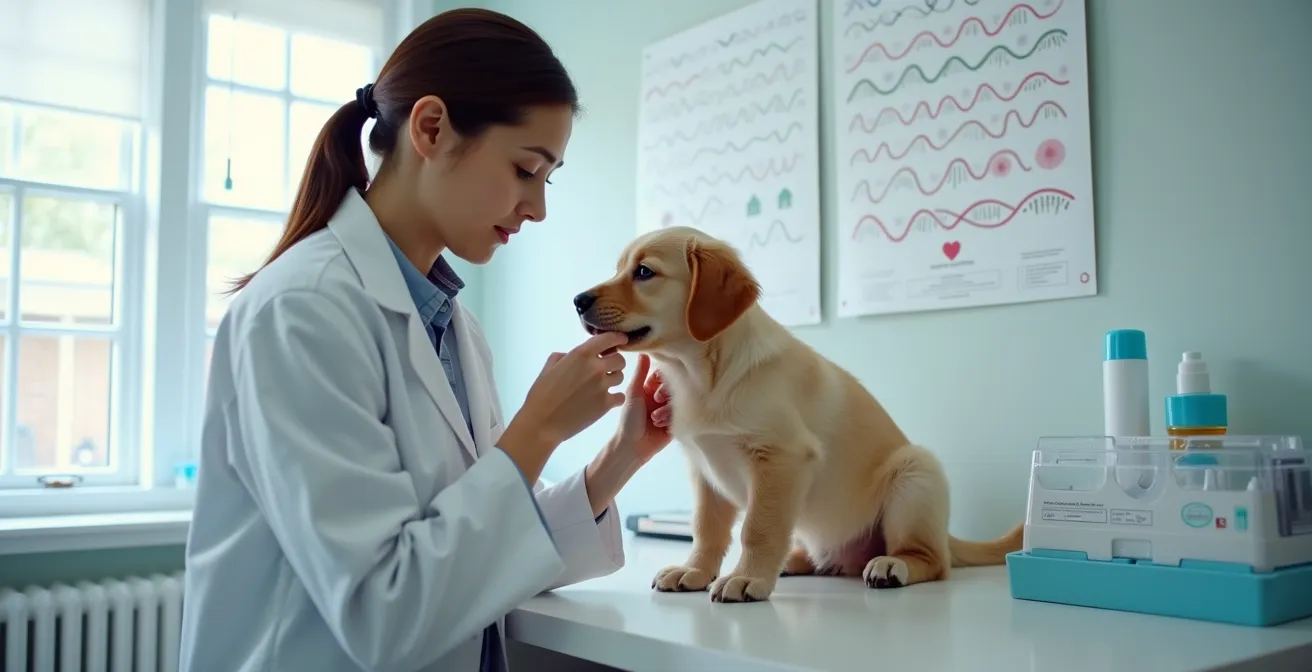
Relying on a “vet-checked” certificate is a critical mistake; it only assesses a dog’s current appearance (phenotype), not its underlying genetic code (genotype) which dictates future health risks.
- A physical exam cannot detect “silent” carrier status for devastating hereditary diseases that appear later in life.
- Advanced diagnostics like PennHIP and genomic COI are far more predictive of long-term health than traditional observation-based methods.
Recommendation: Prioritize breeders who provide comprehensive DNA health panels and multi-year genetic guarantees, proving they manage their program based on genotype, not just phenotype.
As a prospective dog owner, you seek reassurance. You want a healthy companion, and the phrase “vet checked” seems like a gold-standard seal of approval. It implies a clean bill of health, a puppy free from problems. This belief, however, is a dangerous oversimplification. A veterinary examination is a critical snapshot of a puppy’s current condition, but it is fundamentally limited to observing the phenotype—the dog’s physical traits, from its coat color to the sound of its heart at that specific moment.
The true blueprint for a dog’s long-term health is hidden from the stethoscope and the naked eye. It lies within the genotype: the dog’s unique genetic code. This code contains the instructions for everything, including the potential for debilitating hereditary diseases that may not manifest for years. A puppy can be a “silent carrier” for a condition, appear perfectly healthy during a vet check, yet pass the disease to its offspring or develop it later in life. Relying solely on a phenotypic evaluation is like buying a house after only checking if the lights turn on, without ever inspecting the foundation.
This guide will deconstruct the false security of a simple vet check. We will explore the crucial difference between what you can see and what is written in the DNA. By understanding the tools and strategies that responsible breeders use—from advanced hip scoring to carrier screening and inbreeding analysis—you will be equipped to ask the right questions and demand a higher standard of health verification, one based on a scientific blueprint, not just a momentary snapshot.
For those who prefer a visual summary, the following video provides an excellent overview of the complexities and importance of canine genetic testing.
To navigate the scientific and practical aspects of canine health, this article is structured to build your expertise systematically. The following sections will guide you through the modern tools and concepts that define responsible breeding and informed puppy buying.
Summary: Understanding a Dog’s True Health Blueprint
- Breeding Carrier to Clear: How to Eliminate Disease Without Shrinking the Gene Pool?
- Why Test a Poodle for von Willebrand’s Disease?
- OFA vs. PennHIP: Which Predicts Arthritis Risk More Accurately?
- COI Calculation: What Percentage Is Too High for Health?
- Embark vs. Wisdom Panel: Which Gives Actionable Medical Data?
- Why Do Cavalier King Charles Spaniels Need Cardiologist Visits by Age 5?
- 1-Year vs. 3-Year Genetic Guarantees: What Is Standard?
- Congenital vs. Hereditary: Understanding the Cause of Your Pet’s Defect
Breeding Carrier to Clear: How to Eliminate Disease Without Shrinking the Gene Pool?
The discovery that a dog is a carrier for a genetic disease can be alarming. The intuitive reaction is to remove that animal from any breeding program. However, this approach, while seemingly cautious, can be devastating to a breed’s genetic diversity. When a significant portion of a breed’s population carries a recessive gene, eliminating all carriers can create a genetic bottleneck, concentrating other potentially harmful genes and shrinking the available gene pool for future generations. For example, research indicates that if a recessive condition is prevalent, eliminating all carriers could result in a 20% loss of a breed’s genetic diversity.
The scientifically sound strategy is not elimination, but management. This is where genotyping becomes an indispensable tool. By DNA testing breeding stock, a breeder can identify three distinct groups: Clear (possesses two normal copies of the gene), Carrier (possesses one normal and one mutated copy), and Affected (possesses two mutated copies). For a recessive disease, a Carrier will not show symptoms but can pass the mutation on. A responsible breeder can then implement a “Carrier to Clear” breeding strategy. By mating a known Carrier with a known Clear dog, statistics show that 50% of the puppies will be Clear and 50% will be Carriers, but crucially, zero puppies will be Affected by the disease.
This data-driven approach allows breeders to retain dogs with otherwise excellent qualities—such as temperament, conformation, and working ability—while systematically reducing the prevalence of the disease-causing gene over generations. As Dr. Danika Bannasch, a leading geneticist at UC Davis, explains:
For recessive conditions, testing can allow people to safely breed carriers to unaffected animals while avoiding producing offspring affected with a devastating disease.
– Dr. Danika Bannasch, Maxine Adler Endowed Chair in Genetics at UC Davis
This level of genetic management is the hallmark of a breeder who works with the genotype, not just the phenotype. It’s a proactive strategy that a simple vet check could never inform.
Why Test a Poodle for von Willebrand’s Disease?
A Standard Poodle may appear perfectly healthy during its veterinary puppy check. It may be active, bright, and show no outward signs of illness. Yet, hidden within its genotype could be a mutation for von Willebrand’s Disease (vWD), the most common inherited bleeding disorder in dogs. This is a classic example of where phenotype is a dangerously unreliable indicator of underlying risk. vWD is caused by a deficiency of a specific protein needed for blood to clot. In a mild to moderate case, a dog may show no clinical signs in daily life, and the condition only becomes a life-threatening crisis during surgery, after an injury, or while giving birth.
Breed-specific screening is critical because the prevalence of certain genetic mutations is not uniform across all dogs. Breed-specific screening data indicates that both Standard and Miniature Poodles have a known, elevated risk for Type I vWD. Testing is not just a theoretical exercise; it has a direct impact on the dog’s medical management. A veterinarian who knows a dog is genetically at-risk for vWD can take precautions, such as pre-surgical blood screening, having clotting agents on hand, and avoiding certain medications that interfere with platelet function. Without the genotypic information, a routine procedure like a spay or neuter could turn into an emergency.

The Doberman Pinscher breed provides a stark case study. A large-scale study revealed that more than 70% were carriers of the vWD gene, yet most showed no signs of a bleeding problem. This highlights how a condition can become widespread within a breed while remaining invisible to physical examinations alone. Asking a Poodle breeder for vWD genetic test results is not being overly cautious; it is a fundamental part of due diligence to ensure the “vet checked” puppy isn’t a silent carrier of a hidden, and potentially fatal, condition.
OFA vs. PennHIP: Which Predicts Arthritis Risk More Accurately?
Canine hip dysplasia is a debilitating condition familiar to many large-breed owners. For decades, the Orthopedic Foundation for Animals (OFA) certification has been the standard evaluation method. A breeder might proudly present an OFA certificate showing a dog’s hips are rated “Good” or “Excellent.” This, like a vet check, is a phenotypic evaluation based on a subjective assessment of a single X-ray taken when the dog is at least 24 months old. It diagnoses the presence of dysplasia at that moment but has limitations in predicting future risk.
A more advanced, quantitative method is the University of Pennsylvania Hip Improvement Program (PennHIP). This method uses three separate X-rays to measure actual hip joint laxity, or “looseness,” which is the primary cause of degenerative joint disease. The result is an objective Distraction Index (DI) number. A lower DI means tighter hips and a very low risk of developing arthritis. The crucial difference is that PennHIP is predictive. It can be performed on puppies as young as 16 weeks and provides a reliable forecast of their lifelong hip health. The OFA method, in contrast, is a pass/fail snapshot of an adult dog.
The superiority of a predictive, genotype-informed approach is stark. An eye-opening 2010 JAVMA study found that 52% of dogs rated ‘Excellent’ by OFA still had a PennHIP DI score indicating susceptibility to developing arthritis. This means that over half the dogs receiving the top phenotypic rating still carried a significant underlying risk that the older method failed to detect. A breeder who relies only on OFA scores is missing a huge piece of the puzzle.
| Criteria | OFA | PennHIP |
|---|---|---|
| Minimum Age | 24 months | 16 weeks |
| Methodology | Single radiograph, subjective scoring | Three radiographs, quantitative DI measurement |
| Predictive Value | Diagnosis of current dysplasia | Prediction of future arthritis risk |
| Cost | Lower | Higher |
| Anesthesia Required | Optional | Required |
When you inquire about a puppy’s parents, asking for their PennHIP scores, not just OFA ratings, demonstrates a deeper understanding of health screening. You are asking for predictive data about the puppy’s genetic potential for healthy hips, not just a subjective opinion of the parents’ current status.
COI Calculation: What Percentage Is Too High for Health?
Beyond single-gene diseases and joint issues lies a broader measure of genetic health: the Coefficient of Inbreeding (COI). The COI is a percentage that estimates the probability that two copies of a gene are identical by descent from a common ancestor. In simpler terms, it’s a measure of how inbred a dog is. A high COI is associated with a range of negative health outcomes, including reduced litter size, shorter lifespan, and an increased risk of “inbreeding depression,” where complex immune and metabolic systems are compromised. A low COI, conversely, is linked to greater vigor and resilience, a phenomenon known as hybrid vigor.
Traditionally, COI was calculated from a dog’s pedigree, typically looking back 5 or 10 generations. This method is flawed. It relies on the accuracy of paper records and makes assumptions about the genes passed down. It is another form of phenotypic or “on-paper” analysis that can be misleadingly low. Today, genetic science offers a far more precise tool: genomic COI. DNA testing companies like Embark now offer calculations that measure the actual percentage of the genome where the genes are identical (homozygous), providing a true measure of inbreeding.
So, what percentage is too high? There’s no single magic number, as it varies by breed. The average COI for a purebred dog is often around 25%, equivalent to the inbreeding of a parent-offspring mating. However, many experts suggest that breeders should aim for a COI below 10%, and ideally below 5%, to maximize health. A responsible breeder will not only know the genomic COI of their breeding dogs but will use online tools to predict the COI of a potential litter, actively selecting pairings that reduce inbreeding and increase genetic diversity. This is the pinnacle of data-driven breeding—a concept entirely absent from a standard vet check.
Action Plan: How to Assess a Breeder’s COI Management
- Ask for the genomic COI of the puppy’s parents, not just a pedigree-based calculation.
- Inquire how the parents’ COI compares to the breed average; responsible breeders aim for dogs in the healthier, more diverse half of the population.
- Check if the breeder uses litter prediction tools to calculate the expected COI of the puppies before the mating occurs.
- Verify that the breeder’s goal is to produce litters with a lower COI than the parent dogs, actively improving genetic diversity.
- Ask if they consider other diversity metrics, such as DLA haplotype diversity, which relates to the immune system.
Embark vs. Wisdom Panel: Which Gives Actionable Medical Data?
Once you’ve embraced the need for genetic testing, the next question is which test to use. The two dominant players in the consumer dog DNA space are Embark and Wisdom Panel. Both offer comprehensive panels that screen for breed identification, traits, and a vast number of genetic health conditions. On the surface, their health screening offerings appear similar; current testing capabilities show Wisdom Panel tests for over 265 health conditions, while Embark screens for more than 270.
However, the key differentiator for a discerning puppy buyer or a responsible breeder is not just the raw number of tests, but the depth and actionability of the data provided. This is where the platforms diverge. While both can identify if a dog is Clear, a Carrier, or At-Risk for specific conditions, some platforms provide more advanced tools that empower data-driven breeding decisions. This goes beyond simple health screening into the realm of true genetic management.

The most sophisticated breeders are looking for more than a simple “yes/no” on diseases; they are managing the overall genetic health of their lines. This requires tools that analyze genetic diversity and predict outcomes of potential pairings.
Case Study: Advanced Breeder Toolkit Comparison
Embark for Breeders offers a suite of tools specifically designed for proactive genetic management. A key feature is the ability to calculate the expected COI (Coefficient of Inbreeding) for potential litters by pairing any two dogs in their database. This allows a breeder to see the genetic outcome of a mating before it happens. Furthermore, they provide data on DLA (Dog Leukocyte Antigen) haplotype diversity, which is crucial for immune system health. This allows breeders to make data-driven decisions that balance reducing single-gene disease risk with improving the overall genetic resilience of their puppies, a level of detail that provides far more actionable medical data than a simple list of conditions.
When speaking to a breeder, asking which DNA test they use is a good start. A better question is: “How do you use the genetic data to make your breeding decisions?” A breeder who can discuss managing COI and DLA diversity is operating on a completely different level than one who simply states the parents were “health tested.”
Why Do Cavalier King Charles Spaniels Need Cardiologist Visits by Age 5?
The Cavalier King Charles Spaniel is a breed that tragically exemplifies the critical failure of phenotype-based health assessments. A young Cavalier is almost universally healthy, happy, and free of symptoms. A vet check at eight weeks, one year, or even two years will almost certainly reveal a healthy-sounding heart. Yet, a genetic time bomb is often ticking within the breed: Mitral Valve Disease (MVD).
MVD is a degenerative condition where the mitral valve in the heart weakens and fails over time, leading to congestive heart failure. While it can affect any older dog, its prevalence in Cavaliers is a genetic catastrophe. According to the Cavalier Health foundation, over 50% of all Cavaliers develop MVD by the age of 5, and that number skyrockets to over 90% by age 10. The condition is so pervasive that research from the University of Florida found that MVD is about 20 times more prevalent in the Cavalier than in other breeds. It is not a question of *if* most Cavaliers will get MVD, but *when*.
Because the onset is gradual, a standard vet check is insufficient. The first sign is often a faint heart murmur that a general practitioner might not detect in its earliest stages. For this reason, breed-specific screening protocols for Cavaliers recommend an annual examination by a board-certified veterinary cardiologist starting as early as age 1. A breeder who simply says their dogs’ hearts are “vet-cleared” is not meeting the minimum standard of care for this breed. A responsible Cavalier breeder follows the established cardiologist screening protocols and makes breeding decisions based on these results, aiming to use older, heart-clear dogs to push back the average age of onset in their lines.
This is a stark lesson in the difference between a “healthy puppy” and a puppy with the genetic potential for a long, healthy life. The phenotype (a clear heart sound today) provides false security against the high probability of the genotype (a predisposition to heart failure tomorrow).
Key Takeaways
- A “vet check” is a phenotypic snapshot, not a guarantee against future hereditary disease.
- Genotyping (DNA testing) is the only way to identify “silent” carriers and predict future health risks.
- Advanced tools like PennHIP, genomic COI, and litter predictors represent a higher standard of care than traditional evaluation methods.
1-Year vs. 3-Year Genetic Guarantees: What Is Standard?
The health guarantee in a puppy contract is where the breeder’s philosophy on health testing becomes legally tangible. A buyer who doesn’t understand the science behind genetic disease is likely to accept any guarantee as a sign of good faith. However, the terms of that guarantee reveal everything about a breeder’s accountability and their understanding of genotype versus phenotype.
A common red flag is a one-year genetic health guarantee. This may seem reasonable, but it is functionally meaningless for the most serious and costly hereditary conditions. As the study of genetics has advanced, we know that many of the most devastating diseases are late-onset. For example, Degenerative Myelopathy (DM) often doesn’t show clinical signs until a dog is 8-14 years old. Hip dysplasia may not be definitively diagnosed until age 2, and many inherited eye conditions or heart diseases also manifest well after the first year of life. A one-year guarantee conveniently expires just before these genotypic time bombs are likely to detonate.
A modern, reputable breeder understands this. They offer guarantees that extend for at least two or three years, covering the period when conditions like hip and elbow dysplasia are most likely to be diagnosed. Furthermore, the substance of the guarantee matters. A poor guarantee often includes a “replacement puppy” clause, which may require the owner to return their beloved, now-sick pet—something few owners would ever do. A strong guarantee, by contrast, focuses on transparency and shared responsibility. It will clearly detail the health testing performed on the parents (OFA/PennHIP scores, DNA panel results) and may offer a partial refund towards veterinary expenses, without requiring the return of the dog. This demonstrates a breeder who stands behind their genetic selections, rather than one who is simply running out the clock on a useless warranty.
Congenital vs. Hereditary: Understanding the Cause of Your Pet’s Defect
Now that we have explored the tools and stakes of genetic health, it is crucial to clarify two fundamental terms that are often confused: congenital and hereditary. Understanding this distinction is the final step in moving beyond the “vet-checked” mindset. A vet check is excellent at identifying congenital defects. These are abnormalities that are present at birth. They can be structural, like a cleft palate, or metabolic. A congenital issue can be caused by a genetic mutation, but it can also be caused by environmental factors during fetal development, such as a maternal infection, drug exposure, or nutritional deficiency. It simply means “present at birth.”
A hereditary defect, on the other hand, is specifically caused by a gene or genes passed down from the parents. This is the dog’s genotype at work. The critical point is that not all hereditary defects are congenital. As we’ve seen with MVD, late-onset PRA, and DM, a dog can be born with the genetic mutation for a disease (hereditary) but appear perfectly normal at birth, with the defect only manifesting years later. This is the blind spot of the phenotypic vet check. It can clear a puppy of visible congenital issues, but it cannot see the hereditary instructions for future disease written in the DNA.
The diagnostic journey to determine the cause of a defect involves a systematic process. It begins with a physical exam to identify the issue, followed by a deep dive into the puppy’s history. This includes reviewing the breeder’s family health records, assessing the mother’s pregnancy history for environmental factors, and ultimately, conducting specific DNA testing to confirm or rule out a suspected hereditary cause. As veterinary geneticist Dr. Jenna Dockweiler states, the two work in tandem: “Genetic testing may identify at-risk individuals, and it should be followed by blood tests that measure the amount of vWF to assess bleeding risk.” This process separates issues of chance from issues of inheritance, and a responsible breeder focuses on controlling the latter through rigorous, genotype-based screening.
When you buy a puppy, you are buying its genotype. A “vet checked” certificate ensures the phenotype is sound on the day of sale, but a comprehensive portfolio of genetic testing on the parents is the only true assurance you have about the blueprint for its future. To make an informed decision, you must demand to see that blueprint.
Frequently Asked Questions about Genotype vs. Phenotype
Why are 1-year guarantees insufficient for genetic conditions?
Many hereditary conditions like hip dysplasia, PRA, and degenerative myelopathy have late onset, typically manifesting after 2-3 years of age, making 1-year guarantees functionally meaningless for these conditions.
What should a modern health guarantee include?
A comprehensive guarantee should detail the breeder’s health testing (genetic results, OFA/PennHIP scores), owner responsibilities (weight management, veterinary care), and clear terms without requiring pet return.
What are red flags in health guarantee contracts?
Replacement puppy clauses requiring return of the affected dog, guarantees under 2 years for late-onset conditions, and contracts that void coverage for routine veterinary procedures.