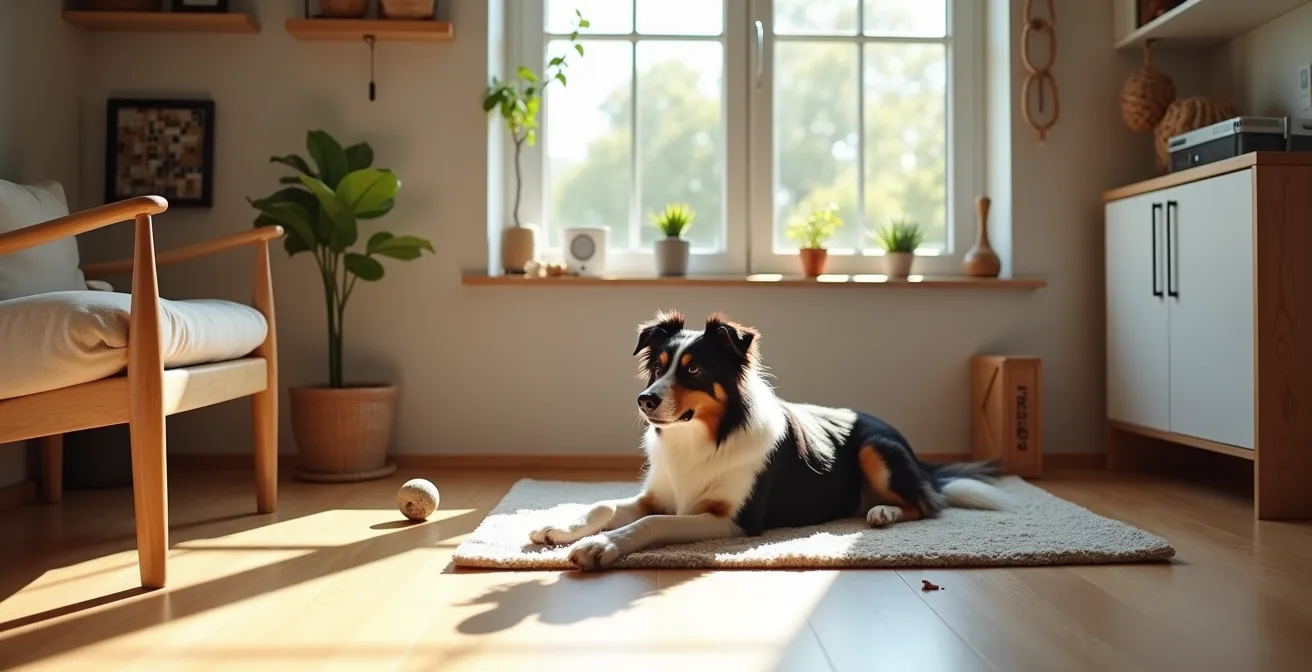
The common advice to ‘just exercise more’ is failing you and your high-energy dog in a small apartment. True management lies in precision, not exhaustion.
- Genetic predispositions, like a Cavalier’s heart or a Terrier’s intellect, dictate care needs far more than your apartment’s square footage.
- A balanced ‘mental diet’ of targeted enrichment is more effective at calming a dog than hours of repetitive physical exercise.
Recommendation: Shift your focus from *how much* activity you provide to *what kind* of activity, tailoring it specifically to your dog’s breed, health, and individual needs to turn your apartment into a cognitive gym.
That intense, unblinking stare from your Border Collie across your 550-square-foot studio apartment. The frantic ‘zoomies’ your Vizsla does between the couch and the kitchen. If you’re a young professional sharing a small urban space with a high-energy dog, you know this feeling: a mix of love, guilt, and quiet desperation. You’ve heard the standard advice a thousand times. More walks. A dog park membership. Hiring a dog walker for the third time this week. It’s a brute-force approach to energy management that leaves you exhausted and your dog still bouncing off the walls.
But what if the problem isn’t your dog’s energy level, but your approach to it? What if the solution isn’t a bigger park, but a smarter apartment? The secret to a calm, happy, high-energy dog in a small space isn’t about running them into the ground. It’s about precision care—understanding their unique genetic and physiological needs and transforming your home from a limitation into a powerful tool for their well-being. This isn’t about just surviving with your dog; it’s about helping them thrive by turning your apartment into a cognitive gym.
This guide moves beyond the generic to provide tailored strategies. We will explore specific breed-related health considerations you cannot ignore, debunk training myths that are making you and your dog miserable, and build a new framework for ‘exercise’ that prioritizes mental work over mindless running. It’s time to work smarter, not harder, to meet your brilliant dog’s needs.
Table of Contents: A Precision Care Guide for the Urban Dog
- Why Do Cavalier King Charles Spaniels Need Cardiologist Visits by Age 5?
- How to Maintain a Double Coat During Shedding Season Without Shaving?
- Running With Great Danes: Why Wait Until 18 Months?
- The Stubbornness Myth: Why Terriers Don’t Respond to Repetitive Drills
- Heatstroke Risks: Why French Bulldogs Can’t Hike in Summer?
- Why Test a Poodle for von Willebrand’s Disease?
- Why Champion Lines Matter Even for “Just a Pet”?
- Passive vs. Active Enrichment: Balancing the Mental Diet
Why Do Cavalier King Charles Spaniels Need Cardiologist Visits by Age 5?
The charming Cavalier King Charles Spaniel seems like a perfect apartment companion, but their adorable exterior hides a serious genetic predisposition. For this breed, managing energy isn’t just about preventing boredom; it’s a critical component of life-long health management due to the prevalence of Mitral Valve Disease (MVD). This progressive heart condition is so common that statistics show that mitral valve disease affects more than 50% of Cavaliers by age 5, and the number climbs to over 90% by age 10. For an apartment dweller, this isn’t an abstract veterinary fact; it directly impacts how you structure your dog’s daily life.
An early diagnosis from a veterinary cardiologist is your most powerful management tool. It allows you to make proactive adjustments to their lifestyle long before symptoms appear. This means shifting the focus from high-impact, arousal-inducing activities like frantic hallway fetch to more controlled, low-stress forms of engagement. The goal is to keep their mind engaged and their heart rate stable. Implementing a heart-healthy management plan within your apartment is non-negotiable and involves a combination of medical oversight and thoughtful environmental design to ensure your Cavalier enjoys a high quality of life.
How to Maintain a Double Coat During Shedding Season Without Shaving?
For the owner of a Siberian Husky, Samoyed, or German Shepherd in a small apartment, shedding season can feel like a force of nature taking over your home. The temptation to shave it all off is immense, but this is one of the most damaging things you can do. A double coat is a sophisticated, natural climate control system. The dense, soft undercoat provides insulation, while the longer, coarser guard hairs protect against UV rays, moisture, and dirt. Shaving this system disrupts your dog’s ability to regulate its temperature, making them *more* susceptible to overheating in summer and getting cold in winter.
The solution isn’t removal, but maintenance. A successful small-space grooming strategy, as highlighted by American Kennel Club resources, focuses on systematically removing the loose, dead undercoat while preserving the guard hairs. This is achieved through a technique called line-combing, where you part the hair and use an undercoat rake to gently pull out the fluff. Setting up a temporary grooming station in a bathroom or on a balcony with a washable blanket can contain the mess, turning an overwhelming chore into a manageable, structured bonding session. This process is about preserving the coat’s natural function, which is essential for a dog living in a climate-controlled apartment who experiences sudden temperature changes on every walk.

As the image demonstrates, the right tools and technique are key. A quality undercoat rake, not a blade, allows you to work through the fur layer by layer, ensuring the guard hairs remain intact while the shedding undercoat is effectively removed. This maintains the coat’s integrity and dramatically reduces the amount of fur floating around your apartment.
Running With Great Danes: Why Wait Until 18 Months?
You have a magnificent Great Dane puppy in your apartment, and you dream of the day you can go on long runs together to burn off that energy. The single most important piece of advice you will ever receive is: wait. Pushing a giant breed puppy into strenuous, repetitive, high-impact exercise like running is a recipe for lifelong orthopedic problems. The reason lies in their growth plates—the soft areas of developing cartilage at the ends of their long bones. These plates don’t fully harden and close until they are mature, and for giant breeds, orthopedic development research shows that this process can take 18-24 months.
Running on hard pavement before these plates are closed can cause permanent damage, leading to conditions like hip dysplasia, elbow dysplasia, and arthritis later in life. In an apartment setting, this also applies to seemingly innocent activities like repeatedly climbing many flights of stairs or jumping on and off high furniture. The goal for the first 18 months is to build a strong, stable body without stressing the delicate skeletal structure. The focus should be on low-impact activities that build proprioception (your dog’s awareness of their body in space) and core strength, all of which can be done in your small apartment.
Your Action Plan: Low-Impact Exercise for Giant Breed Puppies
- Limit stair climbing to essential trips only – carry the puppy when possible.
- Focus on proprioception exercises using wobble boards and balance pads for short sessions.
- Practice ‘mat work’ for 15-20 minute calm settling sessions daily to teach an ‘off switch’.
- Engage in gentle leash walks limited to 5 minutes per month of age (e.g., a 4-month-old gets 20 minutes).
- Introduce varied walking surfaces like grass, carpet, and tile for sensory development.
- Build impulse control through ‘wait’ and ‘leave it’ commands, which is crucial for a large dog in a small space.
- Avoid jumping on or off furniture by using ramps or steps.
The Stubbornness Myth: Why Terriers Don’t Respond to Repetitive Drills
If you share your apartment with a Jack Russell, Airedale, or any other member of the tenacious terrier group, you’ve likely found yourself frustrated during training. You ask for ‘sit’ five times, and by the third, your dog is staring at the wall or trying to dig into your couch cushions. You might call them stubborn, but you’re misinterpreting a core genetic trait. Terriers are not stubborn; they are intelligent, independent problem-solvers who get profoundly bored by repetition. As one expert succinctly puts it:
Terriers were bred to work independently and solve problems without constant direction. Repetitive drills are antithetical to their core intelligence, leading to frustration, not learning.
– Professional Dog Training Expert, 3 Lost Dogs – High Energy Dog Management
Forcing a terrier through repetitive drills is like asking a brilliant mathematician to solve ‘2+2’ all day. They don’t see the point and will disengage to find something more interesting to do. The key to training a terrier, especially in a confined apartment space, is to give them a genetic job. You must frame training as a series of novel problems to solve, not a mindless routine. A notable case study in terrier training showed that using variable reinforcement with unpredictable, high-value rewards resulted in 70% better engagement than traditional repetitive drilling. The solution is to get creative. Instead of ‘sit-stay’, play ‘hide-and-seek’ with a favorite toy. Turn your apartment into a ‘barn hunt’ by hiding scented items in cardboard boxes. This approach channels their problem-solving drive, respects their intelligence, and builds a powerful bond.
Heatstroke Risks: Why French Bulldogs Can’t Hike in Summer?
For owners of brachycephalic (flat-faced) breeds like French Bulldogs, Pugs, and Boston Terriers, summer in the city presents a serious, life-threatening danger: heatstroke. These dogs are anatomically inefficient at cooling themselves. Their shortened nasal passages and elongated soft palates mean they can’t pant effectively, which is a dog’s primary method of thermoregulation. A leisurely summer hike or even a brisk walk to the dog park on an 80°F day can be a death sentence for them. The five-second pavement test (if you can’t hold the back of your hand on the pavement for five seconds, it’s too hot for your dog’s paws) is a good start, but it doesn’t account for the ambient temperature and humidity that can quickly overwhelm their system.
In an apartment, your role is to become the master of your dog’s climate. The focus shifts entirely from outdoor exercise to indoor environmental management and enrichment. Your air-conditioned apartment is not a prison; it is a life-saving sanctuary. Providing cooling mats, frozen treats, and limiting all outdoor activity to the coolest parts of the day (early morning and late evening) is not optional. Play sessions must be short, with enforced rest periods, and you must be hyper-vigilant for early signs of heat stress, such as excessive lip licking or restlessness.
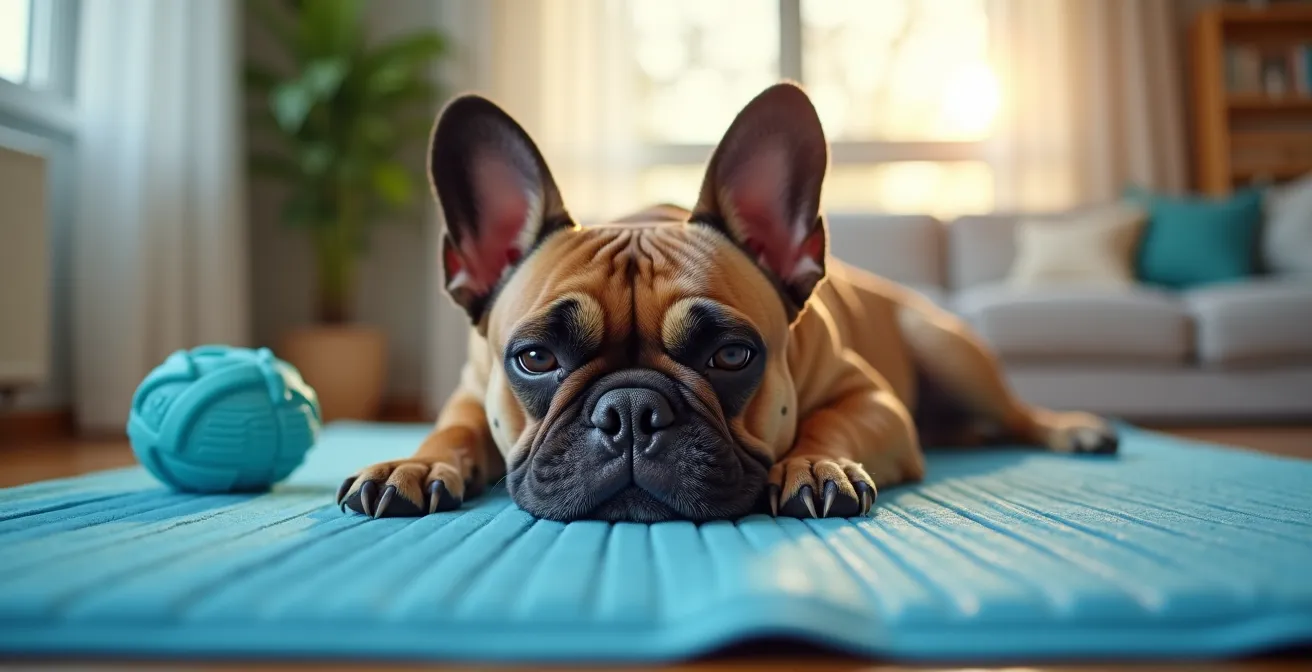
Creating a safe and stimulating indoor environment is paramount. As the image suggests, a cooling mat in a cool spot, perhaps with a frozen Kong nearby, is the picture of responsible brachycephalic care in the summer. Your creativity in providing indoor fun directly correlates to your dog’s safety and well-being.
Why Test a Poodle for von Willebrand’s Disease?
The elegant Poodle, a popular choice for apartment living due to their intelligence and hypoallergenic coat, carries a potential genetic risk for a bleeding disorder called von Willebrand’s Disease (vWD). This is an inherited condition where the blood doesn’t clot properly due to a deficiency of a specific protein. For an apartment dog, where minor bumps and scrapes can happen in tight quarters, knowing your dog’s vWD status is a critical piece of safety information. A simple DNA test can tell you if your dog is clear, a carrier, or affected.
If your Poodle is affected, it doesn’t mean they can’t live a full and happy life in your apartment. It simply means you must become a proactive risk manager. This involves making specific modifications to your home and communicating clearly with anyone who cares for your dog, like groomers or walkers. Owners of vWD-affected dogs have successfully managed the condition by replacing hard chew toys with softer alternatives, padding sharp furniture corners, and keeping an emergency kit with blood-clotting powder readily accessible. These small changes transform your apartment from a collection of potential hazards into a safe haven.
The environment of an apartment presents a unique set of risks and advantages compared to a house with a yard.
| Risk Factor | Apartment Living | House with Yard |
|---|---|---|
| Nail Injuries | Higher – hard floors, tight spaces | Lower – grass surfaces available |
| Furniture Collisions | Higher – limited space to navigate | Lower – more open areas |
| Emergency Response Time | Faster – closer to urban vet clinics | Slower – potentially rural location |
| Environmental Control | Better – owner always present | Variable – unsupervised yard time |
As the table shows, while some risks are heightened, the controlled environment and proximity to emergency care in an urban setting can be highly advantageous. Knowledge and preparation are your best tools.
Why Champion Lines Matter Even for “Just a Pet”?
When searching for a puppy to be your apartment companion, you might see breeders advertising “champion lines” and think, “I just want a pet, I don’t need a show dog.” This is one of the most common and critical misunderstandings in choosing a dog, especially for a demanding environment like a small apartment. A responsible breeder who invests the time, money, and effort to earn titles on their dogs—whether in conformation (dog shows), agility, obedience, or other dog sports—is not just chasing ribbons. They are proving the quality of their dogs against a breed standard.
For you, the urban professional, this is your single best guarantee of getting a dog with a predictable and stable temperament. It’s an insurance policy against the unknown. A “champion” title is objective, third-party verification of a dog’s soundness, trainability, and adherence to the breed’s ideal temperament. As a canine genetics expert noted, this has direct implications for apartment life:
Reputable breeders who title their dogs in sports like agility, obedience, or conformation are proving temperament, trainability, and structural soundness. For an apartment dweller, this translates to a dog with a more predictable energy level and a more stable, resilient temperament.
– Canine Genetics Expert, Professional Dog Training Resources
A dog from proven lines is more likely to have a functional ‘off switch,’ be less prone to noise phobias (a major issue in city apartments), and have the cognitive ability to engage in the kind of enrichment we’ve discussed. Choosing a puppy from a breeder who proves their stock is not elitism; it’s the most practical first step you can take in setting yourself and your dog up for a successful, peaceful life in a small space.
Key Takeaways
- Precision Over Power: Tailor care to your dog’s specific genetic and health needs, not just their energy level. A Cavalier’s heart health is as important as a Border Collie’s herding instinct.
- The Apartment as a Cognitive Gym: Shift your focus from endless physical exercise to a structured ‘mental diet’. Mental fatigue is more effective at creating a calm dog than physical exhaustion.
- Breeding is a Management Tool: Choosing a dog from proven, titled lines is your first and best step in ensuring a stable, trainable temperament suited for the challenges of apartment living.
Passive vs. Active Enrichment: Balancing the Mental Diet
We’ve established that mental exercise is the key to a happy, high-energy dog in a small apartment. But not all enrichment is created equal. Pouring your dog’s kibble into a puzzle toy every single day is a start, but it’s not a strategy. To truly create a calm and fulfilled companion, you need to think like a nutritionist and balance your dog’s mental diet between two types of enrichment: active and passive.
Active enrichment is collaborative and requires your dog’s focus and problem-solving skills. This includes training new tricks, playing scent work games, and engaging with complex puzzle toys. It’s the ‘main course’ of their mental meal. Passive enrichment, on the other hand, is about creating a sensory-rich environment that allows for calm observation and engagement without requiring intense effort. This could be a comfortable window perch, playing calming nature sounds, or providing a mat with a unique texture to explore. It’s the ‘healthy side dish’ that supports overall well-being. A dog that only gets active enrichment can become over-aroused and demanding, never learning to simply relax.
The most successful urban dog owners operate on an “enrichment budget.” A case study of a Border Collie owner in a 550 sq ft apartment showed that by implementing a structured plan of 60% active and 40% passive enrichment, they reduced destructive behaviors by 90% within 6 weeks. The key was realizing that constant stimulation is as detrimental as no stimulation. A balanced mental diet, planned for the week, ensures your dog’s cognitive needs are met without creating an adrenaline junkie. This balance is what teaches a high-energy dog the most valuable skill of all for apartment living: how to have an off-switch.
Start today. You don’t need a bigger apartment; you need a more precise plan. Pick one strategy—just one—from this guide and implement it this week. Whether it’s swapping a frantic game of fetch for a calm scent work session, or researching breeders who prove their dogs’ temperaments, every small, smart change moves you away from chaos and toward a calm, fulfilling partnership with the incredible dog you chose to share your life with.