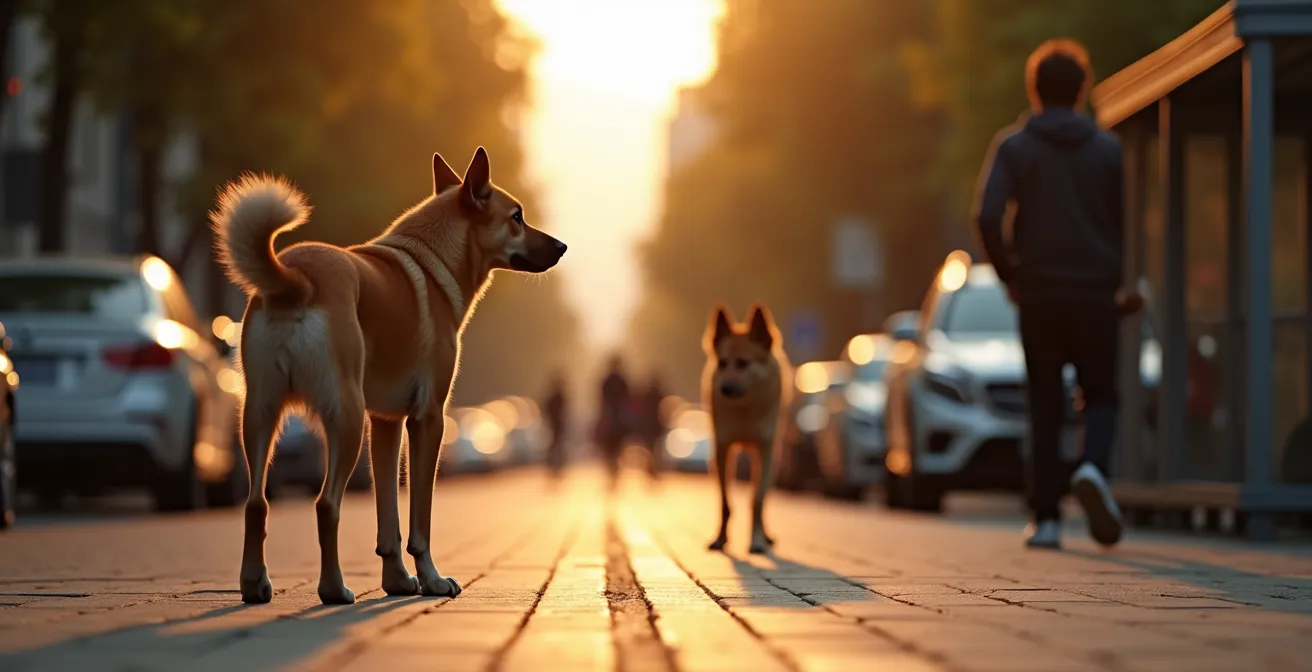
Leash reactivity is rarely true aggression; it’s an external symptom of an internal emotional flood, often rooted in fear or frustration.
- Managing your dog’s cumulative daily stress (the “stress bucket”) is more critical than simply trying to control the lunge itself.
- Effective training focuses on changing your dog’s underlying feelings about a trigger, not just suppressing the outward reaction.
Recommendation: Start by identifying your dog’s subtle stress signals and working at a distance where they can remain calm, which is the foundation for changing their behavior.
The heat rises in your cheeks as your dog erupts into a frenzy of barking and lunging at the end of the leash. Every person on the street turns to stare. In that moment, you feel a mix of embarrassment, frustration, and helplessness. Many owners interpret this explosive behavior as aggression or dominance, a conclusion that often leads to punitive tools and a breakdown in trust. The common advice to “just use treats” or “be the alpha” fails to address the real issue.
But what if this behavior isn’t a sign of a “bad dog,” but a dog who is struggling to cope? Leash reactivity is an outward expression of an internal emotional state. It’s a panic response, not a malicious one. The leash itself contributes, creating a sense of being trapped—known as barrier frustration—which can amplify a dog’s fear or excitement into an overwhelming outburst. Understanding this is the first step toward a real solution.
The key to changing this behavior lies not in suppressing the reaction, but in understanding and altering the emotion behind it. This guide will shift your perspective from controlling a problem to supporting your dog through their anxiety. We will move beyond superficial fixes and delve into the core concepts of stress management, emotional counter-conditioning, and force-free techniques that build confidence in both you and your dog, paving the way for calmer, more enjoyable walks.
For those who prefer a visual summary, the following video provides a great overview of the principles behind counter-conditioning to reduce stress and achieve more successful training outcomes.
To help you navigate these concepts, this article is structured to build your skills progressively. You will learn to identify the root causes of reactivity, master emergency maneuvers, choose the right equipment, and ultimately, rewire your dog’s emotional responses.
Summary: Leash Reactivity: Is It Fear, Frustration, or Aggression?
- The Stress Bucket: Why Your Dog Explodes on the Last Block of the Walk?
- The Emergency U-Turn: How to Escape a Trigger Instantly?
- Head Halter vs. Front-Clip Harness: Which Gives Better Control?
- Finding the “Working Distance”: How Far Is Far Enough?
- Bar Open/Bar Closed: Changing the Emotional Response to Triggers
- How to Read Subtle Stress Signals Before a Bite Occurs?
- 10 Minutes of Observation vs. 1 Hour of Play: Which Is Better?
- How to Rewire Reactive Behaviors Without Force in Adult Dogs?
The Stress Bucket: Why Your Dog Explodes on the Last Block of the Walk?
Imagine your dog has a “stress bucket.” Every minor stressor throughout the day adds a little bit of water: the mail carrier at the door, a squirrel dashing by the window, the sound of a truck backfiring. None of these events alone is enough to cause an issue. However, they accumulate. By the time you get to the last block of your walk, the bucket is full to the brim. The sight of another dog—even one they might have tolerated earlier—is the final drop that causes the bucket to overflow, resulting in an explosive reaction. This is why a dog can seem “fine” one minute and “reactive” the next. The final trigger isn’t the sole cause; it’s simply the last straw.
This concept is supported by our understanding of canine physiology. As experts Garbiec et al. note, chronic stress has a profound biological impact.
Chronic stress activates the HPA axis persistently, resulting in prolonged cortisol release, which can heighten the animal’s sensitivity to environmental stimuli and lower its threshold for stress responses.
– Garbiec et al., Behavioral, Physiological, and Pathological Approaches of Cortisol in Dogs
This prolonged release of cortisol, the primary stress hormone, effectively lowers your dog’s trigger point. It makes them more sensitive and quicker to react. Research on working dogs further confirms that a dog’s arousal state significantly impacts their behavior and ability to learn. Dogs with high baseline stress levels perform worse when more stress is added. Therefore, managing leash reactivity starts long before you even clip on the leash. It begins with proactively managing your dog’s daily stress levels to keep their bucket as empty as possible through enrichment, adequate rest, and decompression activities.
The Emergency U-Turn: How to Escape a Trigger Instantly?
Even with the best management, you will inevitably find yourself in a situation where a trigger appears too close, too suddenly. In these moments, you don’t need a training command; you need an escape plan. The Emergency U-Turn is your most valuable tool for instantly creating distance and preventing your dog from going over their emotional threshold. This isn’t about yanking your dog; it’s a smooth, practiced maneuver designed to disengage quickly and calmly. The goal is to make an immediate 180-degree turn and walk briskly in the opposite direction, creating a positive association with moving away from the trigger.
This technique is particularly vital because research indicates that many dogs are most reactive in their own neighborhood or apartment complex—environments filled with unavoidable triggers. To teach the U-turn, start in a low-distraction area. As you walk, say a cue like “This way!” in an upbeat tone, turn your body decisively, and use the leash to gently guide your dog around with you. The moment your dog turns, reward them with a high-value treat. Practice this randomly on walks when there are no triggers present, so the movement becomes a fun, reflexive game.
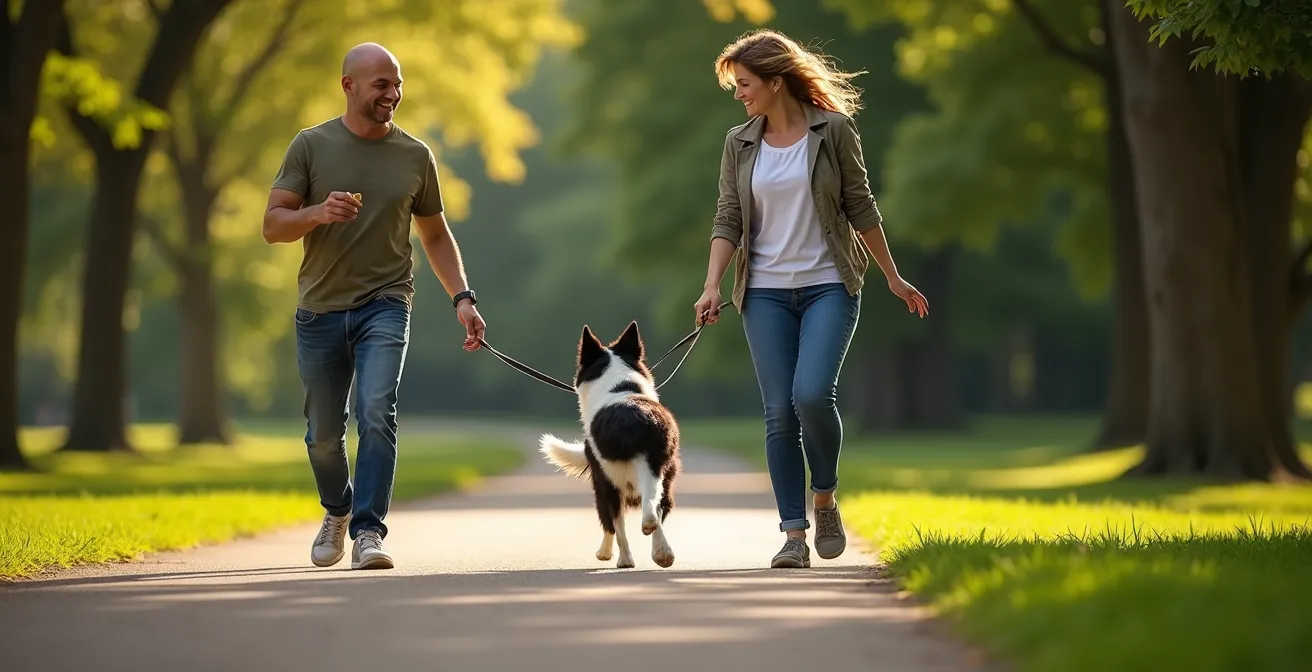
When you see a trigger in the real world, you can then deploy your practiced U-turn without hesitation. The key is to act *before* your dog fixates. The instant you spot the trigger, initiate the turn. This proactive escape prevents the stress bucket from overflowing and teaches your dog that you are a reliable leader who will help them avoid conflict, building their trust in your handling.
Head Halter vs. Front-Clip Harness: Which Gives Better Control?
Choosing the right equipment is a critical part of a safety and management plan, but it’s important to view tools as aids for training, not as solutions in themselves. For reactive dogs, the two most commonly recommended pieces of equipment are head halters and front-clip harnesses. Both work by redirecting the dog’s momentum and preventing them from putting their full weight into pulling, but they function very differently. A front-clip harness has a leash attachment point on the dog’s chest, which gently steers them back toward you when they pull. A head halter fits around the dog’s muzzle and the back of their head, working on the principle that where the head goes, the body will follow.
Neither tool is inherently “better”; the right choice depends on the specific dog, the owner’s handling skills, and the severity of the reactivity. Head halters offer maximum directional control for strong or large dogs, but they carry a higher risk of creating a negative association if not introduced slowly and positively. Many dogs find them aversive at first. Front-clip harnesses offer moderate steering control and are generally accepted more easily by most dogs, making them an excellent starting point for many teams. The following comparison highlights the key differences to help you make an informed decision.
As outlined in clinical guidelines on the topic, a properly fitted tool can be invaluable. This table breaks down the pros and cons based on an analysis from the Veterinary Information Network.
| Feature | Head Halter | Front-Clip Harness |
|---|---|---|
| Control Level | Maximum directional control | Moderate steering control |
| Pressure Point | Head and muzzle area | Chest and shoulders |
| Risk of Aversive Association | Higher – can worsen reactivity if improperly introduced | Lower – less likely to create negative associations |
| Natural Opposition Reflex | Can trigger resistance in some dogs | Minimizes pulling reflex |
| Introduction Period | Requires extensive desensitization (2-4 weeks) | Faster acceptance (3-7 days) |
| Best For | Dogs needing maximum control, after proper conditioning | Most reactive dogs, especially during initial training |
Ultimately, the best tool is one that your dog is comfortable wearing and that gives you the confidence to manage situations safely while you work on the underlying behavior modification.
Finding the “Working Distance”: How Far Is Far Enough?
The single most important concept in modifying reactive behavior is “threshold,” or the point at which your dog transitions from a calm, thinking state to an emotional, reactive one. To change your dog’s feelings about a trigger, you must work “sub-threshold”—at a distance where your dog can notice the trigger but is not so stressed that they react. This is their “working distance.” Finding this distance is not about a fixed number of feet; it’s a dynamic assessment that changes based on numerous factors. Many owners make the mistake of thinking that if their dog was okay at 30 feet yesterday, they will be today. This often leads to failure and frustration.
The environment plays a huge role in determining this distance. You must become an expert at “environmental engineering,” using physical objects to your advantage. A parked car, a large tree, or a hedge can serve as a visual barrier, effectively increasing the perceived distance to a trigger and helping your dog feel safer. By strategically placing these barriers between your dog and a trigger, you can work closer than you could in an open field.
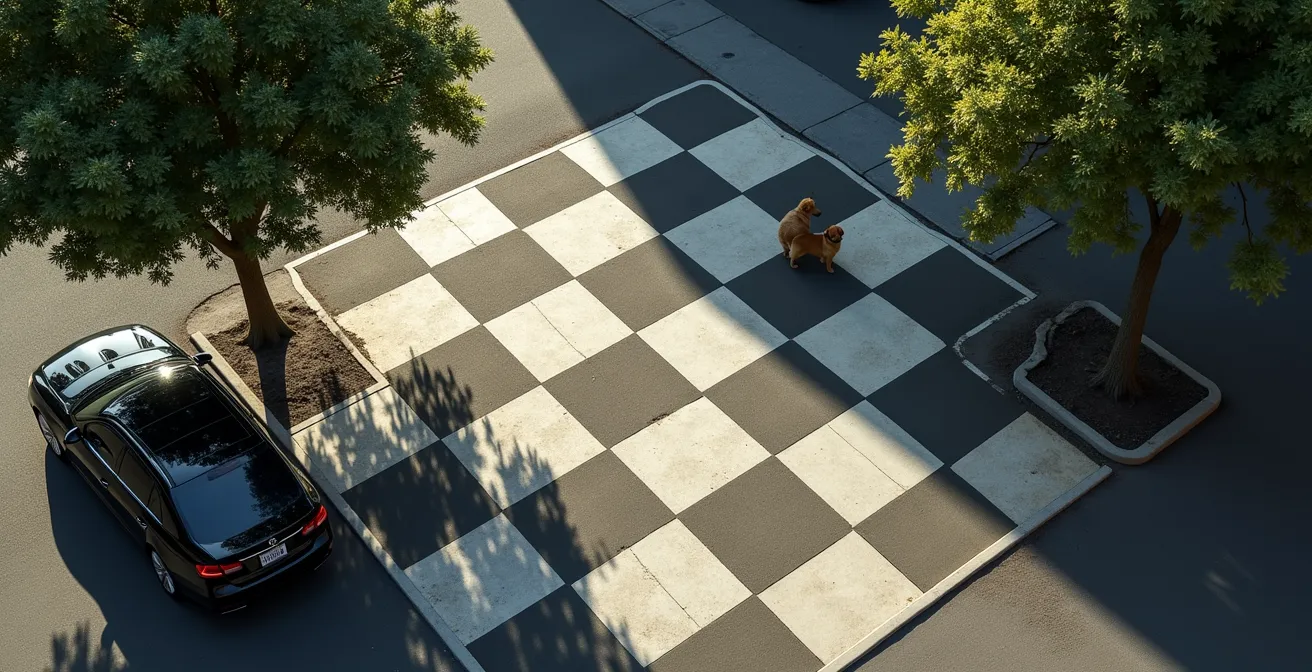
Understanding the fluid nature of thresholds is essential for successful training. It requires you to become a skilled observer of both your dog and the environment.
Case Study: Dynamic Threshold Management
Research from Cornell University’s veterinary experts highlights that a dog’s reactive threshold is not static. It’s influenced by the trigger’s characteristics (e.g., a fast-moving, barking dog is more intense than a calm, stationary one), the context (a narrow sidewalk vs. an open park), and the dog’s current stress level. A dog comfortable with another dog at 20 feet might need over 50 feet if that other dog is staring directly at them on a dark street. This demonstrates that successful management requires the owner to constantly reassess the working distance and manipulate the environment, for example, by ducking behind a car to create a visual block, rather than relying on a fixed distance.
Your job is to be your dog’s advocate, constantly scanning the environment and adjusting your position to ensure your dog stays in a state where they are capable of learning new, positive associations.
Bar Open/Bar Closed: Changing the Emotional Response to Triggers
Once you can reliably find your dog’s working distance, you can begin the work of changing their emotional response (the CER) to triggers. This is the core of force-free behavior modification. One of the most effective methods for this is called “Bar Open/Bar Closed.” The concept is simple: when the trigger (e.g., another dog) is visible, the “bar is open,” and amazing, high-value treats flow continuously. The moment the trigger disappears, the “bar is closed,” and all treats stop. This protocol creates a powerful and clear association in the dog’s mind: the presence of the trigger predicts wonderful things.
This is not bribery or simple distraction. The goal is not to get your dog to look at you instead of the trigger. The goal is for your dog to look at the trigger and feel happy anticipation instead of fear or frustration. The timing is critical. Treats must start the instant the dog sees the trigger and stop the instant it’s gone. There are no verbal cues like “look at that” or “be good.” The trigger itself becomes the cue. Your role is that of a calm, predictable treat dispenser, helping to shape a new, positive emotional response through classical conditioning.
Your own emotional state is a huge factor in this process. Dogs are incredibly attuned to our stress. They can smell the changes in our breath and sweat when we become anxious, which can signal to them that there is a reason to be worried. Staying calm and neutral is part of the process.
Action Plan: Implementing the Bar Open/Bar Closed Protocol
- Find the Distance: Start at a distance where your dog can see the trigger but is not reacting (no stiffening, staring, or lunging). This is your working distance.
- Open the Bar: The second your dog notices the trigger, begin delivering a steady stream of pea-sized, high-value treats (like chicken, cheese, or hot dogs) directly to their mouth.
- Maintain the Flow: Continue feeding treats as long as the trigger is in sight and your dog is not reacting. The dog should be thinking, “Oh, there’s that dog, where’s my chicken?”
- Close the Bar: The exact moment the trigger disappears from view (behind a car, around a corner), all treats stop immediately and completely.
- Practice and Repeat: Keep sessions short (5-10 minutes) and always end on a positive note. The goal is quality repetitions, not long duration.
Through consistent repetition, the dog’s conditioned emotional response begins to shift from “Oh no, a dog!” (fear) to “Oh great, a dog!” (anticipation of treats). This is how you truly rewire the brain.
How to Read Subtle Stress Signals Before a Bite Occurs?
A reactive explosion rarely comes out of nowhere. It’s typically preceded by a cascade of much quieter, more subtle signals of stress and anxiety. Learning to recognize these early warnings is like learning to read a weather forecast; it allows you to take action before the storm hits. Owners who miss these whispers are often shocked when their dog finally “shouts” by lunging and barking. By becoming a fluent reader of your dog’s body language, you can intervene when their stress is still low—by increasing distance, using your emergency U-turn, or scattering treats on the ground—long before they go over threshold.
These subtle signals are often called “calming signals” or “displacement behaviors.” They are things dogs do when they are feeling conflicted or uncomfortable. A yawn in the vet’s office is likely not due to sleepiness but to stress. A lip lick when a stranger approaches isn’t about tasting something; it’s a sign of anxiety. Recognizing the difference between a dog who is relaxed versus one who is subtly escalating is a critical skill for any owner of a reactive dog.
Pay close attention to your dog’s entire body—from the tension in their mouth to the height of their tail. A hard, direct stare is very different from soft, blinking eyes. A stiff, vibrating tail held high is a warning, while a loose, wagging tail is a sign of ease. The table below contrasts these escalating signals with their de-escalating, or calming, counterparts.
| Body Part | Escalation Signals | De-escalation Signals |
|---|---|---|
| Eyes | Dilated pupils, hard stare, whale eye | Soft eyes, slow blinking, looking away |
| Mouth | Closed tight, lips pulled back, panting rapidly | Open relaxed, tongue lolling, yawning |
| Ears | Pinned back or rigidly forward | Neutral position, occasional movement |
| Body | Stiff, weight forward, raised hackles | Loose muscles, weight centered, shake-off |
| Tail | High and rigid, vibrating tip | Neutral height, loose wagging |
| Whiskers | Pushed forward, tense | Relaxed, natural position |
By learning to spot a tight mouth or “whale eye” (when the whites of the eyes are visible), you can react much earlier, keeping your dog’s stress bucket from overflowing and making your training far more effective.
10 Minutes of Observation vs. 1 Hour of Play: Which Is Better?
When trying to lower a dog’s stress bucket, many well-intentioned owners assume that more exercise is always better. They might engage in an intense, hour-long game of fetch at the dog park, hoping to tire their dog out before a walk. However, for many reactive dogs, this is counterproductive. High-arousal activities like frantic chasing or rough-and-tumble play can actually *add* water to the stress bucket, not remove it. This type of play floods the dog’s system with adrenaline and cortisol, priming them for an even bigger reaction later. Quality of enrichment trumps quantity of exercise.
For a dog who is already prone to over-arousal, a better choice is often a calm, mentally engaging activity. A 10-minute “sniffari,” where the dog is allowed to lead the way and leisurely investigate every scent on a quiet trail, can be far more beneficial for lowering cortisol than an hour of high-impact play. Scent work, puzzle toys, and calm observation of the world from a safe distance are forms of active decompression. They engage the dog’s brain without over-stimulating their nervous system.
Case Study: The Impact of Arousal on Learning
A compelling study on detection dogs provides scientific backing for this concept. Researchers found that high-arousal play sessions before a training task negatively impacted the performance and memory consolidation of dogs that were already naturally excitable. Conversely, dogs that were given quiet observation periods before training showed improved learning and better memory of their tasks 24 hours later. This underscores that matching the activity to the dog’s individual arousal level is crucial for both behavioral wellness and effective learning. For a reactive dog, starting a walk from a state of calm is paramount.
Instead of thinking about tiring your dog out physically, focus on satisfying them mentally. A short, focused session of sniffing or problem-solving can be incredibly enriching and will set your dog up for a much more successful walk.
- Sniffari Walks: Use a long line (if safe) in a quiet park or trail and let your dog’s nose lead. The goal is exploration, not distance.
- Scent Games: Hide treats around a room and encourage your dog to “find it.” This taps into their natural foraging instincts.
- Puzzle Toys: Licking and chewing are naturally calming behaviors. A stuffed Kong or a LickiMat can help a dog settle.
Key takeaways
- Reactivity is an emotional response, not a choice. Focus on changing the underlying emotion of fear or frustration.
- Proactively managing daily stress through decompression activities is more effective than reactively controlling outbursts.
- Successful training happens at a “working distance” where your dog is calm enough to learn new, positive associations.
How to Rewire Reactive Behaviors Without Force in Adult Dogs?
The journey of working with a reactive dog is a marathon, not a sprint. It’s about slowly rewiring your dog’s brain, not just suppressing behavior. The most effective, humane, and lasting way to do this is through force-free methods rooted in positive reinforcement and classical conditioning. Using tools that cause pain or fear, such as prong or shock collars, may stop the barking and lunging in the short term, but they do so by creating anxiety and shutdown. They don’t change the dog’s underlying negative feelings about the trigger; in fact, they often make them worse by confirming that the trigger’s presence predicts pain. The dog learns that when another dog appears, their neck gets yanked, strengthening the negative association.
In contrast, force-free methods focus on building a new, positive association. By pairing the sight of a trigger with something the dog loves (like high-value food), you change the emotional equation from fear to anticipation. This is a scientifically supported approach. Positive reinforcement-based training has been shown to decrease stress indicators like cortisol and improve a dog’s ability to learn and retain new information. It builds a relationship based on trust and communication, empowering the dog to make better choices.
This process also requires immense compassion for yourself. It is emotionally draining to live with a reactive dog. The embarrassment and anxiety are real. It’s crucial to manage your own stress, celebrate small wins, and not be afraid to take “training-free” days where you and your dog just engage in fun, easy activities at home.
- Document Small Wins: Did your dog see a trigger from 100 feet away and choose to look at you? Celebrate that! Progress is not linear.
- Schedule “Training-Free” Days: Give yourself and your dog a break. Play games indoors or visit a secure private field.
- Find a Support System: Connect with other reactive dog owners online or a certified force-free professional. You are not alone.
- Practice Self-Care: Use deep breathing or positive visualization before a walk to lower your own anxiety. Your calm presence is one of your most powerful tools.
By shifting your focus from “fixing” a bad behavior to holistically supporting your dog’s emotional well-being, you can begin the rewarding process of rewiring their reactive responses and rebuilding a joyful partnership. Your first step is to become a detective of your dog’s stress signals and an architect of their environment.