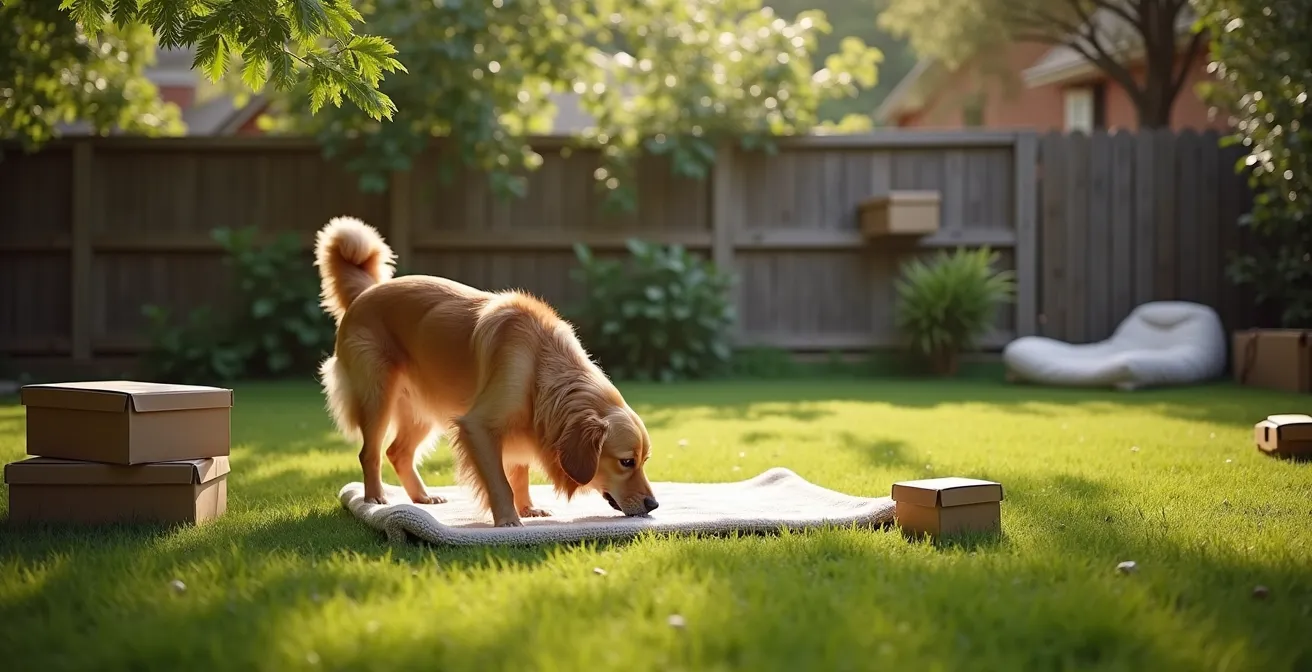
The solution to your dog’s boredom isn’t found in the pet store aisle; it’s rooted in understanding their cognitive needs.
- Passive enrichment (a room full of toys) offers little mental value, like “junk food” for the brain.
- Active enrichment (sniffing, shredding, problem-solving) satisfies core canine instincts and provides a fulfilling “mental workout.”
Recommendation: Shift your focus from acquiring more toys to curating intentional activities that challenge your dog’s mind and build their confidence.
As a devoted dog owner, you’ve likely found yourself in this familiar scenario: you see your dog looking bored, so you head to the store and return with a new, brightly colored toy. For a few hours, or perhaps even a day, it’s a novel delight. But soon, it’s just another piece of plastic collecting dust in a basket overflowing with past “solutions.” This cycle of buying more to combat boredom is a common trap, stemming from a fundamental misunderstanding of what truly satisfies a dog’s mind. The problem isn’t a lack of things, but a deficit in meaningful engagement.
The common advice is often to simply provide more toys or increase physical exercise. While well-intentioned, this approach only skims the surface. It fails to address the core of canine wellness: the need for a balanced mental diet. True enrichment goes far beyond passive objects. It’s about providing active, cognitive challenges that allow your dog to express their innate behaviors. But what if the key to a calm, content dog wasn’t in adding more, but in changing the very nature of their stimulation? What if a cardboard box and an old towel held more enrichment value than a dozen squeaky toys?
This guide will deconstruct the difference between passive “junk food” enrichment and an active, nutritious mental diet. We will explore the science of why sniffing is more tiring than running, how to channel destructive urges productively, and why a simple rotation can make old toys new again. By focusing on your dog’s inherent needs to think, solve problems, and work for rewards, you can move beyond the endless cycle of purchases and become a true curator of your dog’s mental well-being.
For those who prefer a hands-on approach, the following video offers a fantastic example of a simple, do-it-yourself enrichment toy. It perfectly illustrates how low-cost materials can be transformed into a high-value experience for your puppy or dog.
To help you build a truly fulfilling enrichment plan, this article breaks down the essential components of a balanced mental diet. Each section provides practical strategies and explains the science behind why these activities work, empowering you to create a more engaged and happier life for your canine companion.
Summary: Crafting Your Dog’s Balanced Mental Diet
- The Nose Knows: Why Sniffing Tires a Dog Faster Than Running?
- Destruction Box: Channeling the Need to Shred Safely
- The Novelty Effect: Why Hiding Toys Makes Them Valuable Again?
- Cardboard and Towels: Zero-Cost Puzzles for Rainy Days
- Trick Training: Building Confidence Through Success
- The Stubbornness Myth: Why Terriers Don’t Respond to Repetitive Drills
- Why Working for Food Calms High-Energy Dogs?
- How to Stop Bloat in Fast Eaters Using Specialized Feeders?
The Nose Knows: Why Sniffing Tires a Dog Faster Than Running?
Many owners believe a tired dog is a dog that has been run ragged at the park. While physical exercise is vital, it only satisfies one part of your dog’s needs. The real key to deep, satisfying exhaustion lies in their most powerful sense: their nose. A 20-minute session of intensive sniffing can be more tiring for a dog than a 60-minute run. This isn’t just about smelling interesting things; it’s about the immense cognitive load required to process and interpret that information.
When a dog sniffs, they aren’t just passively taking in odors. They are actively analyzing a complex world of information—who was here, what they ate, where they went. This intense mental activity engages what neuroscientists call the “Seeking System.” Engaging this system, which is responsible for hunting and foraging behaviors, triggers a release of dopamine in the brain. This is the “feel-good” chemical associated with motivation, focus, and satisfaction. It’s the neurological equivalent of solving a complex puzzle.
So, while a long run burns physical calories, a “sniffari” burns mental ones. It allows your dog to engage in a biologically fulfilling behavior that reduces stress and builds focus. Instead of prioritizing distance on your next walk, prioritize time spent exploring a single, scent-rich area. Letting your dog lead the way with their nose provides a profound mental workout that passive toys simply cannot replicate, forming the foundational course of their mental diet.
Destruction Box: Channeling the Need to Shred Safely
Finding a favorite pair of shoes or a piece of furniture torn to shreds is a deeply frustrating experience for any dog owner. The immediate reaction is often to label the dog as “bad” or “destructive.” However, this behavior is rarely born from malice. For many dogs, especially certain breeds, the act of ripping, tearing, and shredding is a deeply ingrained behavioral need. Suppressing this instinct is futile; the key is to provide a safe and appropriate behavioral outlet.
As the experts at Dogminded Training explain, the goal is to redirect this natural drive:
We’re especially fond of using delivery boxes and stuffing them with packing paper or ripped paper bags and hiding small treats inside. The goal isn’t to use a lot of treats, but to help meet your dog’s scavenging, ripping, and shredding needs.
– Dogminded Training, Five Go-To Enrichment Activities for Dogs
This is the principle behind the “Destruction Box.” It’s a simple, low-cost, high-reward activity. Take a cardboard box and fill it with dog-safe materials like packing paper, old t-shirts, or more cardboard. Sprinkle a few high-value treats or a portion of their kibble inside and let your dog have at it. This not only saves your furniture but also provides a multi-sensory experience that combines scent work (finding the food) with the physical satisfaction of tearing something apart.

This activity is a perfect example of active enrichment. It doesn’t just occupy your dog; it fulfills a core part of their nature. It turns a “problem behavior” into a structured, confidence-building game. By providing a “yes” instead of a constant “no,” you strengthen your bond and create a calmer, more satisfied companion.
The Novelty Effect: Why Hiding Toys Makes Them Valuable Again?
A dog’s brain is wired to seek out novelty. This is an evolutionary trait that helped their ancestors find new food sources and identify changes in their environment. It’s also why a brand-new toy is incredibly exciting, while one that has been lying around for weeks is virtually invisible. The toy itself hasn’t changed, but its perceived value has plummeted. Your dog has become habituated to it. This is where the endless cycle of buying new toys begins, but the solution isn’t more toys; it’s a better system.
By simply rotating your dog’s toys, you can harness the power of the novelty effect. When a toy is put away for a week or two and then reintroduced, the dog’s brain perceives it as new again, reigniting their interest and engagement. This simple act transforms a passive object into an exciting, active opportunity for play. Instead of an ever-growing pile of forgotten toys, you create a curated library of engaging options.
For a structured approach, you can implement a simple system like the one suggested by the experts at the Dogsthat podcast. This method ensures toys stay fresh and valuable, saving you money and reducing clutter while maximizing your dog’s engagement.
| Bin Category | Status | Duration | Contents Example |
|---|---|---|---|
| Active Roster | Currently Available | 1 week | 3-4 toys in living space |
| On the Bench | Being Rested | 2 weeks | 4-5 toys stored away |
| In the Wash | Cleaning/Repair | As needed | 2-3 toys being maintained |
This system turns you from a mere provider of things into a thoughtful curator of your dog’s environment. It’s a powerful mindset shift that is central to building a balanced mental diet. You are teaching your dog that their environment is dynamic and rewarding, which encourages them to actively engage with it rather than passively waiting for the next new thing.
Cardboard and Towels: Zero-Cost Puzzles for Rainy Days
Effective enrichment doesn’t have to be expensive or complicated. In fact, some of the most engaging brain games for your dog can be created with items you already have at home. This is especially useful on rainy days when outdoor activities are limited. Simple household items like cardboard tubes from paper towels or old bath towels can be transformed into compelling puzzles that satisfy your dog’s natural foraging instincts.
These DIY puzzles are a cornerstone of an accessible mental diet. They prove that the value of an enrichment activity lies in the cognitive challenge it presents, not its price tag. For example, you can hide treats inside a cardboard tube and fold the ends, forcing your dog to work to get the reward. A “snuffle mat” can be made by tying fleece strips to a rubber mat, creating a dense field for your dog to sniff through to find their kibble.
An old towel offers a fantastic, progressive puzzle. You can start simply and increase the difficulty as your dog gets more proficient, which helps build their problem-solving skills and confidence. This prevents frustration and keeps the game engaging over time.
Your Action Plan: Progressive Towel Puzzle
- Level 1 – The Roll-Up: Lay a towel flat, sprinkle treats across it, and simply roll it up. Your dog will use their nose and paws to unroll it and find the rewards.
- Level 2 – The Knot: Once they master the roll-up, tie a loose knot in the towel with the treats hidden inside. This requires more manipulation to solve.
- Level 3 – The Braid: For an advanced challenge, loosely braid three towels together, hiding treats within the folds and knots of the braid.
- Level 4 – The Towel-in-a-Box: Place a knotted or rolled towel inside a cardboard box to create a multi-layered puzzle that requires both shredding and un-knotting skills.
- Safety First: Always supervise your dog during these activities to ensure they do not ingest any fabric, and use sturdy towels without frayed edges.
These zero-cost solutions are a powerful reminder that enrichment is about creativity and intention, not consumption. By seeing the potential in everyday objects, you can provide your dog with endless opportunities for mental stimulation without ever setting foot in a pet store.
Trick Training: Building Confidence Through Success
Trick training is often seen as a frivolous activity, something done for cute social media videos. However, when approached correctly, it becomes a powerful form of active enrichment that builds a dog’s confidence, strengthens your bond, and enhances their ability to problem-solve. It’s not about forcing repetitive behaviors; it’s about teaching your dog how to learn and celebrating their success.
Each time a dog successfully performs a trick and receives a reward, it’s a small victory. This process of trying, succeeding, and being reinforced creates a positive feedback loop. It teaches the dog that they can influence their environment and that trying new things leads to good outcomes. This is especially crucial for timid or anxious dogs, as it helps them build resilience and a sense of agency.
The positive emotional impact of this process is backed by science. It’s not just about the treat; it’s the thrill of the solution.
Case Study: Problem-Solving and Positive Emotions
A study by McGowan et al. in 2014 explored how dogs react emotionally to solving puzzles. They observed that dogs who successfully manipulated objects like levers or buttons to get a reward showed clear signs of positive emotions. According to the analysis of this research, these dogs displayed increased tail wagging and higher activity levels, classic indicators of excitement and joy. This demonstrates that the act of problem-solving itself is intrinsically rewarding and builds positive emotional states.
Instead of thinking about tricks like “sit” or “stay,” consider teaching concepts that encourage body awareness (like backing up or putting paws in a box) or scent discrimination (finding a specific toy). These tasks require a high degree of focus and cognitive effort, making them excellent additions to your dog’s mental diet. This form of collaborative work is one of the most fulfilling activities you can share with your dog.
The Stubbornness Myth: Why Terriers Don’t Respond to Repetitive Drills
Owners of terriers and other independent breeds often face a unique challenge: a dog that seems intelligent but willfully “stubborn.” They might learn a new command in five minutes and then refuse to perform it on the tenth repetition. This isn’t a flaw in the dog’s character; it’s a feature of their genetic design. Labeling this behavior as stubbornness is a misunderstanding of their core nature and a primary reason why traditional, repetitive training often fails with these dogs.
These breeds were not developed to work in close partnership with a human, taking direction for every move. They were bred for a specific, independent job.
Terriers were bred to work independently underground, out of sight and earshot of humans. Their perceived ‘stubbornness’ is actually bred-in intelligence, problem-solving ability, and task-oriented persistence that served them well in their original working roles.
– Canine Behavior Specialists, Understanding Terrier Behavior and Motivation
For a terrier, repeating “sit” ten times is a pointless, boring task. Their brain craves a problem to solve, a purpose for their actions. Instead of fighting this trait, a smart owner learns to work with it by incorporating their dog’s bred-in intelligence into their enrichment. This means shifting from a “drill sergeant” mentality to that of a “game master,” setting up challenges rather than demanding mindless obedience. Their mental diet needs to be rich in problems, not just repetitions.
To truly engage a terrier’s mind, you need to provide enrichment that mimics their original job:
- Mock Hunts: Create “barn hunt” style games by hiding scented items or treats in layered blankets or cardboard tubes, encouraging them to “dig” and search.
- Advanced Puzzles: Use puzzle toys that require tenacity and physical manipulation, like pushing, pulling, and pawing, rather than simple actions.
- Scent Trails: Instead of just hiding food, drag a scented object across a room or yard to create a trail for them to follow independently, engaging their tracking instincts.
By understanding the “why” behind their behavior, you can provide enrichment that genuinely satisfies their intelligent, persistent minds, turning perceived stubbornness into celebrated success.
Key Takeaways
- True enrichment is active, not passive. It’s about engaging your dog’s mind in problem-solving, not just providing them with objects.
- Understanding and providing outlets for innate behaviors like sniffing, shredding, and foraging is more effective than trying to suppress them.
- A balanced mental diet, rich in novelty and cognitive challenges, is essential for preventing boredom and promoting long-term brain health.
Why Working for Food Calms High-Energy Dogs?
For a high-energy dog, a bowl of food that is devoured in thirty seconds provides almost zero mental engagement. The meal is over before their brain has even had a chance to register the activity. This is a massive missed opportunity for enrichment. The concept of contrafreeloading describes the phenomenon where many animals, including dogs, will choose to work for their food even when an identical free meal is available. This drive to work is a powerful tool for calming an anxious or high-energy dog.
When a dog has to use its brain and body to acquire its meal—by sniffing it out of a snuffle mat, manipulating a puzzle feeder, or chasing a food-dispensing ball—it transforms feeding time from a passive gulp-fest into an engaging, focused task. This process slows them down, forces them to problem-solve, and taps into their natural foraging instincts. The mental effort required has a profound calming effect, helping to reduce stress and anxiety. It gives their busy brain a productive job to do.
While a 2024 study in Nature found that dogs don’t always show a strong preference for contrafreeloading over a free meal, it confirmed their willingness to engage in it, highlighting that individual preferences vary. More importantly, keeping a dog’s mind active has significant long-term health benefits. Compelling research from the Dog Aging Project reveals that the odds of developing canine cognitive dysfunction were 6.47 times higher in inactive dogs compared to their very active counterparts. Making them work for their food is a simple, twice-a-day investment in their long-term brain health.
How to Stop Bloat in Fast Eaters Using Specialized Feeders?
Beyond the mental benefits, slowing down a dog’s eating has a critical physical health component, particularly for dogs prone to eating too quickly. Fast eating can lead to a life-threatening condition called Gastric Dilatation-Volvulus (GDV), or bloat, where the stomach fills with gas and can twist on itself. The conventional solution has been a simple slow-feeder bowl, but a truly effective mental diet integrates the solution into an enriching activity.
Using enrichment feeders—like puzzle toys, snuffle mats, or products like the Kong—is one of the most effective ways to combat fast eating. These tools do more than just create physical barriers; they turn mealtime into a game that requires thought and focus. The impact can be dramatic. A 2024 veterinary study on enrichment feeding found that it took dogs almost 20 times longer to eat the same amount of food from a Kong toy compared to a standard bowl. This extended duration not only drastically reduces the risk of bloat but also gives the dog’s brain time to receive satiation signals, leading to a greater sense of fullness and satisfaction.
The right tool often depends on the individual dog’s physical structure and temperament. A one-size-fits-all approach is less effective than matching the feeder to the dog’s specific needs, ensuring the activity is challenging but not frustrating.
| Dog Type | Recommended Solution | Why It Works | Additional Benefits |
|---|---|---|---|
| Brachycephalic Food-Bolter | Shallow, wide slow feeder | Accommodates flat face structure | Reduces air intake |
| High-Energy, Anxious Eater | Snuffle mat | Promotes calm, focused sniffing | Reduces stress hormones |
| Intelligent, Bored Eater | Level 2 puzzle feeder | Provides mental challenge | Satisfies problem-solving needs |
| Competition-Stressed Eater | Separate feeding room | Removes perceived threats | Creates positive associations |
By integrating feeding into your enrichment strategy, you’re hitting two targets with one stone: you are protecting your dog’s physical health while providing a crucial component of their daily mental diet. This holistic approach is the ultimate goal of thoughtful, modern dog ownership.
Now that you’re equipped with the knowledge to build a balanced mental diet, the next step is to start observing your dog and implementing these strategies. Begin by replacing one bowl-fed meal with an enrichment feeder and introduce one new, low-cost puzzle this week.