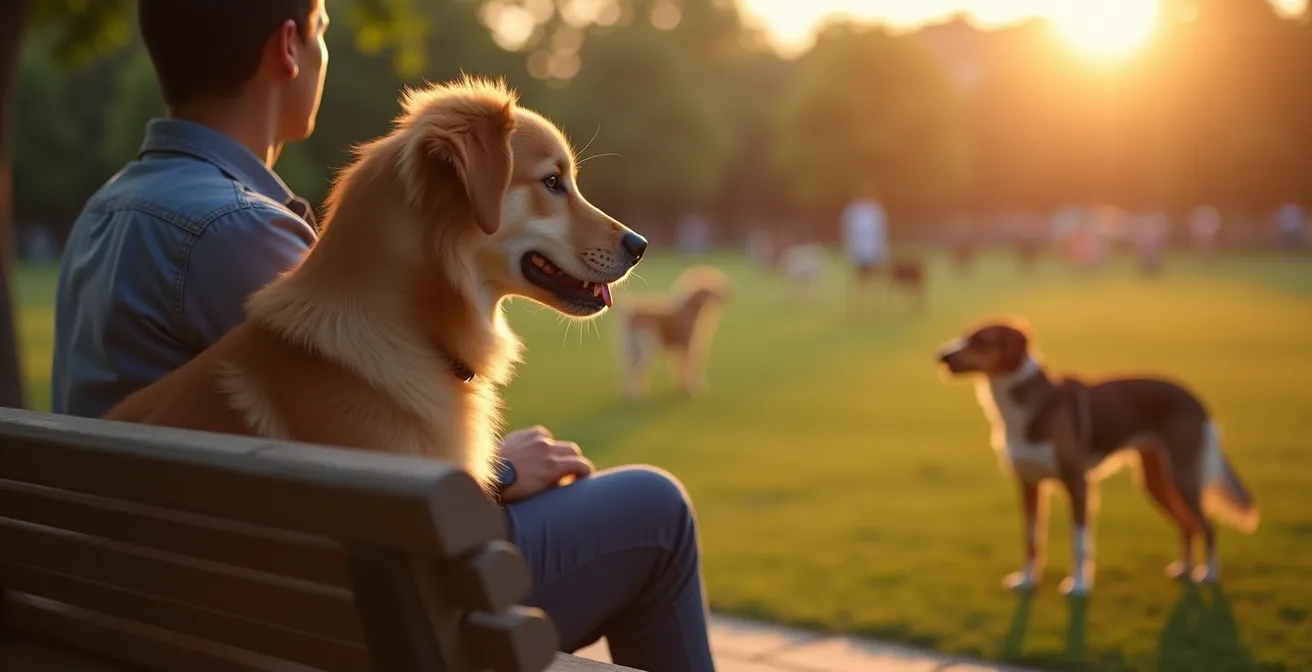
The common belief that socializing a dog means encouraging interaction with every person and dog is actively creating reactive, anxious pets.
- True, effective socialization teaches a dog to be neutral and calm in the presence of stimuli, not to engage with them.
- Forcing greetings, especially on-leash, often overwhelms a dog, leading to fear, frustration, and reactivity.
Recommendation: Shift your focus from creating interactions to managing environments. Teach your dog the skill of calmly observing the world from a safe distance.
You’re walking your puppy, and a well-meaning stranger approaches, hand outstretched, cooing, “Can he say hi?” A wave of pressure washes over you. The conventional wisdom screams “Yes! Socialize him!” You’ve been told to expose your dog to as many people, places, and other dogs as possible. You frequent the dog park, encourage on-leash greetings, and celebrate every interaction as a win. Yet, you might notice your dog is becoming more tense, not less. He’s starting to pull, bark, or lunge at the very things you’re trying to make him love.
This is the great paradox of modern dog ownership. In our quest for a “friendly” dog, we often follow advice that inadvertently fosters the opposite: a reactive, overwhelmed, and anxious companion. The problem isn’t socialization itself, but our fundamental misunderstanding of its goal. We’ve conflated socialization with constant social interaction, a platitude that ignores canine psychology. This guide will challenge that outdated notion.
But what if the true key to a well-adjusted dog isn’t more interaction, but less? What if the most valuable skill you can teach your dog is how to calmly do nothing in a busy world? This is the principle of environmental neutrality. It’s a shift from forcing your dog to “make friends” to empowering them to coexist peacefully with their surroundings. This approach prioritizes quality of exposure over quantity of encounters, a concept supported by modern behavioral science.
This article will deconstruct the common myths surrounding socialization. We will explore why structured observation is more powerful than chaotic play, how to work with adult rescue dogs, why fear periods demand a strategic pause, and how to identify the root causes of leash reactivity. Prepare to redefine what it means to have a truly socialized dog.
This guide provides a structured path to understanding and implementing a modern, more effective approach to socialization. Explore the key concepts below to transform your dog from reactive to relaxed.
Summary: Rethinking Socialization: A Guide to Canine Neutrality
- 10 Minutes of Observation vs. 1 Hour of Play: Which Is Better?
- Is It Too Late to Socialize a 5-Year-Old Rescue Dog?
- The Dog Park Mistake: Why Leashed Dogs Should Not Enter Off-Leash Zones?
- Coffee Shop Training: Teaching Your Dog to Do Nothing in Public
- Why You Should Pause Socialization Outings During a Fear Period?
- Why Is Your 5-Month-Old Puppy Suddenly Scared of Trash Cans?
- Finding the “Working Distance”: How Far Is Far Enough?
- Leash Reactivity: Is It Fear, Frustration, or Aggression?
10 Minutes of Observation vs. 1 Hour of Play: Which Is Better?
The goal of socialization is not to create a party animal, but a dog that is comfortable and confident in the human world. This requires teaching them that most things—people, dogs, cars, skateboards—are just “background noise” not worthy of a reaction. The prevailing myth is that more exposure is better, but this often leads to “flooding,” where a dog is overwhelmed by stimuli. A far more effective strategy is prioritizing quality over quantity. A short, successful experience is infinitely more valuable than a long, stressful one.
A 10-minute session of calm observation from a distance where your dog feels safe builds confidence and reinforces neutrality. In this state, your dog is learning to see a stimulus and choose to disengage. Conversely, an hour of chaotic, high-arousal play at a dog park can teach a dog that other canines are sources of over-the-top excitement or conflict, which can fuel frustration and reactivity later. The goal is calm coexistence, not constant interaction.
This focus on quality is backed by behavioral science. A comprehensive review by the American Veterinary Medical Association highlights that controlled, positive experiences during the critical socialization window have lasting benefits. It found that puppies attending well-managed classes were less likely to develop fear or aggression, emphasizing that the context of the exposure matters more than the duration. Many owners seek help with this, as recent industry data shows that 79% of dog training customers seek services for basic obedience, a category where socialization is a core component.
Action Plan: The ‘Scan & Settle’ Protocol for Observation Training
- Start at a distance where your dog notices but doesn’t react to the stimulus (other dogs, people).
- When your dog observes the stimulus, mark with a calm ‘yes’ or click.
- Immediately reward when the dog voluntarily looks back at you (the ‘check-in’).
- Gradually decrease distance only when the dog maintains calm observation at the current distance.
- Practice in various environments, always prioritizing quality of observation over proximity.
Ultimately, a dog that can watch the world go by without reacting is far more “socialized” than one that must greet every living thing it sees.
Is It Too Late to Socialize a 5-Year-Old Rescue Dog?
A common and heartbreaking question from owners of adult rescue dogs is, “Did I miss the boat?” The critical socialization period for puppies (roughly 3 to 20 weeks) is indeed when the brain is most adaptable. Unfortunately, concerning statistics reveal that just over 33% of dogs were properly socialized as puppies, leaving many adult dogs with behavioral deficits. However, it is a damaging myth that socialization is impossible after this window closes. You can absolutely help an adult dog become more comfortable with the world; the process is just different. It’s less about broad exposure and more about systematic desensitization and counter-conditioning.
For an adult dog, especially one with an unknown history, the goal is not to “make up for lost time” by throwing them into busy environments. This will almost certainly backfire. Instead, the focus is on building trust and creating positive associations with specific triggers at a pace the dog can handle. This means identifying what makes them nervous—strangers, other dogs, loud noises—and re-introducing these things from a safe distance (their “threshold”) paired with high-value rewards.
The key is to manage expectations. An undersocialized adult may never become a social butterfly who loves dog parks or crowded patios, and that is perfectly okay. Success is not a “cured” dog, but a dog who is less stressed in their daily life. This sentiment is echoed by experts across the field. As the Best Friends Animal Society states in their guide, “How to Socialize a Dog”:
It’s never too late to socialize a dog. However, exposure to new experiences is especially important when dogs are puppies. Between 3 and 20 weeks of age is the critical socialization period in puppy development.
– Best Friends Animal Society, How to Socialize a Dog
This confirms that while the puppy period is optimal, improvement is always possible with patience and the right techniques.
The journey with an adult rescue is one of management, trust-building, and celebrating small victories, like walking past another dog without reacting. This is the true meaning of socialization for them.
The Dog Park Mistake: Why Leashed Dogs Should Not Enter Off-Leash Zones?
The dog park is often touted as the ultimate socialization tool. In reality, for many dogs, it’s a recipe for behavioral disaster. The environment is typically chaotic, unregulated, and filled with dogs of varying temperaments and play styles. This high-arousal setting is the antithesis of the calm, neutral exposure we aim for. One of the most dangerous and common mistakes is allowing a leashed dog to interact with off-leash dogs, either inside or at the gate of a dog park.
Being on a leash while other dogs are free creates a significant power imbalance. The leashed dog’s fight-or-flight response is compromised; they cannot retreat if they feel threatened. This feeling of being trapped and unable to control the situation can dramatically increase stress and trigger defensive aggression. The handler, holding the leash, inadvertently becomes part of this tension, further signaling to their dog that the situation is unsafe. This can severely damage the dog’s trust in their owner’s ability to protect them.
This overwhelming experience is a classic example of “flooding.” Instead of learning to be calm, the dog learns that other dogs are a source of intense, unavoidable stress. This can create lifelong negative associations.
Case Study: Flooding and Negative Association Formation
Best Friends Animal Society documented that overwhelming a dog with too much stimuli at once can create lifelong fears. When dogs experience high-energy sensory assault while physically restricted (leashed), they cannot employ normal coping strategies like creating distance. This breach of trust teaches dogs their handler cannot protect them, undermining neutrality training foundations. Studies show dogs in these situations often develop reactive behaviors requiring months of counter-conditioning.
A far better alternative to the dog park is a “sniffari” or a structured pack walk. A sniffari is a decompression walk where the dog is allowed to lead and explore their environment through their nose on a long line in a quiet area. This builds confidence and lowers stress. Structured walks with known, calm dogs can also teach appropriate social skills without the chaos of a free-for-all.
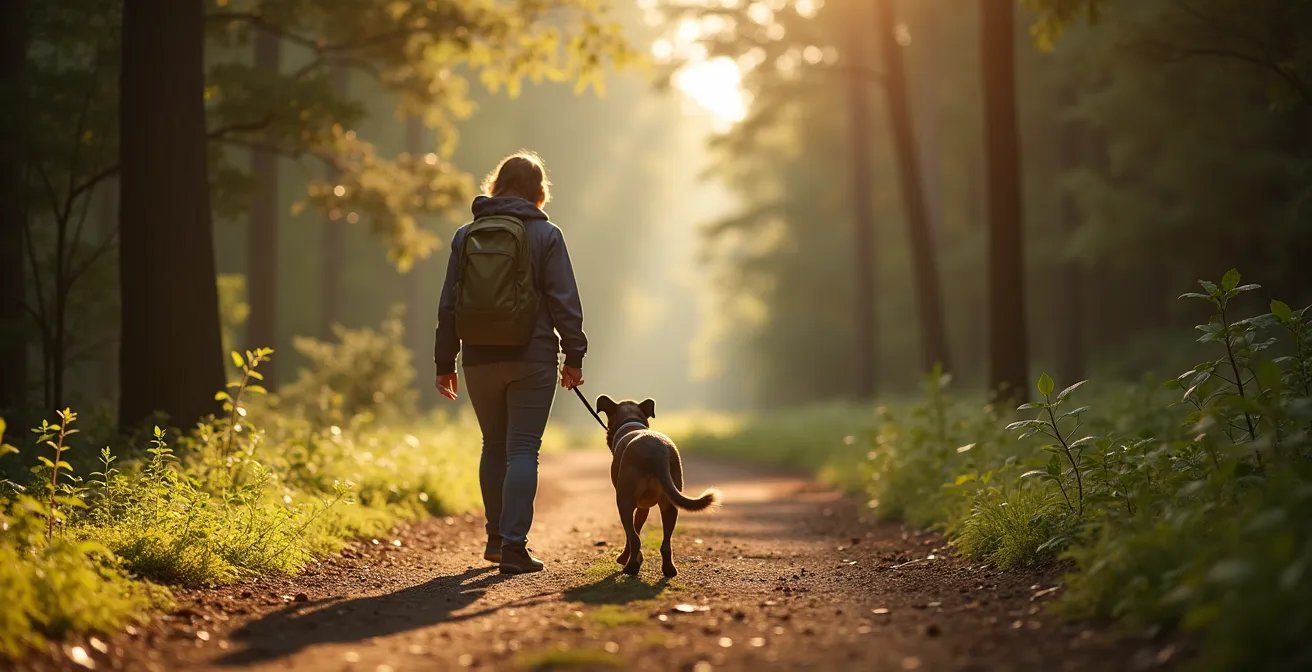
As this image suggests, true enrichment often comes from calm exploration, not forced interaction. Prioritizing these activities over the dog park fosters a stronger bond and a more resilient, balanced dog.
By choosing environments that set our dogs up for success, we build their confidence rather than shattering it.
Coffee Shop Training: Teaching Your Dog to Do Nothing in Public
The pinnacle of environmental neutrality is not a dog who can play with everyone, but a dog who can settle calmly on a mat at a busy coffee shop patio, observing the world without needing to react. This “skill of doing nothing” is an advanced concept that requires building a strong foundation of duration, distraction management, and calmness. It is the ultimate test of true socialization, demonstrating that the dog sees people, noises, and other dogs as irrelevant background information.
Achieving this level of calm requires a systematic approach; you cannot simply show up at a café and expect your dog to relax. The training begins at home, in a zero-distraction environment, teaching the dog to go to a mat and stay there for increasing periods. This “place” or “mat” cue becomes a portable safe space for your dog. Once the behavior is solid at home, you gradually introduce low-level distractions, like practicing in your yard or on a quiet sidewalk.
Only after the dog can hold a settle with mild distractions do you move to the “real world.” This is done in stages, starting far away from the source of the activity. For example, your first session might be at a table across the street from the coffee shop during its quietest hours. The goal is many short, successful sessions, not one long, failed one. You are teaching your dog that in the presence of high activity, the correct and most rewarding behavior is to relax. This structured approach is why an overwhelming majority of owners, 82%, recognize that professional training is essential for a well-behaved pet; it provides the proven, step-by-step protocols necessary for success.
Action Plan: Café Matrix Protocol for Progressive Public Training
- Week 1: Practice mat work at home with zero distractions – build 10-minute duration.
- Week 2: Mat work in your yard or quiet outdoor space – maintain duration despite mild distractions.
- Week 3: Practice outside a closed café during off-hours – dog learns to settle near the environment.
- Week 4: Distant table during the café’s quietest time (e.g., 2-4 pm) – 5-minute sessions initially.
- Week 5: Gradually move to busier times while maintaining distance from high-traffic areas.
- Week 6: Progress to normal seating areas during moderate activity – celebrate calm observation.
This skill is not only impressive but is the true mark of a dog who is confident and at ease anywhere you take them.
Why You Should Pause Socialization Outings During a Fear Period?
Puppy development is not a linear progression of growing confidence. It’s punctuated by distinct developmental stages, including “fear periods.” These are temporary phases where a puppy may suddenly show intense fear towards things they previously ignored, such as a trash can, a person in a hat, or a plastic bag blowing in the wind. The first major fear period typically occurs between 8-11 weeks, with a second, more significant one happening during adolescence, anywhere from 5 to 18 months.
During a fear period, the puppy’s brain is neurologically primed to form lasting negative associations from a single scary event. A negative experience that a puppy might have shaken off a week earlier could now create a lifelong phobia. Pushing a puppy through “socialization” outings during this sensitive time is one of the most detrimental things an owner can do. Forcing them to confront their fears will not make them braver; it will validate their fear and teach them that their owner will not protect them from perceived threats.
The correct strategy is to pause and pivot. This doesn’t mean stopping all training. It means shifting the focus from public exposure to confidence-building activities in a safe, controlled environment like your home. This is a crucial time to build your dog’s problem-solving skills and body awareness, which directly contributes to their overall confidence. When you do go out, keep walks short, familiar, and positive. Avoid new, unpredictable environments until the period has passed.
Action Plan: Fear Period Activity Menu for Home Confidence Building
- Nose work games: Hide treats around the house to build confidence through successful searching.
- Trick training: Teach low-pressure tricks like ‘spin’ or ‘paw’ to maintain learning without stress.
- Proprioception exercises: Use unstable surfaces (cushions, balance discs) to build body awareness.
- Puzzle toys: Rotate different food puzzles to maintain mental stimulation safely at home.
- Gentle handling practice: Brief, positive sessions of paw touches and ear checks with high-value rewards.
By managing the environment and focusing on confidence-building, you can navigate these tricky phases and emerge with a more resilient and trusting dog.
Why Is Your 5-Month-Old Puppy Suddenly Scared of Trash Cans?
You’re on a familiar walk when your 5-month-old puppy, who has passed the same trash can a hundred times, suddenly slams on the brakes, hair raised, and starts barking at it as if it’s a monster. This baffling and common scenario is a classic sign of the adolescent fear period. It’s not a regression in training or a sign of a “bad” dog; it is a normal, albeit challenging, developmental stage. As puppies transition into adolescence, their perception of the world shifts from one of naive curiosity to a more cautious, survival-oriented mindset.
This is a biologically hardwired process. In the wild, this is the age when a young canine would start venturing further from the den, and a healthy dose of suspicion towards novel things would be crucial for survival. As the Animal Humane Society explains, this is a predictable part of development. Their guide notes:
Starting around 5 months old, your dog may start to interpret anything unfamiliar as a threat and will typically either flee or confront what frightens him. Punishing this reaction will only confirm his fear.
– Animal Humane Society, Socializing Your Dog Guide
Punishing the fear or forcing the puppy to approach the “scary” object is counterproductive. It validates their fear and damages their trust in you. The best approach is to increase distance until the puppy is calm and then turn the situation into a positive training game, like “Look At That” (LAT).

This intense, curious gaze captures the internal conflict of a puppy in a fear period. Your role is to build positive associations, not force confrontation. The LAT game teaches the puppy that looking at the scary thing and then looking back at you is a highly rewarding behavior. It shifts their emotional response from fear to one of optimistic anticipation.
Action Plan: ‘Look At That’ (LAT) Protocol for Fear Management
- Position yourself at a distance where your puppy notices the scary object but isn’t panicking.
- The moment your puppy looks at the object, mark with ‘yes!’ in a happy voice.
- Immediately deliver a high-value treat while the puppy is still calm.
- If the puppy looks at the object again, repeat marking and rewarding.
- Gradually decrease distance only when the puppy actively seeks to ‘play’ the looking game.
- Apply this same protocol to any novel scary item: statues, people in hats, or plastic bags.
By responding with patience and positive training instead of force, you can help your puppy navigate this phase and build lasting confidence.
Finding the ‘Working Distance’: How Far Is Far Enough?
One of the most critical skills in modern dog training, especially when working with fearful or reactive dogs, is understanding and respecting the concept of “threshold.” A dog’s threshold is the point at which they transition from being able to think and learn to being overwhelmed and reactive. The “working distance” is the space you need to maintain from a trigger (another dog, a person, etc.) to keep your dog “sub-threshold,” or in a calm, thinking state. Simply put, far enough is whatever distance allows your dog to notice the trigger without reacting.
This distance is not a fixed number; it is dynamic and can change daily based on numerous factors. This is a concept that many owners struggle with, as they expect linear progress. However, as research from Off Leash K9 Training on reactive dogs has shown, this is a fallacy.
Case Study: Dynamic Threshold Research in Reactive Dogs
Off Leash K9 Training documented that working distance is not static but changes based on multiple factors. Their research with reactive dogs showed threshold distances could vary by 50% or more depending on trigger stacking from earlier encounters, the dog’s baseline stress level, time of day, and trigger intensity. A dog comfortable at 20 feet from a calm, sitting dog might need 50+ feet from a running, barking dog. This emphasizes the need for handlers to continuously assess and adjust distance rather than applying fixed measurements.
Learning to read your dog’s subtle body language is the only way to know if you are at an appropriate working distance. Before a dog barks or lunges, they offer a cascade of quieter signals: a closed mouth, a stiffening body, a hard stare, or “whale eye” (showing the whites of their eyes). Ignoring these signals and pushing the dog closer is what leads to explosive reactions. The ability to recognize these early warnings allows you to create distance and prevent the dog from going “over threshold.”
| Body Part | Below Threshold (Good) | At Threshold (Caution) | Over Threshold (Too Close) |
|---|---|---|---|
| Mouth | Soft, may be slightly open | Closing, occasional lip licks | Tight, panting, or showing teeth |
| Ears | Neutral or relaxed position | Alert, forward or back | Pinned back or rigidly forward |
| Body | Loose, fluid movement | Starting to stiffen | Rigid, frozen, or lunging |
| Eyes | Soft, occasional glances | Focused stare, dilated pupils | Hard stare, whale eye visible |
| Response to treats | Takes treats gently | Takes roughly or hesitates | Refuses treats completely |
All effective training happens below threshold. If your dog is reacting, you are too close. The first step is always to create more distance.
Key Takeaways
- True socialization is about teaching environmental neutrality, not forcing interaction.
- Quality of exposure (calm, controlled) is far more important than quantity (chaotic, overwhelming).
- Leash reactivity is often a symptom of improper socialization techniques, such as forced greetings and dog park flooding.
Leash Reactivity: Is It Fear, Frustration, or Aggression?
Leash reactivity—the barking, lunging, and growling behavior directed at other dogs, people, or objects while on a leash—is an epidemic in the dog world. It’s a stressful and embarrassing problem for owners, and it’s a clear sign that the dog is emotionally overwhelmed. In fact, industry trends show that professional trainers are seeing that 63% of them report increased demand for reactive dog training programs. This behavior is rarely born from true “aggression” in the way most people think of it. It is almost always a symptom of a deeper emotional state: fear or frustration.
Understanding the underlying emotion is the first step toward creating an effective behavior modification plan. A dog lunging and barking out of fear is trying to create distance and make the scary thing go away. Their body language is often defensive (cowering, tail tucked). A dog lunging and barking out of frustration is often desperate to get closer and greet the other dog, a behavior often created by a history of being allowed to pull towards and greet every dog they see. Their body language may look more “excited” or conflicted (play bows mixed with tense lunges). Both look similar from the outside but require different approaches.
The leash itself is a huge contributing factor. It prevents the dog from using its natural communication and coping mechanisms, such as creating an arc to greet another dog or simply moving away if uncomfortable. This barrier frustration, combined with an owner’s tension traveling down the leash, creates a perfect storm for an explosive reaction. The key to addressing leash reactivity is not to punish the barking, but to change the dog’s underlying emotional response to the trigger through counter-conditioning and desensitization, always working from a safe distance.
To differentiate between the root causes, a careful observation of the dog’s complete body language is necessary, as different motivations produce distinct clusters of signals.
| Type | Body Language | Vocalizations | Movement Pattern | Typical Trigger |
|---|---|---|---|---|
| Fear-Based | Cowering, tail tucked, ears back | Low growls, defensive barking | Trying to increase distance, backing up | Unfamiliar dogs/people approaching |
| Frustration | Pulling forward, play bow attempts | High-pitched whining, excited barking | Lunging toward trigger, jumping | Seeing dogs they want to greet |
| Fear-Aggression | Stiff posture, raised hackles | Deep growls, explosive barking | Forward offensive lunge then retreat | Perceived threats when escape blocked |
| Mixed Response | Conflicting signals, stress indicators | Variable pitch, intensity changes | Approach-avoidance conflict | Chronic frustration evolving to fear |
By addressing the root cause—the fear or frustration—instead of just the symptom, you can begin the journey of helping your dog feel safe and calm on walks again.