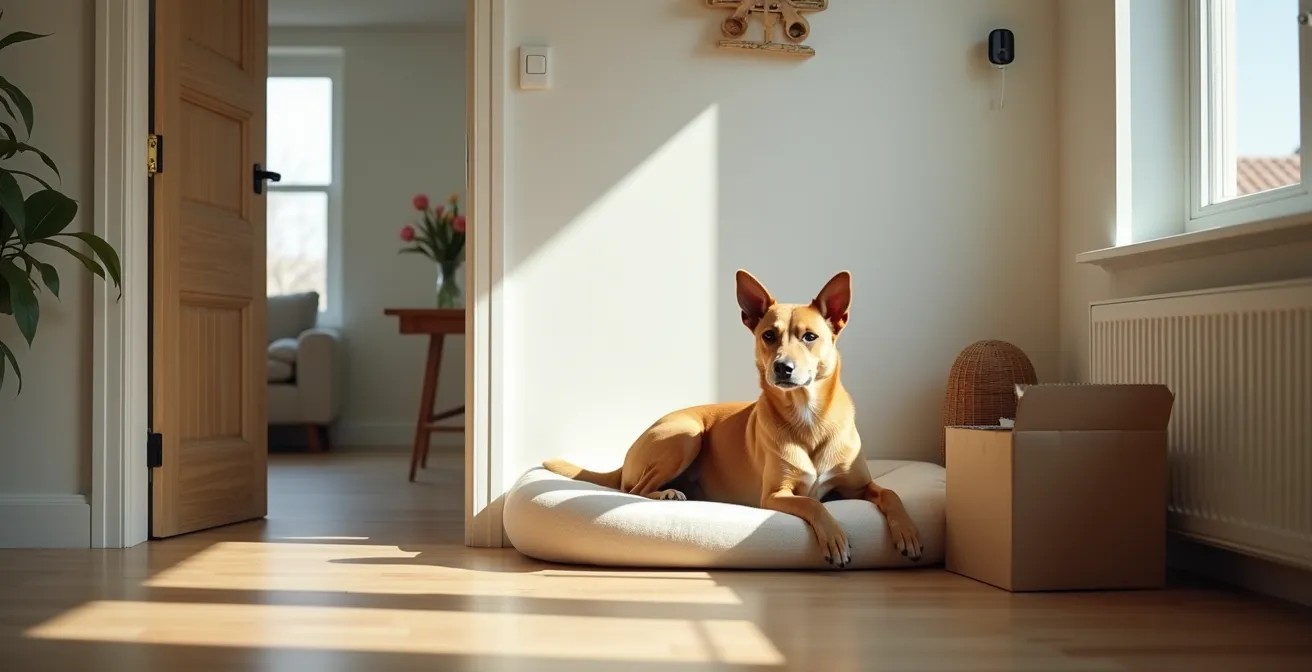
The key to solving your dog’s destructive behavior is accurate diagnosis: video evidence reveals whether the root cause is a clinical panic disorder (separation anxiety) or a need for mental stimulation (boredom).
- Separation anxiety is characterized by distress behaviors occurring within minutes of departure, often targeting exits.
- Boredom-related destruction typically happens hours after you leave and is focused on accessible, “fun-to-shred” items.
Recommendation: Before starting any training, record the first 60 minutes of your dog’s time alone. This diagnostic footage is the most critical tool for creating an effective treatment plan.
Discovering a shredded sofa or a scratched doorframe upon returning home is a deeply frustrating experience for any dog owner. The immediate question is always “Why?” The common advice is often a confusing mix of suggestions: more exercise, a tougher crate, or a puzzle toy. While well-intentioned, this advice fails to address the fundamental diagnostic question: are you dealing with a dog who is bored, or a dog who is having a clinical panic attack? Treating one like the other is not only ineffective but can make the underlying problem significantly worse. Many owners assume their dog is acting out of spite or a lack of training, but this is rarely the case.
The truth is, you cannot manage what you do not correctly identify. The difference between isolation distress (a true panic disorder) and boredom is not a matter of opinion but of observable, time-sensitive behavioral patterns. This is where using video as a diagnostic tool becomes non-negotiable. It moves you from guessing to knowing. Instead of focusing on generic solutions, the clinical approach is to first establish a behavioral baseline and identify specific triggers and symptom clusters that point definitively toward one condition or the other. Is the dog’s ‘hyper-attachment’ a sign of affection or a precursor to panic?
This article provides a clinical framework for using simple video technology to analyze your dog’s behavior when left alone. We will deconstruct the behavioral cues, explain the gold-standard training methodologies for true separation anxiety, and clarify when medication or specific enrichment strategies are appropriate. By learning to interpret your dog’s actions through the lens of a behaviorist, you can finally implement a targeted, effective, and humane solution. You will learn to differentiate panic from mischief and chart a clear path forward.
This guide will walk you through the essential steps, from identifying subtle panic triggers to structuring a safe and effective enrichment plan. Below is a summary of the key areas we will cover to help you become a more informed observer of your dog’s behavior.
Summary: A Clinical Guide to Canine Separation Anxiety and Boredom
- Why Picking Up Your Keys Triggers a Panic Attack?
- The “Yo-Yo” Method: Increasing Absence by Seconds, Not Minutes
- When to Ask Your Vet for Anti-Anxiety Meds for Training Success?
- Camera Placement: What Your Dog Does When You Are Out of Frame?
- Why Does Your Dog Follow You Everywhere: Anxiety or Affection?
- Destruction Box: Channeling the Need to Shred Safely
- Returning to Work: How to Transition From Remote Work to Office Days?
- Passive vs. Active Enrichment: Balancing the Mental Diet
Why Picking Up Your Keys Triggers a Panic Attack?
For a dog with separation anxiety, your departure routine is not a series of random actions but a predictable sequence that culminates in the terror of being left alone. This is classical conditioning in action. The sound of keys jingling, the act of putting on a specific pair of shoes, or even walking towards the door become pre-departure cues. These cues function as triggers, initiating a cascade of stress hormones like cortisol and adrenaline long before you actually leave. The dog isn’t being “dramatic”; their brain has formed a powerful association between these seemingly innocent actions and the imminent onset of a panic state.
The goal of a behaviorist is to deconstruct this sequence through a process of desensitization and counter-conditioning. This involves systematically exposing the dog to these triggers without the associated negative outcome (your departure). By picking up your keys and then sitting down to watch TV, or putting on your coat and then starting to cook, you begin to break the predictive link. The trigger no longer reliably forecasts abandonment, and its power to induce panic diminishes. This must be done carefully, always staying below the dog’s distress threshold—the point at which anxiety becomes visible. The first step is to identify precisely which parts of your routine are the most potent triggers by observing your dog’s reaction to each one in isolation.
The “Yo-Yo” Method: Increasing Absence by Seconds, Not Minutes
The cornerstone of treating true separation anxiety is sub-threshold training. This means all training exercises are conducted at a level of intensity that does not trigger the dog’s panic. The common mistake owners make is increasing absence durations too quickly, often in increments of minutes. This inevitably pushes the dog over their distress threshold and reinforces their fear. The correct, clinical approach is to increase absences by mere seconds at a time. This is often called the “Yo-Yo” or “non-linear” method, where you systematically vary the duration of your departures: five seconds out, two seconds back, ten seconds out, one second back.
This variability is crucial because it prevents the dog from anticipating a pattern. If you always increase the time, the dog learns to expect that each absence will be longer and more stressful than the last. Randomizing the duration keeps them guessing and, more importantly, keeps them calm. The goal is to have hundreds of successful, panic-free “departures” of varying short lengths, rather than a few failed attempts at longer ones. Progress is not a straight line; it involves frequent steps back to previously successful durations to solidify the dog’s confidence. This process requires patience and the use of a camera to ensure the dog remains calm and relaxed throughout every single repetition.

As one expert notes, the path to recovery is rarely linear. Shoshi Parks, a Certified Separation Anxiety Trainer, emphasizes the nature of this process in her guide for Rover.com:
The dog will eventually be able to cope to the situation. In 95% of the separation anxiety/isolation distress cases I work with, training is not a straight line. What we are looking for is gradual improvements over time; a general trend of moving towards longer and longer absences.
– Shoshi Parks, Ph.D., CPDT-ka, CSAT, Rover.com Expert Guide to Training
When to Ask Your Vet for Anti-Anxiety Meds for Training Success?
Behavioral medication is not a “cure” for separation anxiety, but it can be an indispensable tool for facilitating successful training. For some dogs, their level of panic is so high that they are physiologically incapable of learning. Their brain is in a state of fight-or-flight, making it impossible to process the lessons of desensitization and counter-conditioning. In these cases, asking your veterinarian about anti-anxiety medication is not a sign of failure but a strategic step toward success. The medication’s role is to lower the dog’s baseline anxiety to a point where they can remain below their distress threshold and engage in the learning process.
Research consistently shows that a combination of medication and a structured behavior modification plan yields the best results. For example, a study on the use of fluoxetine, a common SSRI, found that over 73% of dogs on fluoxetine combined with behavior modification showed significant improvement within eight weeks. It’s critical to understand that there are different classes of medication for different purposes, a choice that should be made in consultation with your vet.
The following table, based on information from veterinary professionals at DVM360, outlines the primary types of medications used. This illustrates why a veterinary consultation is essential to select the right pharmacological support for your dog’s specific needs, as outlined in a comprehensive guide for prescribing veterinarians.
| Medication Type | Examples | Use Case | Onset Time |
|---|---|---|---|
| Long-term SSRIs | Fluoxetine (Reconcile), Sertraline | Daily use for severe, generalized anxiety | 4-8 weeks for full effect |
| Situational/Short-term | Trazodone, Gabapentin | Specific triggers, given 90 min before event | 1-2 hours |
| Tricyclic Antidepressants | Clomipramine (Clomicalm) | Daily use, FDA approved for separation anxiety | 4-6 weeks |
| Benzodiazepines | Alprazolam, Clonidine | Acute panic, given 30-60 min before | 30-60 minutes |
Camera Placement: What Your Dog Does When You Are Out of Frame?
Without video, you are working blind. A camera is the single most important diagnostic tool in differentiating separation anxiety from other issues like boredom or frustration. The footage provides objective data on the timing, nature, and intensity of your dog’s distress. A dog with separation anxiety will typically begin showing signs of panic—such as pacing, whining, howling, or drooling—within minutes of your departure. Destruction is often focused on exit points like doors and windows. In contrast, a bored dog might sleep for an hour, wake up, and then casually begin to chew on an accessible object.
Effective camera placement is key to gathering useful diagnostic footage. You need a wide-angle view that covers the primary exit door as well as common “problem” areas (like the sofa or a specific corner where urination occurs). You don’t need to record the entire day; the most critical period for diagnosis is the first 30-60 minutes after you leave. Analyzing this footage allows you to create a behavioral timeline. At what minute mark does the panting start? Does the whining escalate into barking? Does the dog attempt to escape or settle down? This data is invaluable for establishing a baseline and measuring progress during your sub-threshold training.
Action Plan: Camera Setup and Analysis Guide
- Position the camera with a wide-angle view covering exit doors and any common areas of destruction or elimination.
- Record at least the first 30-60 minutes after your departure to capture the peak period for distress behaviors.
- Use a time-lapse feature if available to quickly review longer periods of footage for patterns of activity versus rest.
- Document specific behaviors observed and their timing: note pacing patterns, types of vocalization (whine, bark, howl), and any escape attempts.
- Create a simple “behavioral heatmap” by noting where the dog spends the most time during your absence to identify areas of high anxiety.
Why Does Your Dog Follow You Everywhere: Anxiety or Affection?
A dog that follows you from room to room, often called a “Velcro dog,” can be showing deep affection, but it can also be a primary symptom of underlying separation anxiety. The key difference lies in the dog’s emotional state during this behavior. Is the dog relaxed and casually choosing to be near you, or are they tense, vigilant, and unable to settle if you are out of sight? This hyper-attachment is problematic when the dog is not just seeking proximity but is actively monitoring you, unable to relax for fear you might disappear.
A simple diagnostic exercise is the Doorway Distress Test. When you go into the bathroom, close the door as you normally would. A dog with healthy attachment might wait calmly outside or wander off. A dog with incipient separation anxiety will likely show immediate, low-level distress: whining, scratching at the door, or anxiously listening for your return. Their inability to tolerate even a momentary, predictable separation is a significant red flag. This isn’t just about love; it’s an inability to self-soothe and feel secure when alone. In a clinical context, a healthy dog’s behavior in the owner’s absence is marked by inactivity. As a comprehensive research review in PMC notes:
Dogs without separation anxiety are passive and inactive in their owner’s absence, and the initially anxious behavior of puppies separated from their owners has been found to decrease quickly after adoption.
– Research review, PMC – Canine Separation Anxiety Study
Training a “place” or “stay” command with high-value rewards while you move around the house is a core component of treatment. This teaches the dog that they can remain calm and stationary while you are briefly out of sight, building their tolerance for separation in a controlled, positive way.
Destruction Box: Channeling the Need to Shred Safely
If your video analysis reveals that destruction occurs hours after you’ve left and seems exploratory rather than frantic, you are likely dealing with boredom, not panic. A bored dog needs a job to do and an appropriate outlet for their physical and mental energy. For dogs that find joy in shredding, a “destruction box” is an excellent management tool. This is simply a cardboard box filled with safe-to-shred, non-ingestible items like paper towel rolls, egg cartons, and packing paper.
The key is to make this activity more rewarding than chewing on your furniture. You can hide high-value treats or their regular kibble between the layers of paper and cardboard, turning it into a foraging game. It’s crucial to introduce the destruction box when you are home and can supervise, presenting it as a fun, interactive toy. This prevents the box itself from becoming a pre-departure cue that signals your absence. For a bored dog, providing a sanctioned outlet for natural behaviors like ripping, tearing, and shredding can easily solve the problem. However, this is not a solution for separation anxiety. For an anxious dog, a destruction box is just another object in the environment they will ignore while they focus on their panic.
As experts at Positively.com explain, the timing of the destruction is the critical differentiating factor. Their analysis highlights this clear distinction:
If barking, whining and destruction are severe within the first 30 minutes of departure, that indicates separation distress. If the dog goes to sleep after you leave then wakes up and chews, the behavior is more likely due to boredom.
To implement this strategy safely, fill the box with items like cardboard tubes and paper bags, rotate the contents to maintain novelty, and always monitor via camera initially to ensure the dog chooses the box over other household items.
Returning to Work: How to Transition From Remote Work to Office Days?
The widespread shift to remote work followed by a return to the office created a perfect storm for a spike in separation anxiety cases. Dogs that were accustomed to constant companionship suddenly faced long hours alone. This is a significant environmental change that requires a proactive and gradual transition plan to prevent the onset of separation anxiety, a condition that up to 20% of the entire dog population is estimated to suffer from. Simply leaving for an eight-hour workday after two years of being home is a recipe for distress.
The solution is to simulate the “return to office” schedule in gradual, controlled steps long before it actually happens. This process mirrors the sub-threshold training used for existing anxiety. Start by creating separation while you are still in the house, such as working in a separate room with the door closed for increasing durations. Progress to short trips outside to the garden or garage, then brief drives around the block. The goal is to slowly acclimate your dog to being alone again, ensuring they remain calm at each stage. Utilizing dog walkers or daycare for partial days initially can also help ease the transition and prevent a full day of solitude from becoming overwhelming.
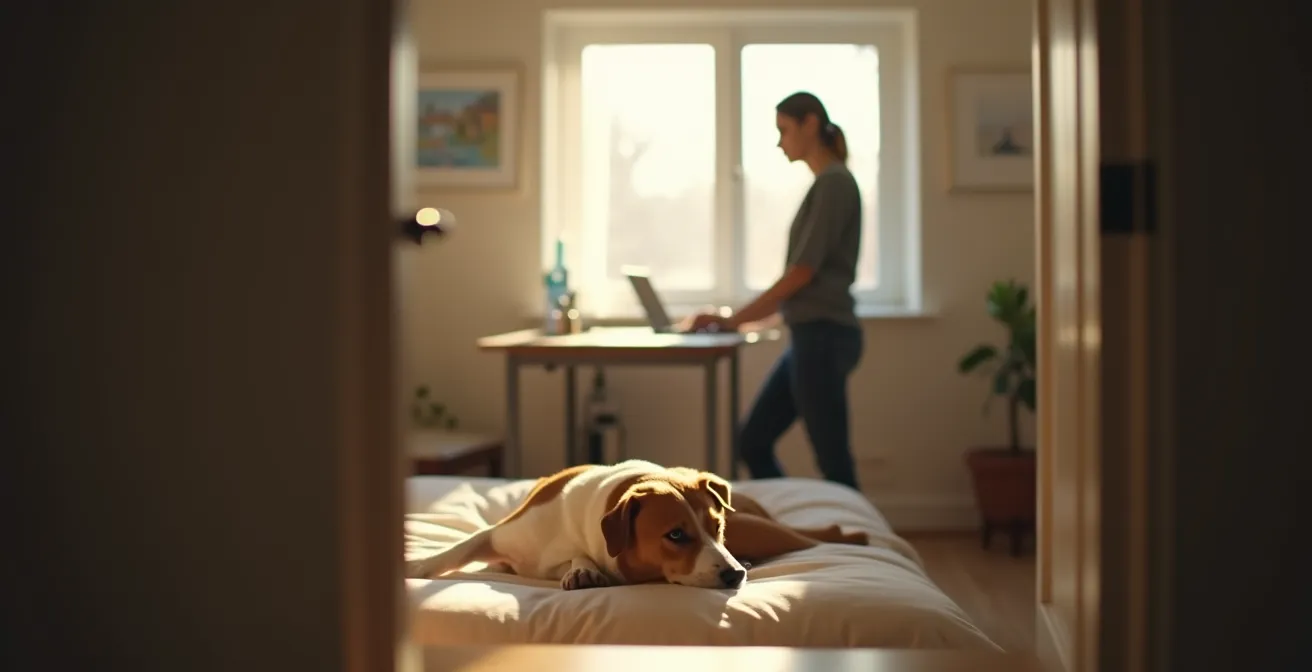
This gradual reintroduction to being alone helps rebuild your dog’s confidence and independence. The process should span several weeks, starting with just minutes of separation and slowly building up to hours. Rushing this transition is the most common cause of regression or the development of new anxiety issues. Patience and a clear, incremental plan are your best tools for a smooth and stress-free return to the office for both you and your dog.
Key Takeaways
- Timing is the Telltale Sign: Panic-driven destruction happens within minutes of departure, while boredom-driven chewing occurs hours later.
- Focus on Exits vs. Objects: Anxious dogs often try to escape by destroying doors and windows; bored dogs typically shred accessible, “fun” items.
- Video is Not Optional: Objective video evidence is the only reliable way to distinguish between a clinical panic disorder and a lack of stimulation.
Passive vs. Active Enrichment: Balancing the Mental Diet
Enrichment is a critical component of any behavior plan, but it’s vital to distinguish between passive and active forms, especially for an anxious dog. Passive enrichment refers to activities a dog can engage with on their own, such as a food-stuffed puzzle toy, a lick mat, or a snuffle mat for scent work. These are excellent tools for encouraging calm, focused behavior and can help a bored dog pass the time. The act of licking, in particular, has been shown to release endorphins, which have a naturally calming effect. For a dog with mild anxiety, a frozen Kong can provide a soothing activity to focus on as you depart.
However, for dogs with moderate to severe separation anxiety, passive enrichment is often insufficient and can even be ignored. Their panic is too overwhelming to allow them to engage with a toy. This is where active enrichment—activities you do with your dog—becomes paramount. This isn’t about tiring the dog out physically but about building their mental resilience. The most important form of active enrichment for an anxious dog is calmness training, such as Dr. Karen Overall’s Relaxation Protocol.
Case Study: Dr. Karen Overall’s Relaxation Protocol
This renowned protocol is a form of active enrichment that directly builds a dog’s ability to remain calm during periods of separation. It involves a series of 15 structured tasks that systematically teach a dog to stay in a relaxed “down” position while the owner performs increasingly distracting actions, like walking around the room, clapping, or briefly stepping out of sight. The protocol starts with very simple steps, like taking one step away and returning, and gradually progresses to tasks like knocking on the door or leaving the room for 30 seconds. By rewarding the dog for maintaining a calm state through these small, controlled stressors, the protocol builds a powerful foundation of self-regulation that is essential for overcoming separation anxiety.
The ideal mental diet for any dog, especially one prone to anxiety, is a balance of both. Passive enrichment provides healthy outlets for a dog’s mind when alone, while active enrichment builds the core skills of confidence and self-control that prevent panic from taking hold in the first place.
By systematically applying these diagnostic and training principles, you move from a position of frustration to one of informed action. The key is to start with objective observation, proceed with a patient and incremental plan, and provide the right balance of management and training. Begin today by setting up a camera and gathering the data you need to truly understand your dog’s behavior.