
The most common puppy problems are not training failures; they are symptoms of a mismanaged socialization window.
- Effective socialization is not a frantic checklist of exposures but a strategic process of building your puppy’s emotional resilience.
- Understanding and managing your puppy’s energy, fear periods, and environment is more critical than teaching “sit” or “stay” in these early weeks.
- The goal before 16 weeks is to teach your puppy *how* to cope with the world, not just to see it.
Recommendation: Shift your focus from simple exposure to creating structured, positive experiences that build a lifetime of confidence. This guide is your roadmap.
That tiny, warm ball of fur in your arms represents boundless joy, but also a profound responsibility. As a new puppy owner, you’re likely flooded with advice, much of it conflicting, all of it urgent. You hear about house training, crate training, and obedience, but one timeline looms larger than all others: the critical socialization window, which slams shut around 16 weeks of age. The pressure to “get it right” is immense, and the fear of creating a difficult adult dog is very real. Many owners fall into the trap of either frantically trying to expose their puppy to everything, or keeping them in a bubble until vaccinations are complete, both of which can have damaging consequences.
The common wisdom often centers on checklists: “expose your puppy to 100 people,” “let them meet dozens of dogs.” But what if this approach is fundamentally flawed? What if the key isn’t the sheer quantity of experiences, but the *quality*? This guide offers a different perspective. We propose that the primary goal of this critical period is not just exposure, but the strategic development of your puppy’s emotional resilience. It’s about teaching your puppy how to handle surprises, bounce back from a scare, and navigate the world with confidence rather than fear.
This isn’t about throwing your puppy into the deep end. It’s about being their trusted guide, managing their environment, and building a “confidence bank” of positive experiences they can draw on for the rest of their lives. Throughout this article, we will deconstruct common puppy problems—from sudden fears and potty accidents to biting and recovery from surgery—and reframe them as opportunities to build that crucial resilience. This is your urgent, structured plan to move beyond the fear of messing up and start building the well-adjusted, confident companion you’ve always wanted.
To navigate this critical period effectively, this article is structured to address the most pressing challenges you’ll face. Each section tackles a common puppy issue, revealing how it connects to the larger goal of building a resilient and well-behaved dog.
Summary: The Critical Socialization Window: What to Do Before Week 16?
- Why Is Your 5-Month-Old Puppy Suddenly Scared of Trash Cans?
- How to Break the Cycle of Nighttime Accidents in Crate Training?
- Redirecting vs. Ignoring: Which Stops Puppy Biting Faster?
- The Calcium Danger: Why You Must Not Supplement Large Breed Puppies
- When Is It Safe to Let Your Puppy Walk on Public Sidewalks?
- Why You Should Pause Socialization Outings During a Fear Period?
- Timeline for Spay Recovery: What to Expect Day by Day?
- How to Rewire Reactive Behaviors Without Force in Adult Dogs?
Why Is Your 5-Month-Old Puppy Suddenly Scared of Trash Cans?
Just when you think you’re past the fragile puppy stage, it happens. Your confident 5-month-old, who previously ignored the trash can, suddenly barks, lunges, or cowers at its sight. This is not a regression; it’s a completely normal, yet often misunderstood, developmental stage known as the second fear period. While puppies experience their first fear period around 8-11 weeks, a second one typically emerges between 6 and 14 months as their perception of the world matures. An object that was once just part of the background is now seen with new, more discerning eyes, and sometimes, that new perception is “danger.”
Your response is critical. Forcing your puppy to confront the object will only validate their fear and damage their trust in you. Yelling at them for barking reinforces a state of high arousal. Instead, this is a prime opportunity to build emotional resilience. The goal is to change their emotional response from “That’s terrifying!” to “That thing predicts awesome stuff happens!” This process, known as counter-conditioning and desensitization, empowers your puppy by teaching them they have control and that scary things can become good things. It’s a foundational skill that will serve them for a lifetime when encountering new, potentially frightening stimuli.
Action Plan: The Deconstruction & Association Method
- Start at a distance where your puppy notices the trash can but isn’t fearful (this may be 20+ feet away).
- Reward any calm observation (a glance without reacting) with a high-value treat, like a tiny piece of chicken.
- Practice the “look at that” game: reward your puppy for looking at the object and then immediately looking back at you.
- Gradually decrease the distance over multiple short sessions, spanning days or even weeks. Never rush this process.
- Once close, add controlled movement. With the can empty, gently roll it a tiny bit from a distance and reward a calm response.
- Introduce sound separately. While your puppy is engaged in a fun activity elsewhere, have someone tap the lid softly from another room.
By breaking down the “scary thing” into its smallest, non-threatening parts (sight, sound, movement) and pairing each with something wonderful, you are systematically rewiring your puppy’s brain. You’re not just fixing a fear of trash cans; you’re giving your puppy a blueprint for how to handle the unknown with confidence.
How to Break the Cycle of Nighttime Accidents in Crate Training?
Night after night, you’re woken up by a whining puppy and the disheartening discovery of another accident in the crate. It’s easy to assume the cause is a small bladder or a failure in house-training. However, persistent nighttime accidents are often a symptom of something else: stress and over-arousal. A puppy who goes into the crate feeling anxious or overly stimulated will struggle to settle into the deep sleep necessary for their body to manage bladder control. In fact, research shows that stress hormones like cortisol decrease during the REM sleep that a calm puppy can achieve, but an anxious puppy’s elevated cortisol can interfere with this process.
The solution isn’t to limit water or hope they “grow out of it.” The key is to implement a dedicated pre-bedtime decompression protocol. The hour before bed should be a predictable, calming ritual designed to lower arousal and prepare your puppy’s brain and body for rest. This shifts the focus from “containing” the puppy to actively helping them transition into a restful state. This routine makes the crate a place of sanctuary, not a source of stress, which is fundamental to successful crate training and a dry night.
This calming routine should involve activities that encourage licking, chewing, or sniffing, which are naturally soothing behaviors for dogs. A great tool for this is a simple lick mat or a food-dispensing toy.

As you can see, the act of focusing on a simple, rewarding task helps the puppy’s mind settle. Avoid high-energy games like fetch or wrestling right before bed. Instead, opt for a slow, sniffy walk, a gentle massage, or quiet time with a chew toy. This routine, performed consistently every night, becomes a powerful signal to your puppy that it’s time to wind down, making deep sleep—and a dry crate—far more attainable.
By treating nighttime accidents as a communication of stress rather than defiance, you can address the root cause. A calm puppy is a puppy who can sleep soundly, and a puppy who sleeps soundly is a puppy who can wake up clean and happy.
Redirecting vs. Ignoring: Which Stops Puppy Biting Faster?
Those needle-sharp puppy teeth on your hands, ankles, and clothes can be maddening. The common advice is split: some say to redirect the biting onto a toy, while others insist you should ignore the behavior by yelping or leaving the room. The truth is, there is no single “fastest” way; the most effective strategy depends entirely on the *reason* for the bite. Treating an over-tired, cranky nip the same as a demanding, attention-seeking bite will only lead to frustration for both of you.
Understanding the context is everything. This is where your role as a puppy detective comes in. Before you can choose the right response, you must learn to read the situation. Is your puppy getting wild-eyed and zoomy? That’s arousal biting. Are they calm and then suddenly bite you when you stop petting them? That’s likely demand biting. This nuanced approach is the cornerstone of teaching one of the most important lessons of puppyhood: bite inhibition. As explained by Harmony Diers, a veterinary technician at the Texas A&M School of Veterinary Medicine, this is about the puppy learning to control the pressure of their mouth.
Bite inhibition refers to a puppy learning how hard to bite their playmate based on the reaction they get from that playmate.
– Harmony Diers, Veterinary Technician, Texas A&M School of Veterinary Medicine
The different types of biting require different responses because they are driven by different needs. The following table breaks down the most effective, context-dependent strategies.
| Biting Type | Best Response | Why It Works | Avoid |
|---|---|---|---|
| Arousal/Play Biting | Redirect to appropriate toy | Channels energy into an acceptable outlet | Punishment or yelling |
| Demand/Attention Biting | Reverse Time-Out (owner leaves) | Removes reinforcement (attention) | Pushing away or engaging |
| Fear-Based Nipping | Create space, assess triggers | Reduces stress, prevents escalation | Forcing interaction |
| Overtired Biting | Enforce nap time in a quiet space | Addresses the root cause (exhaustion) | More stimulation/play |
Ultimately, a multi-faceted approach is fastest. You redirect play biting, remove attention for demand biting, and enforce naps for overtired biting. This teaches your puppy that their teeth are not a tool to get what they want from you, but are for appropriate things like toys and chews, all while strengthening your bond.
The Calcium Danger: Why You Must Not Supplement Large Breed Puppies
As a loving owner of a large or giant breed puppy, you want to do everything possible to ensure they grow up strong and healthy. You see their rapid growth and might be tempted to “help” by adding a calcium supplement to their diet. This is one of the most dangerous, albeit well-intentioned, mistakes you can make. The skeletal development of a large breed puppy is a finely-tuned biological process, and adding extra calcium can have catastrophic consequences.
The problem lies in the delicate balance between calcium and phosphorus. Reputable, commercially formulated large-breed puppy foods have been painstakingly designed by veterinary nutritionists to provide the exact ratio of these minerals needed for steady, healthy bone growth. When you add supplemental calcium, you disrupt this ratio. Excess calcium can interfere with the hormones that regulate bone development, leading to a cascade of potential orthopedic problems. This can include painful conditions like osteochondritis dissecans (OCD), hypertrophic osteodystrophy (HOD), and can contribute to the severity of developmental diseases like hip and elbow dysplasia.
Your job is not to play nutritionist. Your job is to select a high-quality food specifically labeled for “large breed puppies” and trust the science behind its formulation. These foods are designed to promote a slower, more controlled growth rate, which is essential for allowing their joints and bones to develop correctly without being put under excessive strain. Resisting the urge to supplement is a critical act of responsible ownership. You are not depriving your puppy; you are protecting them from a future of pain and costly veterinary bills.
Instead of supplements, focus your energy on maintaining a healthy, lean body condition for your puppy. Keeping them from becoming overweight is one of the most effective things you can do to protect their developing joints. Trust the food, watch their weight, and you will be providing the best possible foundation for a long, mobile, and healthy life.
When Is It Safe to Let Your Puppy Walk on Public Sidewalks?
This is the ultimate new puppy owner’s dilemma: your veterinarian advises keeping your puppy away from public areas until their vaccination series is complete (around 16 weeks), yet trainers and behaviorists stress the urgency of socializing them before that same deadline. This conflicting advice creates a paralyzing catch-22. The solution is to reframe the question. It’s not about *if* you should socialize before full immunity, but *how* you can do it safely. The risk of a puppy developing lifelong fear-based behavior problems from lack of socialization is generally considered higher than the risk of contracting a disease if proper precautions are taken.
The key is the “Four on the Floor” rule: socialization does not require your puppy’s paws to touch the ground in high-traffic public areas. Your goal is to provide positive sensory exposure to the sights, sounds, and smells of the world from a safe vantage point. This allows their brain to build a rich library of “normal” experiences without direct exposure to potential pathogens. You become their safe, mobile observation deck to the world.
Carrying your puppy is the number one tool in your safe socialization toolkit. A front-facing carrier, a sling, or even a pet-safe stroller allows your puppy to experience the world with the security of being close to you.
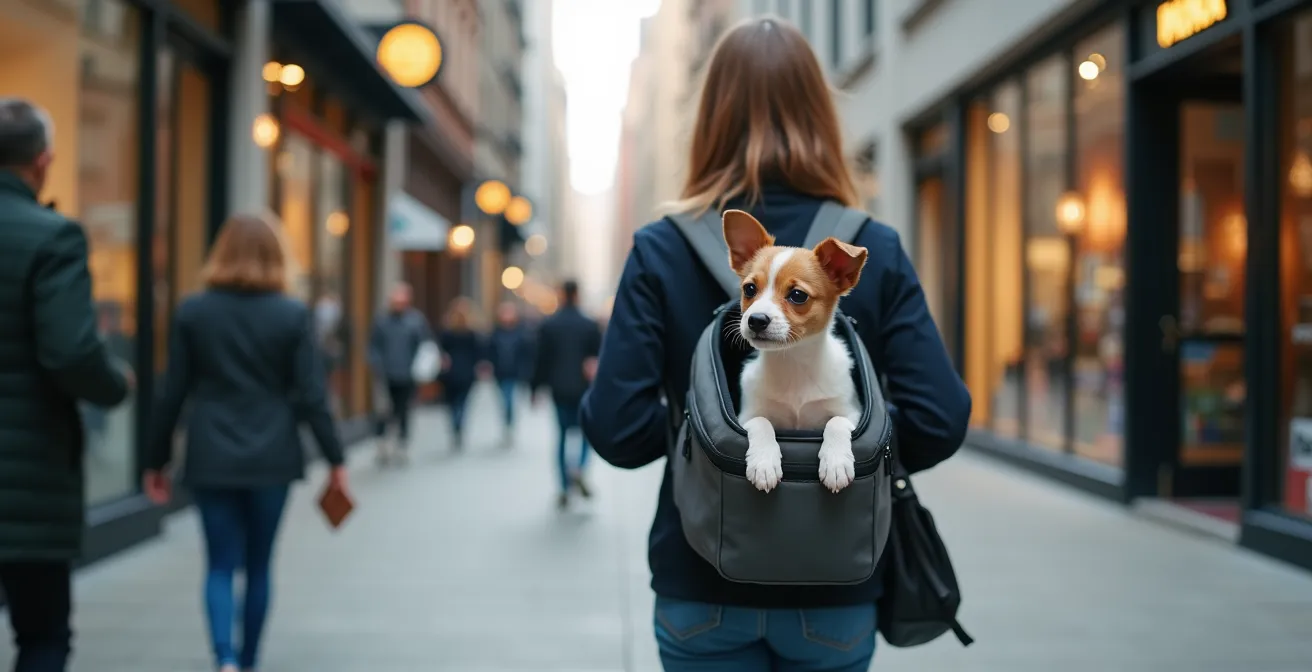
This approach allows you to take them almost anywhere. A trip to a pet-friendly hardware store, a bench outside a busy cafe, or a walk through a bustling neighborhood becomes a valuable and safe learning experience. The American Veterinary Medical Association’s position supports this balanced approach, emphasizing that puppies should experience the world at their own pace. Here are some ways to do it safely:
- Use puppy carriers or slings for walks in public spaces.
- Visit pet-friendly stores while carrying your puppy, allowing them to experience new sights and sounds without ground contact.
- Drive to different places (like a school during pickup time) and sit in the car with the windows down for sensory exposure.
- Set up a blanket in a quiet corner of a park for a controlled observation session.
- Arrange playdates with known, healthy, vaccinated, and friendly adult dogs in a safe, private yard.
By focusing on what you *can* do, you can confidently meet your puppy’s crucial developmental needs without compromising their physical health. You are building their confidence and teaching them that the world is an interesting, non-threatening place, all from the safety of your arms.
Why You Should Pause Socialization Outings During a Fear Period?
In the race against the 16-week clock, the instinct is to push forward relentlessly. If your puppy suddenly seems scared of things they were fine with yesterday, it feels counter-intuitive to stop. Shouldn’t you push through and show them it’s okay? The answer is an emphatic no. Pausing structured socialization outings during a fear period is not a setback; it is a vital, strategic move that protects your puppy’s long-term emotional health.
A fear period is a neurological event. It’s a time when a single frightening experience can have a lasting, traumatic impact. Forcing your puppy into a situation where they feel overwhelmed (like a busy farmer’s market or a crowded pet store) when they are already feeling anxious is like pouring gasoline on a fire. It can solidify a fear for life and, more importantly, it can teach your puppy a devastating lesson: that you, their trusted protector, will not listen to them when they are scared. This can severely damage your bond and their trust in you as a safe base.
The goal is to build resilience, not to test their breaking point. As noted by one research team, a puppy’s brain chemistry changes dramatically after this window closes. During the critical weeks, their brains produce higher levels of neurotransmitters that make them naturally curious. After 14-16 weeks, they become naturally more cautious. Pushing them when they are in a fear-based neurological state works against their biology. Pausing high-intensity outings doesn’t mean stopping socialization. It means shifting your focus to controlled, positive experiences in environments where your puppy feels secure. Work on counter-conditioning from a safe distance (like with the trash can example), visit a quiet park at an off-peak time, or simply have a positive one-on-one training session at home. Listening to your puppy’s subtle signals and honoring their need for a break is one of the most profound ways you can build their trust and confidence.
A day or two of quiet time at home is a small price to pay to prevent a lifetime of fear. True socialization is a dance, not a march. It requires you to be attuned to your partner and know when to take a step back, allowing them to regain their footing before continuing.
Timeline for Spay Recovery: What to Expect Day by Day?
Bringing your puppy home after her spay surgery can be nerve-wracking. She’s groggy, uncomfortable, and confined to strict rest for what feels like an eternity—often 10 to 14 days. This mandatory downtime, right in the middle of the critical socialization period, can feel like a major setback. But it doesn’t have to be. By understanding the recovery timeline and reframing “rest” as an opportunity for “calm enrichment,” you can continue to meet her developmental needs without compromising her physical healing.
The first few days are about managing pain and ensuring she doesn’t disturb her incision. Activity should be limited to short, leashed potty breaks. But as her energy returns, the challenge becomes keeping her mentally stimulated without allowing running, jumping, or rough play. This is where sensory socialization shines. Her body may need to be still, but her brain can still be busy and learning. The goal is to trade physical exercise for mental exercise. The recovery period is a timeline of gradually increasing activity, and you can pair each stage with appropriate, calm socialization activities.
Here is a general guide to what you can expect, though you should always follow your own veterinarian’s specific instructions. This table from VCA Animal Hospitals provides a helpful framework:
| Day | Physical Status | Activity Level | Socialization Options |
|---|---|---|---|
| Days 1-3 | Grogginess, tender incision | Strict rest, potty breaks only | Gentle petting, quiet voice work |
| Days 4-7 | More alert, incision healing | Short leash walks (5 min) | Scent games, puzzle feeders |
| Days 8-10 | Normal energy returning | Controlled indoor play | Training tricks (sit, down) |
| Days 11-14 | Incision closed, stitches ready | Gradual return to routine | Window watching, sound exposure |
During the most restrictive days (4-7), you can engage her senses without physical exertion. Try these sensory socialization activities:
- Hide treats around her recovery area for nose work.
- Play YouTube videos of different sounds (traffic, birds, vacuums) at a very low volume.
- Set up a comfy bed by a window for “window watching” sessions.
- Practice gentle handling: softly touching her paws, ears, and tail while she rests.
- Introduce new textures like a fleece blanket or a cooling mat to her rest area.
By focusing on what your puppy *can* do instead of what she can’t, you transform her recovery from a frustrating confinement into a period of calm learning and bonding. You are teaching her how to settle, engaging her brain, and continuing to build a positive association with new experiences, all while she heals safely.
Key Takeaways
- Resilience Over Exposure: The goal is not to show your puppy everything, but to teach them how to cope with novelty and recover from surprises.
- Manage the Environment, Not Just the Puppy: Your primary job is to control the distance, intensity, and duration of experiences to ensure they remain positive.
- Listen to Your Puppy: Pausing during a fear period or providing calming activities when they’re over-aroused is a sign of expert handling, not failure.
How to Rewire Reactive Behaviors Without Force in Adult Dogs?
When an adult dog lunges, barks, and snarls at the sight of another dog or a person, it’s often labeled as “aggression.” But in most cases, the behavior is rooted in something much simpler: fear. This reactivity is frequently the end result of a poorly managed or non-existent socialization period. It’s the adult manifestation of a puppy who was never taught emotional resilience. This is a form of behavioral forensics: tracing the problem behavior of today back to its origins in those critical first 16 weeks. A puppy who didn’t receive adequate positive exposure often grows into an adult who sees the world as a terrifying place, requiring a defensive posture to feel safe.
Rewiring this behavior is not about force, punishment, or “showing the dog who’s boss.” Choke chains, prong collars, or yelling only add to the dog’s fear and anxiety, confirming their belief that the trigger (e.g., another dog) causes bad things to happen. The modern, humane approach is the same one used for puppies: counter-conditioning and desensitization. It involves working at a distance where the dog can see their trigger but not react (their “threshold”), and pairing the sight of that trigger with high-value rewards. This slowly changes their emotional response from “Oh no, a dog!” to “Oh wow, a dog! That means I get chicken!”
This process requires immense patience. You are undoing months or years of ingrained fear. But it is possible. As the American Veterinary Medical Association highlights, progress can be made well beyond the puppy stage with the right approach. It is about empowering the dog and giving them a new, more effective coping strategy.
Fearful or shy puppies should experience the world at their own speed, with every social encounter reinforced with biological rewards. With continued exposure, many will continue to adapt behaviors beyond 20 weeks.
– American Veterinary Medical Association, AVMA Animal Welfare Division
Working with a certified, force-free professional is the most effective path forward. They can help you read your dog’s body language, manage their environment, and implement a systematic plan. It’s a long road, but by replacing fear with confidence, you can give your dog the peaceful life they should have learned was possible from the very beginning.
Frequently asked questions about The Critical Socialization Window: What to Do Before Week 16?
Should I add calcium powder to my large breed puppy’s food?
No, premium large-breed puppy foods are already formulated with the precise calcium-phosphorus ratio needed for proper skeletal development.
What happens with excess calcium in large breed puppies?
Excess calcium interferes with hormonal regulation of bone development, potentially causing skeletal deformities and joint problems like hip dysplasia.
When can I switch from puppy food to adult food?
Large breed puppies should stay on appropriate puppy food until 12-18 months, when their growth plates close. Consult your vet for breed-specific timing.