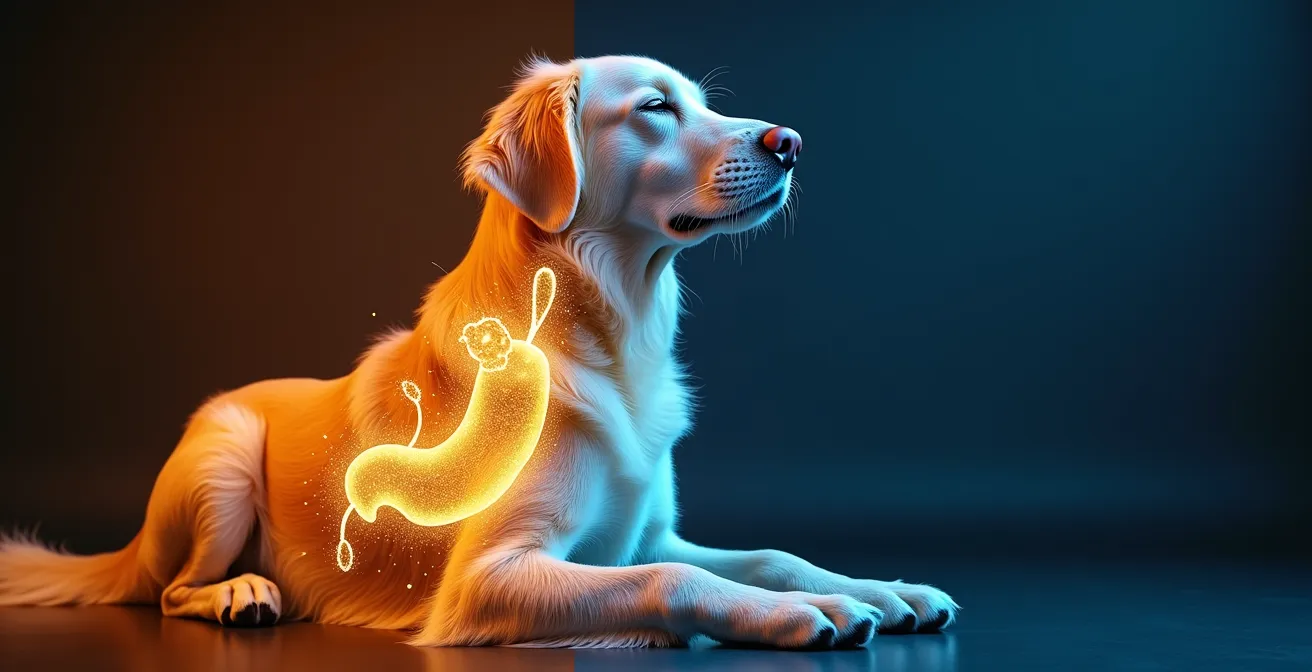
For owners managing a dog with both chronic diarrhea and separation anxiety, the situation can feel hopeless. These are not two separate issues but interconnected symptoms of a dysregulated gut-brain axis. This article decodes the biochemical conversation between your dog’s gut microbiome and their brain, revealing how restoring microbial balance with specific ‘psychobiotics’ is the foundational step toward achieving lasting physical comfort and emotional stability.
Watching your dog suffer from chronic diarrhea is distressing. The constant clean-ups, vet visits, and dietary changes are exhausting. When that same beloved dog also panics every time you leave the house, exhibiting classic signs of separation anxiety, the challenge can feel insurmountable. You’ve likely tried everything: hypoallergenic foods for their stomach and calming supplements or extensive training for their anxiety. Yet, both problems persist, leaving you to wonder if they are somehow connected.
The conventional approach treats these as separate domains: gastroenterology for the gut and behaviorism for the brain. But what if this separation is the very reason progress has stalled? What if the constant gut inflammation is fueling their anxiety, and their chronic stress is preventing their gut from healing? This is the central premise of the gut-brain axis, a complex and bidirectional communication network that scientifically links intestinal health to mental well-being.
This article moves beyond the platitudes of “a healthy diet is important.” We will adopt the lens of a psychobiologist to explore this profound connection. We will uncover how microscopic organisms in your dog’s gut produce mood-regulating neurotransmitters, how chronic stress impacts their intestinal lining, and how specific, targeted interventions can restore a state of holistic homeostasis. By understanding this axis, you can shift from managing symptoms to addressing the root cause, paving the way for a happier, calmer, and physically healthier companion.
This guide will walk you through the science, from stress hormones and sleep cycles to environmental impacts and the power of the human-animal bond. By the end, you will have a new framework and actionable strategies to support both your dog’s mind and body as a single, integrated system.
Summary: The Gut-Brain Axis and Your Dog’s Well-being
- Cortisol Detox: How Long Does It Take for Stress Hormones to Clear?
- REM Sleep deprivation: Is Your Dog Getting Enough Deep Sleep?
- The Bond Effect: How Oxytocin Reduces Pain Perception?
- Feng Shui for Cats: Optimizing Vertical Space for Confidence
- Protecting Hearing: Why Loud Music Stresses Dogs More Than Humans?
- When to Ask Your Vet for Anti-Anxiety Meds for Training Success?
- Hypothyroid Weight Gain: Why Dieting Doesn’t Work Without Medication?
- Passive vs. Active Enrichment: Balancing the Mental Diet
Cortisol Detox: How Long Does It Take for Stress Hormones to Clear?
For a dog suffering from separation anxiety, the brain is in a near-constant state of alert, flooding the body with the stress hormone cortisol. While essential for short-term survival, chronic exposure to high cortisol levels is destructive. It suppresses the immune system, promotes inflammation, and critically, damages the sensitive lining of the gut. This can directly contribute to the chronic diarrhea your dog is experiencing. It’s a vicious cycle: anxiety causes high cortisol, which harms the gut, and an inflamed gut sends distress signals back to the brain, exacerbating anxiety.
The question isn’t just about clearing cortisol after a stressful event; it’s about regulating its production in the first place. This is where the gut microbiome plays a startling role. A healthy gut community can modulate the body’s stress response system (the HPA axis). Emerging research into psychobiotics—probiotics with proven mental health benefits—is showing remarkable results. Certain strains can actively help lower baseline cortisol levels, making the dog less reactive to stressors.
For example, research has demonstrated that dogs supplemented with the probiotic Bifidobacterium longum showed not only significant reductions in anxious behaviors like excessive barking and pacing but also had measurably lower salivary cortisol levels. This provides a direct biochemical link: by introducing specific beneficial bacteria, we can help the body’s internal systems turn down the volume on stress, allowing both the brain and the gut to begin healing.
This evidence reframes probiotics from a simple digestive aid to a powerful tool for psychobiological regulation. It suggests that a key part of “detoxing” stress is not just about time, but about actively repopulating the gut with the right microbial allies to build a more resilient stress response system from the inside out.
REM Sleep deprivation: Is Your Dog Getting Enough Deep Sleep?
An anxious dog rarely sleeps soundly. They may startle at the slightest noise, pace at night, or simply fail to enter the deep, restorative stages of sleep. This lack of quality sleep, particularly REM (Rapid Eye Movement) sleep, is not just a symptom of anxiety—it’s a major contributor to it. During REM sleep, the brain processes emotions and consolidates memories. Without it, a dog’s fear responses become heightened, and their ability to cope with daily stressors diminishes, further fueling their anxiety and the associated gut issues.
The link between sleep and the gut is profoundly direct. Your dog’s gut microbiome is a veritable factory for neurochemicals, including those essential for calm and sleep. One of the most important is GABA (gamma-aminobutyric acid), the primary inhibitory neurotransmitter in the brain. GABA’s job is to apply the brakes on neural activity, reducing anxiety and promoting relaxation. When GABA levels are low, the brain remains in an over-excited state, making deep sleep nearly impossible.
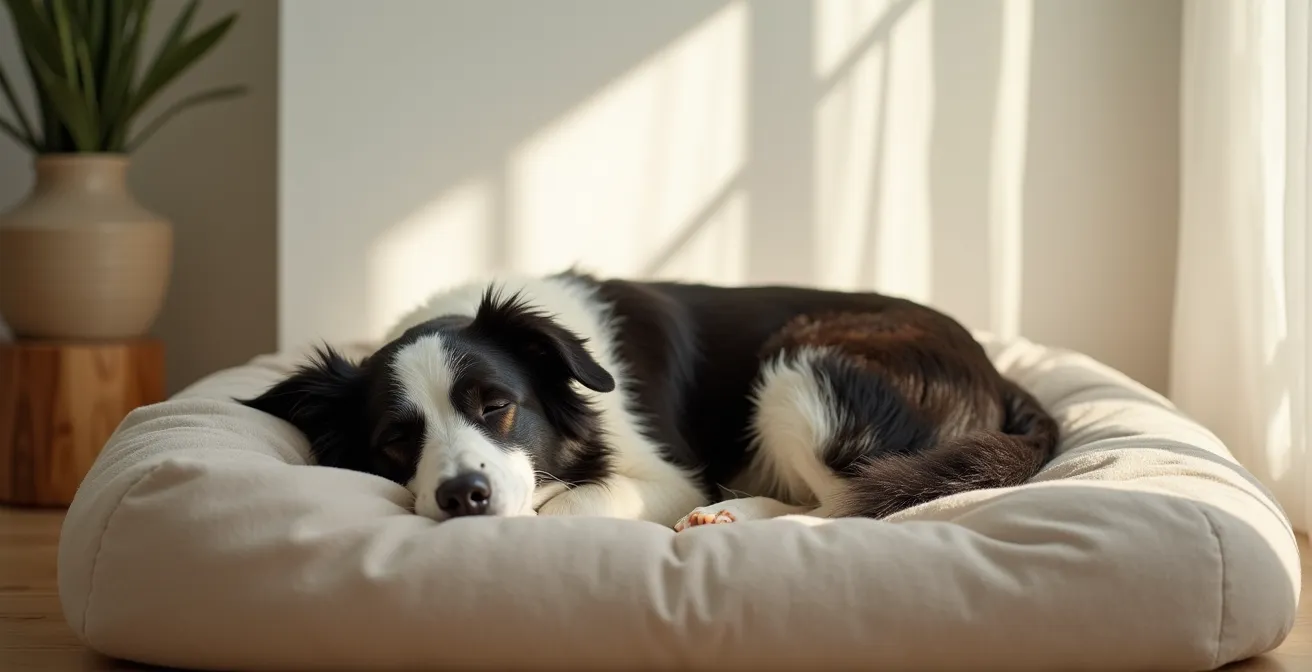
Remarkably, the gut is a key player in GABA production. The biochemical complexity of the gut microbiota shows that GABA is produced by several species of bacteria, including those from the Lactobacillus family. If your dog’s gut is in a state of dysbiosis (an imbalance of good and bad bacteria), its ability to produce this critical calming agent is compromised. This creates another debilitating feedback loop: gut dysbiosis leads to low GABA, which causes poor sleep, which in turn increases stress and cortisol, further damaging the gut.
Therefore, supporting your dog’s sleep isn’t just about providing a comfy bed. It involves nurturing the gut ecosystem responsible for producing the very molecules that allow their brain to switch off and recharge. By addressing the microbial imbalance, you are not just aiming for better digestion; you are helping to restore the brain’s natural ability to rest, recover, and process fear.
The Bond Effect: How Oxytocin Reduces Pain Perception?
While the internal biochemistry of the gut-brain axis is critical, it doesn’t operate in a vacuum. The external environment, particularly the social bond between you and your dog, is a powerful modulator of this system. The simple act of petting, cuddling, or even making eye contact with your dog releases oxytocin in both of you. Often called the “love hormone,” oxytocin does more than foster bonding; it is a potent anxiolytic and analgesic, actively counteracting the effects of stress.
Oxytocin works by directly dampening the activity of the amygdala, the brain’s fear center. This reduces feelings of anxiety and fear. Simultaneously, it triggers the release of the body’s natural opioids, which can lower the perception of pain, including the visceral discomfort associated with an inflamed gut. This “Bond Effect” is a form of natural, external regulation for your dog’s internal state. It’s a real, measurable physiological event. In fact, a Washington State University study found that as little as 10 minutes of interacting with dogs and cats produced a significant reduction in students’ cortisol levels.
This interaction provides a unique form of emotional support that can be more impactful than other relationships, as noted by mental health researcher Dr. Helen Brooks:
Pets provided a unique form of validation through unconditional support, which they were often not receiving from other family or social relationships.
– Dr. Helen Brooks, Mental health researcher
For an owner struggling with a dog’s chronic conditions, this is empowering news. Your presence and affection are not just comforting gestures; they are a direct therapeutic intervention. You are helping to regulate your dog’s cortisol, boost their pain-dulling hormones, and create a sense of safety that allows their nervous system—and by extension, their gut—to switch from “fight or flight” to “rest and digest.” This reinforces the holistic approach: healing the gut-brain axis involves nurturing the microbiome internally and the social bond externally.
Feng Shui for Cats: Optimizing Vertical Space for Confidence
While the title mentions cats and feng shui, the underlying principle is universal and directly applicable to dogs: an animal’s sense of control over its environment is fundamental to its psychological well-being. For a dog with anxiety, the world can feel unpredictable and threatening. Creating an environment that is safe, predictable, and empowering can dramatically lower their baseline stress levels, which in turn gives their gut a chance to heal. This is the canine equivalent of “feng shui”—arranging the environment to promote holistic homeostasis.
This goes beyond providing a soft bed. It means creating “safe zones” where the dog can retreat without being disturbed. It involves establishing predictable routines for feeding, walks, and playtime, which reduces anticipatory anxiety. It also means carefully managing sensory inputs. Anxious dogs are often highly sensitive to environmental stressors that we may not even notice. These seemingly minor events can trigger a cortisol spike, setting back any progress made on their gut health.
Case Study: The Stress of Routine Care
A study by Jeong and Kim (2023) highlighted how even routine procedures can be major stressors. They reported that clipper grooming, a common part of many dogs’ lives, significantly raised cortisol levels and heightened anxiety-related behaviors in companion dogs. This demonstrates that stress isn’t just about major events like thunderstorms or being left alone; it’s woven into the fabric of daily life. Managing these micro-stressors is key to protecting the gut-brain axis.
Optimizing your dog’s environment means identifying and mitigating these hidden stressors. Does the Roomba terrify them? Run it when they are out on a walk. Is the television too loud? Lower the volume. Does the mail carrier’s arrival trigger a frenzy? Work on desensitization exercises in a controlled manner. Each step you take to increase your dog’s sense of safety and predictability helps lower the chronic cortisol drip that irritates their gut and fuels their anxiety.
Protecting Hearing: Why Loud Music Stresses Dogs More Than Humans?
The principle of environmental management extends deeply into the sensory realm. A dog’s hearing is exponentially more sensitive than ours, making our modern world a potential minefield of auditory stress. Loud music, traffic noise, construction, and even household appliances can be overwhelming, triggering a physiological stress response. For a dog already predisposed to anxiety, this constant sensory assault keeps their nervous system on high alert. This is not a minor issue; research shows up to 70% of behavioral disorders in dogs can be attributed to some form of anxiety, and sensory stress is a huge component.
This chronic stress from sources like noise directly impacts the gut-brain axis. Every startling sound can trigger a cortisol release, contributing to gut inflammation and dysbiosis. The challenge is that while we can’t eliminate all noise, we can buffer the dog’s internal response to it. This is where the concept of psychobiotics becomes a game-changing intervention. These are not just any probiotics; they are specific strains clinically shown to have a calming effect on the brain.
The power of this approach is illustrated in a targeted study, which acts as a compelling case for this intervention:
Case Study: Probiotics as a Buffer Against Anxiety
A study on 24 Labrador retrievers with diagnosed anxiety problems provided a clear demonstration of the anxiolytic (anxiety-reducing) power of psychobiotics. The dogs were supplemented with a specific probiotic strain, *Bifidobacterium longum* BL999. The results, as reported by sources like WellyTails summarizing the research, showed that the probiotic appeared to have an effect comparable to an anxiety-reducing drug. The dogs became calmer and less reactive to stressors. This suggests that the probiotic helped modulate their stress response at a fundamental, biochemical level.
This finding is revolutionary for an owner of an anxious, noise-sensitive dog. It means you can do more than just try to soundproof your home. By supporting their gut with the right psychobiotic, you can help build an internal “buffer” that makes them less susceptible to the unavoidable stresses of the environment. You are fundamentally changing their neurochemistry to be more resilient.
When to Ask Your Vet for Anti-Anxiety Meds for Training Success?
Navigating the question of medication is one of the most difficult decisions for a dedicated owner. You want to do what’s best for your dog, but the idea of using pharmaceuticals can be daunting. From a psychobiological perspective, medication should be seen not as a first resort or a failure, but as a strategic tool to be used in conjunction with foundational support. The primary goal of anti-anxiety medication is to lower a dog’s anxiety to a level where they can actually learn new, calmer behaviors through training and behavior modification.
If a dog’s anxiety is so severe that they are constantly over their stress threshold—unable to eat, listen, or engage—they are biochemically incapable of learning. In these cases, medications like SSRIs (e.g., fluoxetine) or TCAs (e.g., clomipramine) can be essential. They help restore some semblance of neurochemical balance, creating a window of opportunity for training to be effective. However, they rarely solve the problem on their own because they don’t fix the underlying dysregulation, especially within the gut-brain axis.
This is why a “gut-first” approach is so powerful. Before or alongside medication, building a healthy gut microbiome should be the priority. Yet, this foundational step is often overlooked. For instance, a recent behavioral microbiome study found that only 5 out of 48 dogs were being regularly supplemented with a commercial probiotic, highlighting how underutilized this strategy is. By first focusing on healing the gut with diet, psychobiotics, and stress reduction, you may find that the need for medication is reduced or even eliminated. In other cases, this foundational work makes the medication far more effective.
The conversation with your vet should be about an integrative plan. Ask: “How can we support my dog’s gut-brain axis as the foundation? And what is the role of medication in helping us achieve our training goals while that foundation is being built?” This positions medication as a supportive bridge, not the final destination.
Hypothyroid Weight Gain: Why Dieting Doesn’t Work Without Medication?
While your dog’s primary issues are diarrhea and anxiety, this section’s title about hypothyroidism serves as a crucial reminder: the body is a web of interconnected systems. Symptoms can be misleading, and what appears to be one issue may be masking or influenced by another. A dog’s anxiety or lethargy might be hastily blamed on behavior when it’s actually rooted in a hormonal imbalance like hypothyroidism or Cushing’s disease (cortisol overproduction). It’s vital that your veterinarian conducts thorough diagnostics to rule out these other conditions that can mimic or co-exist with gut-brain axis dysfunction.
The science linking specific microbes to behavior is advancing at a breathtaking pace, offering new ways to understand these overlaps. We are moving beyond generalities and identifying specific microbial signatures associated with certain conditions. This is a core focus of psychobiology: decoding the precise conversation between gut bacteria and the brain. A prime example is the growing body of research on specific bacterial genera and their link to anxiety.
The Blautia-Anxiety Connection
In a groundbreaking study, researchers used machine-learning models to predict a dog’s behavioral group based solely on their gut microbiota composition. As detailed in the journal *Scientific Reports*, the analysis consistently identified one genus in particular: Blautia. This genus was found in different abundances in anxious dogs compared to non-anxious dogs, suggesting a direct link. This is a significant finding because, as the study notes, Blautia is known to be particularly sensitive to dietary changes and probiotics. This opens the door for highly targeted interventions aimed at modulating specific microbial populations to influence behavior.
This level of specificity is the future of canine wellness. It reinforces the idea that we are not just randomly adding “good bacteria.” We are beginning to understand which microbes are out of balance and how to restore them. For an owner, this means that while it’s essential to rule out major hormonal diseases with your vet, the path forward will increasingly involve a detailed focus on nurturing and rebalancing your dog’s unique gut ecosystem as a primary therapeutic strategy.
Key Takeaways
- Your dog’s anxiety and diarrhea are often two symptoms of one problem: a dysregulated gut-brain axis fueled by the stress hormone cortisol.
- The gut microbiome produces calming neurotransmitters like GABA. An imbalanced gut leads to poor sleep, which in turn worsens anxiety.
- Targeted probiotics, known as ‘psychobiotics’ (e.g., *Bifidobacterium longum*), have been scientifically shown to reduce anxious behaviors and lower cortisol levels.
- Healing is a holistic process that involves internal support (probiotics), external management (low-stress environment), and social connection (the human-animal bond).
Passive vs. Active Enrichment: Balancing the Mental Diet
You’ve addressed the internal biochemistry with psychobiotics and managed the external environment to reduce stress. The final piece of the puzzle is actively enriching your dog’s mental life. A bored dog is a stressed dog, and a stressed dog has an unhappy gut. Enrichment is often misunderstood as simply providing toys. A truly balanced “mental diet,” however, includes both passive and active enrichment to achieve holistic homeostasis.
Passive enrichment involves things the dog can engage with on their own, like food puzzles or durable chews. These are vital for quiet time and for teaching a dog to settle. Active enrichment, on the other hand, involves you. It includes activities that satisfy their core canine instincts: sniffing on a “sniffari” walk where they lead the way, controlled digging in a designated sandpit, or structured training games. This type of engagement is profoundly beneficial for the gut-brain axis. For example, studies demonstrate that exercise increases the number of healthy bacteria in the gut, directly linking physical activity to microbial diversity.
Balancing this mental diet is crucial for a dog with anxiety. Too much high-arousal active enrichment (like frantic fetch) can increase cortisol, while too little can lead to boredom and frustration. The goal is to provide satisfying, calming activities that build confidence and reduce stress. A long, meandering sniff walk is far more therapeutic for an anxious dog than a high-intensity run. This is the final step in shifting your dog’s nervous system from a state of chronic stress to one of calm engagement.
Action Plan: Supporting Your Dog’s Gut-Brain Axis
- Provide Quality Exercise: Focus on activities that satisfy natural instincts, such as long “sniffari” walks, digging in a designated area, or scent work games.
- Audit Their Diet and Environment: Systematically remove foods and products known to disrupt the gut microbiome, including rancid fats, chemical preservatives, and pesticide-treated ingredients.
- Rebuild the Microbiome: Introduce a high-quality, multi-strain probiotic that includes proven psychobiotic strains like *Bifidobacterium longum* into their daily regimen.
- Minimize Environmental Stress: Identify and mitigate household stressors (e.g., loud noises, unpredictable routines) and create predictable, safe spaces for your dog to retreat to.
- Feed the Good Bacteria: Incorporate prebiotic-rich foods, such as pumpkin or leafy greens, in small, appropriate amounts to provide fuel for the beneficial bacteria you are introducing.
By thoughtfully balancing your dog’s mental diet, you are providing the final layer of support for their gut-brain axis. You are not just distracting them from their anxiety; you are helping them build a more resilient, confident, and balanced mind, which is directly reflected in a calmer, healthier gut.
By embracing this integrative framework, you can move beyond simply managing symptoms. The next logical step is to systematically implement these strategies and begin the journey of restoring your dog’s physical and emotional well-being from the inside out.