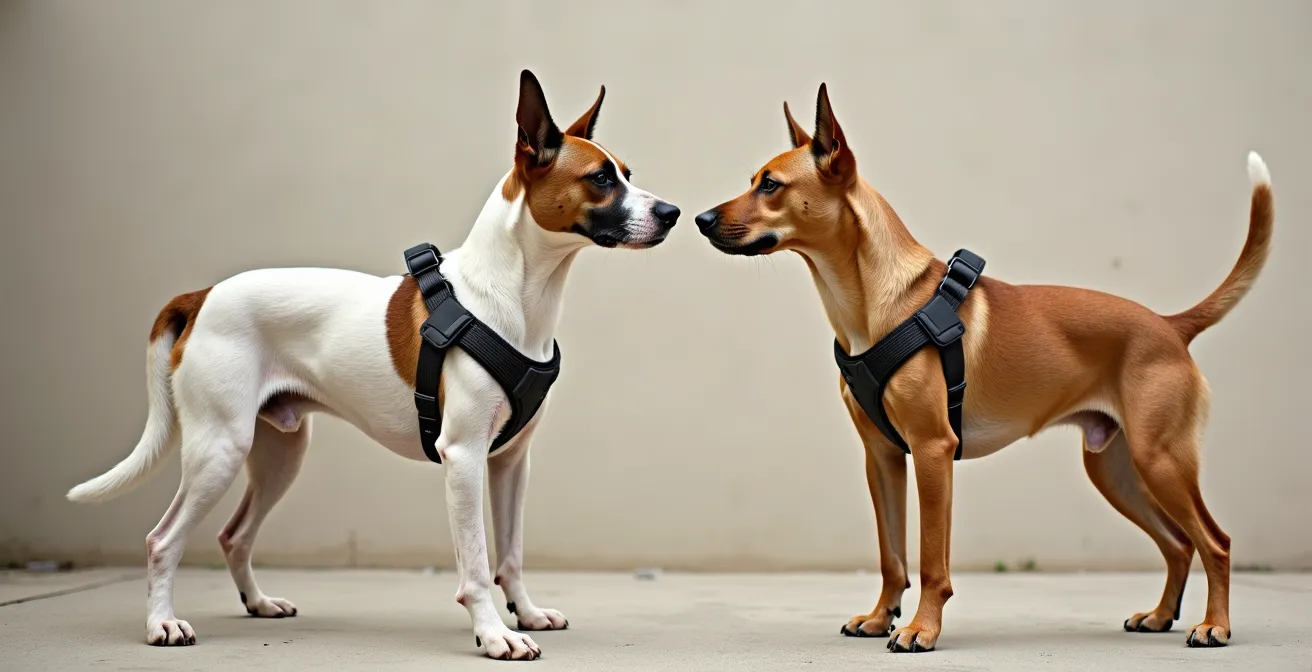
Choosing the right harness is not about brand, but about respecting your dog’s natural anatomy and freedom of movement.
- Restrictive harnesses that cross the shoulder can alter a dog’s natural gait and proprioception, even when off-leash.
- A “dynamic fit” test—assessing the harness while the dog is moving—is far more crucial for preventing escapes than a static two-finger check.
Recommendation: Prioritize harnesses that leave the shoulder joint completely unobstructed and use a dynamic fitting protocol to ensure both safety and comfort.
For any owner of a strong dog that pulls, the daily walk can be a source of constant worry. You feel the strain in your own arm and see the pressure on your dog’s neck, leading you down a path of equipment research. You’ve likely heard the common advice: switch from a collar to a harness to avoid choking, and maybe try a “no-pull” design to gain more control. These front-clip harnesses are often presented as the ultimate solution for managing a powerful puller.
While well-intentioned, this advice often misses a critical piece of the puzzle. The conversation tends to stop at “control” and “no choking,” overlooking a more insidious risk: long-term musculoskeletal damage. The very design that gives you control by turning your dog towards you can, if it crosses the shoulder, subtly interfere with their natural gait, joint function, and even their neurological sense of body awareness.
But what if the key to both safety and control wasn’t just about where the leash attaches, but about how the entire harness interacts with your dog’s biomechanics? This guide moves beyond the simple “Y-harness vs. no-pull” debate. We will dissect the issue from an anatomical and safety-first perspective, treating the harness as a piece of performance equipment. We’ll explore the science of shoulder movement, the engineering of a truly secure fit, and the material properties that prevent secondary issues, so you can make a choice that protects your dog’s long-term health and well-being.
This article provides a comprehensive framework for selecting the right harness. Below is a summary of the key biomechanical and safety aspects we will cover to help you make an informed decision.
Summary: A Biomechanical Guide to Dog Harnesses
- Why Harnesses Crossing the Shoulders Restrict Movement?
- How to Fit a Harness So a Houdini Dog Can’t Escape?
- Nylon vs. Padded Mesh: Which Causes Less Chafing in Wet Weather?
- Reflective Stitching vs. LED Attachments: What Visible Distance Do You Need?
- When to Upgrade From a Puppy Harness to Adult Gear?
- When to Stop Playing Fetch and Start Swimming?
- Why Your Dog Freezes When You Put the Harness On?
- Crash-Tested vs. “Safety” Harness: The CPS Certification Difference
Why Harnesses Crossing the Shoulders Restrict Movement?
To understand why certain harness designs can be detrimental, we must first look at the canine shoulder. Unlike a human’s ball-and-socket joint, a dog’s shoulder assembly (the scapula and humerus) is designed for powerful front-to-back extension and flexion, which propels them forward. Any equipment that lays across the point of the shoulder directly impedes this natural range of motion. The result is a shortened, stilted stride rather than a full, fluid gait.
This is not just an aesthetic issue; it has measurable consequences. Research has demonstrated that restrictive, no-pull style harnesses can significantly reduce joint mobility. For instance, one study found dogs wearing these harnesses had 4.4° less shoulder extension at a trot compared to those with non-restrictive designs. While this number seems small, the cumulative effect over thousands of steps can contribute to repetitive strain injuries, muscle imbalance, and joint stress over time.
Furthermore, this restriction impacts a dog’s proprioception—their internal sense of where their body and limbs are in space. Gait analysis has revealed that dogs in restrictive harnesses bear less weight on their front legs, even without a leash attached, indicating a fundamental change in how they perceive and manage their balance. This altered movement pattern can have long-term orthopedic consequences. As one rehabilitation veterinarian noted in a forum discussion, a primary goal for canine health is to ensure a dog has a “full and natural range of movement through shoulder, elbow and spine,” a goal directly contradicted by straps that cross over these critical joints.
How to Fit a Harness So a Houdini Dog Can’t Escape?
The fear of a dog slipping their harness, especially a “Houdini” dog skilled at backing out of gear, is a major concern for owners. The common advice is the “two-finger rule”—ensuring you can fit two fingers snugly between the harness and the dog. While a good starting point, this static measurement fails to account for the dynamic changes in a dog’s body shape during movement. A truly escape-proof fit must be tested under realistic conditions.
A secure fit relies on the harness staying in place as the dog twists, turns, and even pulls backward. The key is to perform a dynamic fit test. A harness that seems snug when the dog is standing still can develop dangerous gaps around the shoulders and chest the moment the dog puts on the brakes or tries to reverse. The goal is to ensure the harness fits closely behind the dog’s front legs and does not easily slide forward over the wider part of their ribcage when they back up.
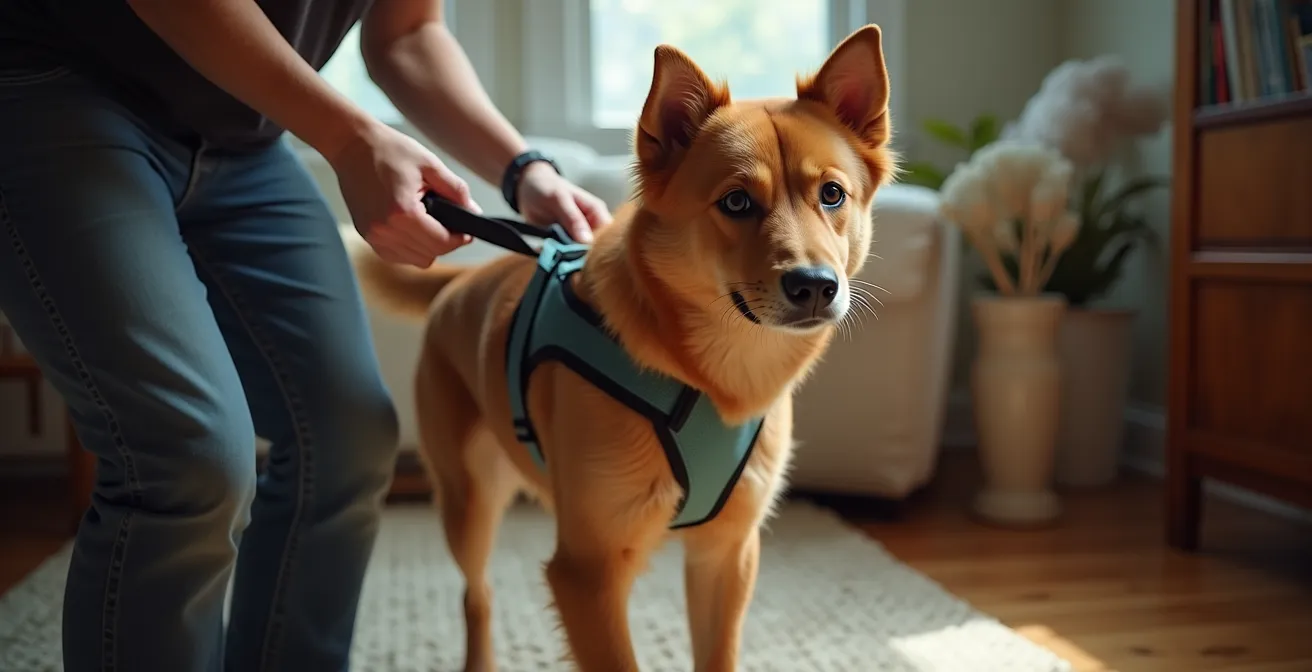
By simulating escape maneuvers in a safe environment, you can identify and eliminate weak points in the fit. This goes beyond a simple measurement and becomes a functional assessment of the equipment’s security in real-world scenarios, giving you true peace of mind that your dog is secure.
Action Plan: The Dynamic Fit Test for an Escape-Proof Harness
- Initial Setup: Loosen all straps on the harness before the first fitting. It should slip over your dog’s head and body easily, without any force.
- Static Check (The Two-Finger Rule): Adjust all straps for a snug fit. You should be able to comfortably slide two (and only two) fingers between the harness and your dog at any point, including the neck, chest, and back straps.
- The Backup Test: Encourage your dog to take a few steps backward, or gently pull the leash from the front. Watch closely for any gaps that appear around the neck and shoulder area as they reverse. The harness should not slide forward.
- The Twist & Shake Test: Have your dog perform a “shake” command or encourage them to twist their body to reach a treat. The harness should remain centered and not shift excessively to one side.
- Shoulder Clearance Check: With the harness fitted, ask your dog to walk forward and pull slightly. Ensure the neck straps remain clear of the shoulder joints and do not slide down to cover them, which would restrict movement.
Nylon vs. Padded Mesh: Which Causes Less Chafing in Wet Weather?
Chafing is a common problem, especially for dogs with short coats or sensitive skin. While many owners gravitate towards thickly padded mesh harnesses, assuming “more padding equals more comfort,” this logic can be flawed, particularly in wet weather. The material’s interaction with water is a critical factor that is often overlooked. The best choice is a material with hydrophobic properties, meaning it repels water rather than absorbing it.
Standard nylon webbing, especially hydrophobic-treated versions, retains very little water. It maintains its shape, dries quickly, and is less likely to create a damp microclimate against the dog’s skin, which can foster bacteria and lead to irritation. Padded mesh, conversely, acts like a sponge. It becomes heavy, sags, and can take hours to dry. This prolonged dampness not only increases the risk of chafing as the wet, stretched material rubs against the skin but also creates an ideal breeding ground for yeast and bacteria, potentially leading to skin infections.
The following analysis, based on data from gear performance tests, highlights the significant differences in how these materials behave when exposed to moisture.
| Material Property | Hydrophobic Nylon Webbing | Padded Mesh |
|---|---|---|
| Water Retention | Minimal (1% of weight) | High (absorbs 15-30% of weight) |
| Drying Time | 15-30 minutes | 2-4 hours |
| Microclimate Risk | Low | High – breeding ground for bacteria |
| Structural Integrity When Wet | Maintains shape | Sags and stretches |
| Friction Points | Consistent | Changes with water weight |
Reflective Stitching vs. LED Attachments: What Visible Distance Do You Need?
Ensuring your dog is visible during low-light walks—at dawn, dusk, or night—is a non-negotiable safety requirement. The two primary technologies used are passive reflective materials and active LED lights. Choosing between them isn’t a matter of which is “better” overall, but which is appropriate for your specific walking environment and the level of risk involved. The goal is to provide enough visible distance for a driver to see, recognize, and react to your dog’s presence.
Reflective stitching or panels work by bouncing light back from a source, like a car’s headlights. This is a form of passive visibility. It’s effective, but its visibility distance is dependent on the strength and angle of the light source. In a well-lit urban or suburban area with ample streetlights, reflective materials are often sufficient. They make the dog “light up” when a car approaches, providing a crucial warning.
LED attachments, on the other hand, provide active visibility. They generate their own light, making the dog visible even in complete darkness without an external light source. This is essential for walks on rural roads, trails, or in areas with no streetlights. An active light source is detectable from a much greater distance, giving drivers significantly more time to react.
A more advanced safety concept is bio-motion visibility. This involves placing reflective or light-up elements on moving parts of the dog’s body, such as the legs or shoulders. This helps the human brain instantly recognize the pattern of a living, moving animal, rather than just a static point of light. This biological recognition can reduce a driver’s reaction time, further enhancing safety.
When to Upgrade From a Puppy Harness to Adult Gear?
Managing a puppy’s gear can feel like a moving target due to their rapid growth. While it’s tempting to use a single, adjustable harness for as long as possible, the transition from puppy to adult gear should be guided by their skeletal development, not just their size. This is particularly important for protecting their joints during their most critical growth phases.
A puppy’s bones are not fully formed at birth. They have “growth plates,” which are soft areas of developing cartilage at the ends of the long bones. These plates are vulnerable to injury, and they gradually harden and close as the dog matures. According to veterinary consensus, it takes anywhere from 6 to 18 months for major growth plates to close, with larger breeds taking longer. During this period, it is paramount to avoid putting undue stress on their developing musculoskeletal system. A harness that restricts shoulder movement or puts pressure in the wrong places can be especially damaging to a growing puppy.
Therefore, the time to upgrade to a permanent, high-quality adult harness is typically when the dog reaches about 85-90% of their expected adult size and their growth rate has noticeably slowed. This usually coincides with the later stages of growth plate closure. Investing in a highly adjustable, non-restrictive Y-shaped harness at this point is wise. It ensures that as they finish growing, their movement is not impeded, and pressure is distributed safely across the sternum, away from the vulnerable trachea and developing shoulder joints.
When to Stop Playing Fetch and Start Swimming?
While not directly related to harness mechanics, considering alternative forms of exercise is part of a holistic approach to preventing joint injury, especially in powerful or high-energy dogs. Repetitive, high-impact activities like playing fetch—with its sudden starts, stops, and twisting leaps—can put significant strain on a dog’s joints over time. For dogs prone to conditions like hip dysplasia or for those already showing signs of joint stress, transitioning to a low-impact activity like swimming can be a game-changer.
Swimming is an excellent form of cardiovascular exercise that builds muscle tone without stressing the joints. The buoyancy of the water supports the dog’s body weight, allowing for a full range of motion that can improve flexibility and strength. However, this transition should not be made without some basic health considerations. Not all dogs are natural swimmers, and certain health conditions can be exacerbated by being in the water.

Before beginning a swimming regimen, it’s essential to perform a quick health assessment to ensure the activity will be both safe and beneficial. This checklist helps you identify any potential contraindications before you take the plunge.
Your Pre-Swimming Health Assessment Checklist
- Check for Ear Infections: Ensure your dog’s ears are clean and free of active infections, as water can worsen existing conditions.
- Assess Skin Condition: Look for any hot spots, open wounds, or skin infections that should be allowed to heal completely before swimming.
- Evaluate Joint Health: If your dog has known joint laxity or is a breed prone to dysplasia, consult your vet. Start with very short sessions.
- Monitor Breathing: Dogs with respiratory or cardiac issues require careful supervision and may need to avoid strenuous swimming.
- Ensure Gradual Introduction: Always start with a slow, positive introduction to shallow water before encouraging full swimming sessions to build confidence and avoid panic.
Why Your Dog Freezes When You Put the Harness On?
One of the most baffling behaviors for owners is when their dog “freezes” or refuses to move upon having a harness put on. This is often misinterpreted as stubbornness or a dislike of walks, but the root cause is frequently neurological. The behavior can be a manifestation of proprioceptive confusion, a sensory mismatch between how the dog intends to move and how the harness allows them to move.
Proprioception, as mentioned earlier, is the body’s awareness of its position and movement. A harness, especially one that is ill-fitting or restrictive, provides constant, unnatural sensory feedback across the dog’s chest, back, and shoulders. For some sensitive dogs, this sensory input is overwhelming or confusing. Their brain receives conflicting signals: the command to move forward is at odds with the physical sensation of being “held” or restricted by the harness straps.
This conflict can trigger a “freeze” response, similar to how a person might freeze momentarily when they lose their balance or encounter an unexpected obstacle. The dog isn’t being disobedient; they are experiencing a momentary sensory overload and are unsure how to proceed. It’s an involuntary reaction to confusing or uncomfortable physical feedback. In some cases, this discomfort can build during a walk, leading to the dog suddenly stopping or struggling against the leash out of sheer frustration from the persistent, confusing sensory input.
Key Takeaways
- Any harness strap that crosses directly over the point of the shoulder will mechanically restrict a dog’s natural gait and can lead to long-term joint issues.
- A truly secure harness fit must be tested dynamically (while the dog is moving, backing up, and twisting) to prevent “Houdini” escapes.
- Center for Pet Safety (CPS) certification is the only independent standard that verifies a car harness has been successfully crash-tested for canine safety.
Crash-Tested vs. “Safety” Harness: The CPS Certification Difference
For owners who travel with their dogs, a car harness is a critical piece of safety equipment. However, the market is flooded with products labeled as “safety harnesses” or “car-safe” that have never undergone independent, standardized testing. There is a profound difference between a harness that simply prevents a dog from distracting the driver and one that is engineered to protect the dog in a crash. This difference is defined by the Center for Pet Safety (CPS) Certification.
CPS is an independent non-profit organization that conducts rigorous, scientific crash tests on pet travel products. Their certification provides a reliable, third-party verification of performance. To become certified, a harness must pass standardized crash tests at speeds up to 30mph using realistic, weighted crash-test dog dummies. A key metric is “excursion,” which measures how far the dog is launched forward during a crash. Certified harnesses must keep excursion within safe limits to prevent the dog from hitting the front seat or other parts of the vehicle interior.
In contrast, non-certified “safety” harnesses often fail catastrophically in crash scenarios. Independent tests have shown these products can have hardware that breaks, webbing that tears, and stitching that gives way, resulting in a complete loss of containment. The distinction is not trivial; it is the difference between a marketing claim and proven engineering.
This table, based on CPS’s published test results and standards, clarifies the critical differences between a truly certified product and a simple restraint.
| Feature | CPS Certified Harnesses | “Safety” Harnesses (Non-Certified) |
|---|---|---|
| Crash Testing Speed | 30 mph standardized tests | Variable or undisclosed |
| Excursion Limits | Measured per FMVSS 213 standards | No standardized measurement |
| Catastrophic Failure Rate | 0% for certified products | Up to 100% in some tested models |
| Legal Requirements | Meets crash protection standards | Only prevents driver distraction |
| Tether System Requirements | Specific connection to seatbelt webbing | Often includes dangerous bungee/extension tethers |
By applying this biomechanical and safety-first lens to your selection process, you move from simply managing your dog to actively protecting them. Choosing a harness that respects their anatomy is one of the most important decisions you can make for their long-term health and your shared peace of mind.
Frequently Asked Questions About Dog Harness Visibility
What visibility distance is needed for urban walking?
In well-lit urban areas with streetlights, passive reflective materials visible at 100-150 feet are typically sufficient for safety.
When should I use LED attachments instead of reflective materials?
LED attachments are essential for rural roads without streetlights where active visibility at 500+ feet is needed, or during dawn/dusk hours.
How does bio-motion visibility improve safety?
Placing reflective materials on moving parts (shoulders, legs) helps drivers instantly recognize a living animal and predict movement patterns, improving reaction time by up to 2 seconds.