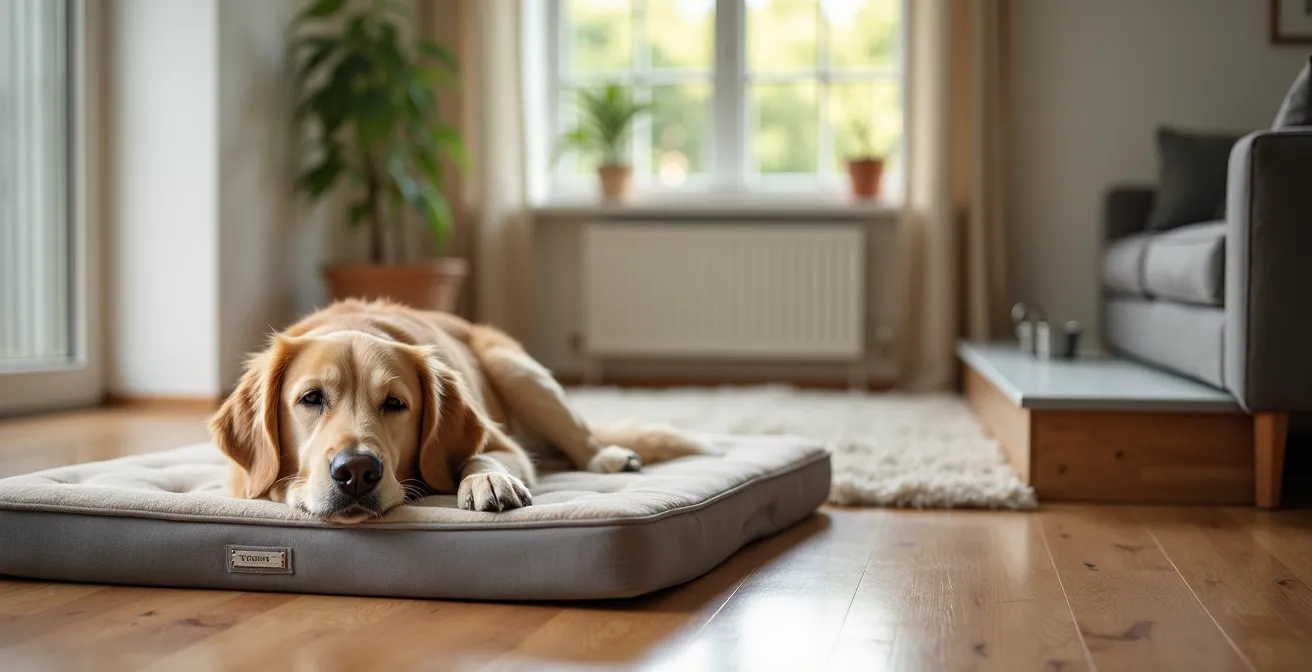
Watching your senior dog struggle with arthritis is heartbreaking, but you can dramatically improve their comfort and mobility by treating your home as a therapeutic environment.
- Focus on creating non-slip “pathways” and multiple “comfort zones” rather than single, isolated solutions.
- Modify exercise to low-impact activities like swimming and scent work to preserve joint health while providing enrichment.
- Use objective quality-of-life scales to track your dog’s comfort and make informed decisions with your vet.
Recommendation: Start by auditing your home’s flooring and creating a ‘safe loop’ between your dog’s key resources: their bed, water bowl, and the door to go outside.
The sound is unmistakable to any owner of an aging dog: the gentle click-clack of nails struggling for purchase on a hardwood floor, followed by a grunt of effort as they try to stand. Watching a loyal companion who once bounded effortlessly now hesitate before a single stair can feel heart-wrenching. You want to help, but where do you begin? The common advice often includes buying a ramp or a new orthopedic bed, and while helpful, these are just single pieces of a much larger puzzle.
These isolated solutions often fail to address the fundamental challenge. The real key to restoring your senior dog’s dignity and mobility isn’t just acquiring new gadgets; it’s about fundamentally redesigning their world through the eyes of a rehabilitation therapist. This means thinking in terms of “environmental biomechanics”—how your dog’s body interacts with their space—and creating a holistic system of support. It’s about building a “network of comfort” throughout the house, not just one perfect bed, and establishing “safe traction corridors” so movement is no longer a daunting task.
This guide moves beyond the basics. We will explore practical, inventive, and evidence-based strategies to transform your home into a haven for your arthritic dog. We’ll cover everything from nighttime safety for cognitive changes to massage techniques, objective comfort tracking, and the critical shift from high-impact play to joint-sparing enrichment. It’s time to give your old friend the supportive environment they so richly deserve.
This article provides a comprehensive roadmap for adapting your living space. The following summary outlines the key areas we will cover to help you create a safer and more comfortable home for your senior companion.
Summary: A Rehab Specialist’s Guide: Adapting Your Home for a Dog With Arthritis
- Why Nighttime Pacing Is a Sign of Dementia, Not Just “Old Age”
- How to Massage a Senior Cat With Stiff Hips?
- Quality of Life Scales: How to Objectively Measure Your Pet’s Comfort?
- The Kidney-Sparing Mistake: Feeding High Phosphorus Jerky to Seniors
- When to Stop Playing Fetch and Start Swimming?
- Conservative Management for Dysplastic Puppies: Can You Avoid Surgery?
- Injectable Adequan vs. Oral Chews: Which Reaches the Joint Faster?
- Is Orthopedic Foam Necessary for Dogs Under 5 Years Old?
Why Nighttime Pacing Is a Sign of Dementia, Not Just “Old Age”
When an elderly dog begins pacing restlessly at night, it’s easy to dismiss it as a simple symptom of old age or arthritis pain. However, this behavior is often a classic sign of Canine Cognitive Dysfunction (CCD), a condition similar to Alzheimer’s in humans. The pacing isn’t random; it’s frequently a sign of confusion, anxiety, and a disrupted sleep-wake cycle. For a dog also managing arthritis, this creates a dual challenge: their mind compels them to move, while their body protests in pain. This is where environmental management becomes crucial for both their mental and physical well-being.
The goal is not to stop the pacing, which can increase anxiety, but to make it safe. Your role is to create a “safe loop”—a designated, hazard-free pathway for your dog to navigate. This involves strategically placing non-slip surfaces like yoga mats or rug runners along their most-traveled routes, typically between their bed, the water bowl, and the door. Installing motion-activated, low-light nightlights along this path can reduce disorientation without disrupting their (or your) sleep. By making their compulsive movements safer, you reduce the risk of slips and falls that could exacerbate their arthritis.
Case Study: Managing Concurrent Arthritis and Dementia
A senior dog with both CCD and arthritis began pulling on the leash during walks due to altered learning and confusion. The owner recognized that retraining was not feasible, especially since the dog’s arthritis meant long walks were no longer an option anyway. Instead of fighting the pulling behavior on short, 10-minute walks, the owner accepted it and shifted their focus. They redirected the dog’s need for enrichment to low-impact scent games in the garden, satisfying the dog’s mind without stressing its joints—a perfect example of adapting goals to the dog’s current capabilities.
Creating this safe nighttime environment requires removing obstacles from their main walking paths. This might mean rearranging furniture or clearing away clutter that has become a new hazard. Furthermore, placing water bowls on absorbent mats prevents spills from creating a slipping danger. By anticipating their needs and engineering a secure space, you provide comfort for their confused mind and protection for their fragile body.
Checklist: Auditing Your Home for a Senior Dog’s Mobility
- Contact Points: List all high-traffic areas and surfaces your dog navigates daily (e.g., floor from bed to water bowl, steps to the garden, car entry point).
- Traction Inventory: Assess the slip-risk of these surfaces. Document existing solutions (e.g., one small rug) and identify slippery zones like tile, hardwood, or linoleum.
- Comfort Consistency: Check the location and quality of resting spots. Are they only in one room? Are they orthopedic and easy to get in and out of? Compare this with your dog’s actual napping spots.
- Accessibility & Obstacles: Walk the main paths from your dog’s low-to-the-ground perspective. Identify furniture corners, clutter, or thresholds that are now obstacles. Is food and water elevated?
- Integration Plan: Prioritize fixes. Create a simple plan to add traction (rug runners, yoga mats), upgrade or add more beds, and clear pathways to improve safety immediately.
How to Massage a Senior Cat With Stiff Hips?
While the principles of gentle massage can be adapted for our feline friends with vet guidance, let’s focus on a common and highly effective technique for dogs suffering from hip stiffness and arthritis. Therapeutic massage is not about deep-tissue work; it’s about increasing blood flow, warming muscles, and reassuring the nervous system. Done correctly, it’s a powerful bonding tool that provides tangible physical relief. The key is to start slow and always be mindful of your dog’s reactions, never forcing anything.
A great approach is the Tellington TTouch method, which begins with calming touches away from the painful area. Start with gentle, one-and-a-quarter circular motions on the ears, mouth, and paws. This helps to relax the entire nervous system before you even approach the hips. Before direct massage, applying a warm compress to the hip area for about 5 minutes can work wonders to relax the muscles, making them more receptive to your touch. Always test the temperature on your own wrist first.
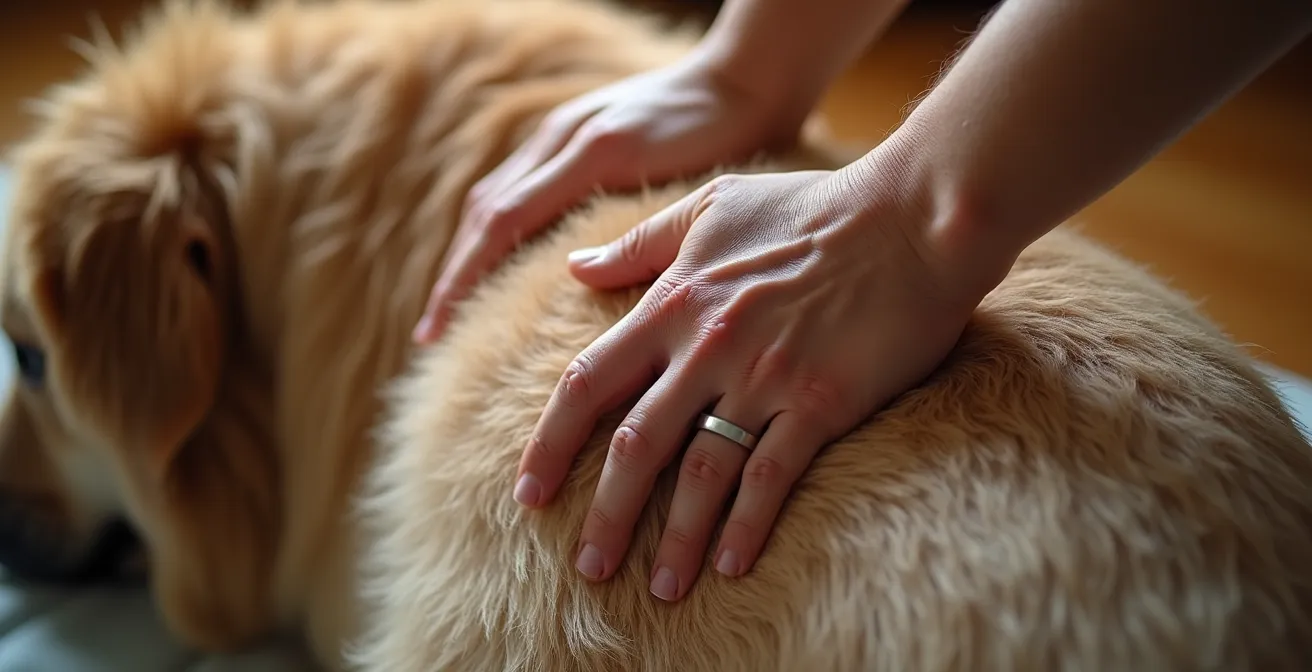
Once your dog is relaxed, use your palm and flat fingers to make broad, gentle strokes on the large muscle groups surrounding the hips, like the glutes and thighs. This helps to massage the supporting muscles that often become tight from compensating for sore joints. Avoid pressing directly on the bone or joint itself. The goal is to promote blood flow and ease muscle tension. You can finish the session with very gentle, vet-approved passive range-of-motion stretches to help maintain joint flexibility, but only if your dog is comfortable and it has been demonstrated by a professional.
Quality of Life Scales: How to Objectively Measure Your Pet’s Comfort?
One of the hardest parts of caring for a senior dog with a chronic condition like arthritis is answering the question, “How are they *really* doing?” Our love can sometimes blind us, causing us to overestimate good days and downplay bad ones. This is why objective tools are invaluable. A Quality of Life (QoL) scale allows you to move beyond subjective feelings and assign a numerical score to different aspects of your dog’s well-being. This creates a baseline, helps you track the effectiveness of treatments, and facilitates clearer conversations with your veterinarian.
The most widely used tool is the HHHHHMM scale, developed by Dr. Alice Villalobos, a veterinary oncologist. The acronym stands for Hurt, Hunger, Hydration, Hygiene, Happiness, Mobility, and More Good Days than Bad. Each category is scored on a scale from 0 to 10, with 10 being the ideal. This forces you to look at your pet’s life in distinct, manageable categories. Are they able to stay clean? Are they showing interest in their favorite people or activities? How difficult is it for them to get around?
According to Dr. Villalobos’s guidelines, a total score greater than 35, or individual scores above 5 in each category, suggests that a dog’s quality of life is acceptable and that continuing with care and support is reasonable. This simple scoring system transforms a vague, emotional assessment into concrete data. It can highlight a specific area that needs attention—for example, a low score in “Mobility” might prompt a discussion about new pain medication or adding more non-slip rugs.
| Criterion | What to Assess | Score Range |
|---|---|---|
| Hurt | Pain control adequacy, breathing ability | 0-10 |
| Hunger | Eating enough, proper nutrition | 0-10 |
| Hydration | Adequate fluid intake (10ml per pound/day) | 0-10 |
| Hygiene | Ability to stay clean, avoid pressure sores | 0-10 |
| Happiness | Joy, interest, responsiveness to family | 0-10 |
| Mobility | Ability to move without excessive difficulty | 0-10 |
| More Good Days | Ratio of good to bad days | 0-10 |
Using this scale regularly, perhaps weekly, provides a trend line of your dog’s health. It helps you recognize gradual declines you might otherwise miss and provides the confidence to know you are making informed, compassionate decisions based on facts, not just fears. A key study on the topic establishes that a score greater than 35 suggests an acceptable quality of life, making this a vital benchmark for ongoing care.
The Kidney-Sparing Mistake: Feeding High Phosphorus Jerky to Seniors
As our dogs age, their organ function, particularly their kidneys, becomes more delicate. At the same time, with osteoarthritis affecting an estimated four out of five older dogs, owners are eager to provide joint-supporting treats. This can lead to an unintentional mistake: feeding commercial jerky and other dried meat treats that are extremely high in phosphorus. While not a problem for a young dog with healthy kidneys, a high phosphorus load can put significant strain on an aging dog’s renal system, potentially accelerating chronic kidney disease.
The best way to provide joint-friendly and kidney-safe treats is to make them yourself. This gives you complete control over the ingredients. Focus on foods with natural anti-inflammatory properties that are low in phosphorus. For example, a simple mix of sweet potato puree, blueberries (a great antioxidant), and a dash of turmeric offers powerful anti-inflammatory benefits without taxing the kidneys. You can easily freeze this mixture in ice cube trays for perfect, portion-controlled treats.
Other simple, safe additions to their diet can also make a big difference. Adding a splash of low-sodium bone broth to your dog’s kibble not only provides joint-lubricating compounds like glucosamine but also increases their hydration, which is crucial for both joint and kidney health. When looking at supplements, omega-3 fatty acids from fish oil are an excellent natural anti-inflammatory. When making or buying any food, be vigilant about reading labels. It’s crucial to avoid bone meal, organ meats, and phosphate additives, as these are hidden sources of high phosphorus that can undermine your efforts to protect their kidneys.
When to Stop Playing Fetch and Start Swimming?
The image of a dog joyfully chasing a ball is iconic, but for a senior dog with arthritis, this high-impact activity can do more harm than good. The repetitive sprinting, sudden stops, and sharp turns put immense strain on aging joints. The “prey drive” that makes fetch so rewarding for them doesn’t just disappear with age, but we must find safer outlets for that energy. Recognizing when to retire the tennis ball and introduce low-impact alternatives is a crucial act of love and responsible ownership.
The goal is to modify, not eliminate, activity. Instead of high-arc throws that encourage leaping, you can switch to gentle, rolling releases of a ball on a soft surface like grass. This satisfies their desire to chase without the jarring impact. The best alternative for a full-body workout is often hydrotherapy or swimming. Water provides buoyancy that dramatically reduces stress on the joints. In fact, one landmark study found that when a dog is exercising in an underwater treadmill with water at hip level, their joints bear 38% less weight than they do on land. This allows them to maintain muscle mass and cardiovascular health without the pain of land-based exercise.
You don’t need a fancy facility to start. A simple kiddie pool in the backyard can provide a great DIY hydrotherapy session on warm days. Other excellent low-impact activities include scent work games, which engage their mind and natural instincts without physical strain, and leisurely “sniffari” walks on flat, soft surfaces. Implementing a short, 5-minute indoor warm-up routine with gentle stretches before any walk can also help prepare their muscles and reduce the risk of injury. The key is to shift the focus from high-intensity bursts to consistent, gentle, and mentally stimulating movement.
Conservative Management for Dysplastic Puppies: Can You Avoid Surgery?
The principles of conservative management, often first applied to puppies diagnosed with developmental issues like hip dysplasia, provide a powerful framework for managing our senior companions with arthritis. The core idea is the same: use a multi-modal approach involving controlled exercise, physical therapy, and environmental modifications to manage the condition and, whenever possible, avoid or delay more invasive procedures. For a senior dog, this philosophy is not about preventing a future problem, but about actively managing a current one to maximize comfort and function.
A common misconception is that an arthritic dog should rest as much as possible. However, inactivity leads to muscle atrophy, which further destabilizes the weak joints and creates a vicious cycle of pain and deterioration. The evidence points in the opposite direction. A fascinating 2013 study found that dogs with hip arthritis that exercised for more than 60 minutes a day had lower lameness scores than dogs exercising less than 20 minutes a day. This underscores the importance of an active lifestyle, centered on the *right kind* of exercise—gentle, consistent, and low-impact.
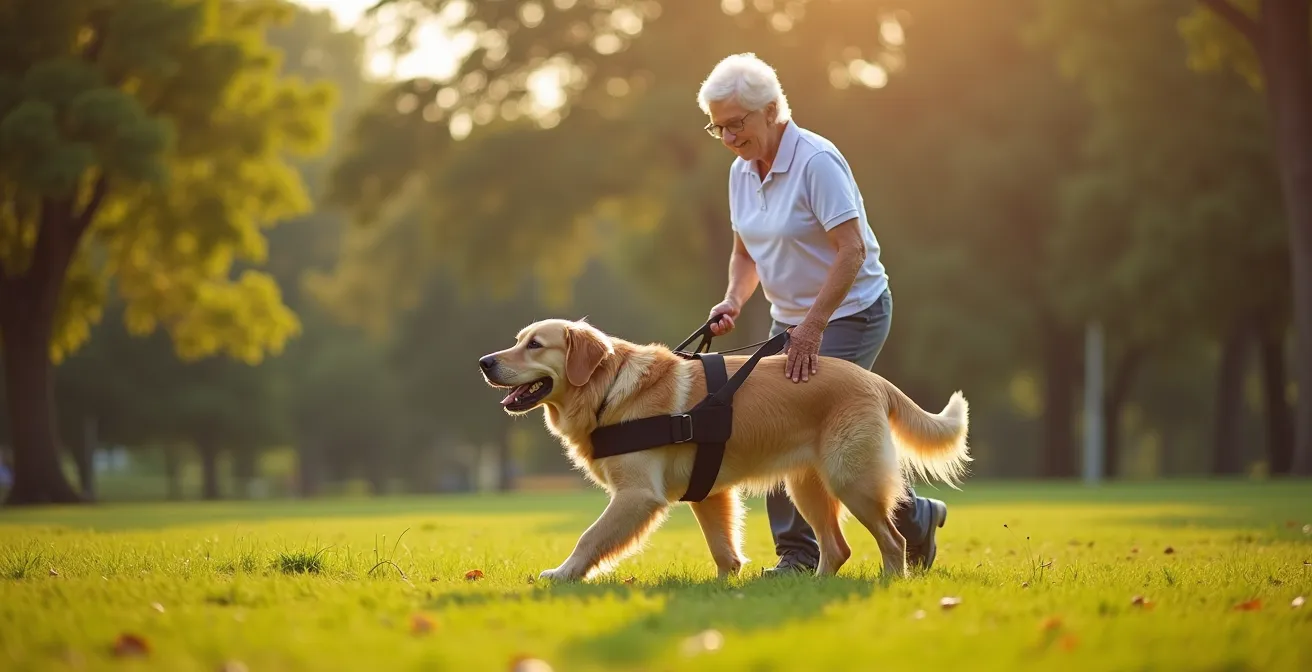
This is where “environmental biomechanics” come into play. A supportive harness with a handle, as shown above, can help you stabilize your dog during walks, giving them the confidence to move. Ramps for cars and stairs prevent the jarring impact of jumping, while raised food and water bowls reduce strain on the neck and front limbs. Every modification is part of a conservative management plan designed to keep them moving comfortably. It’s about creating an ecosystem of support that allows them to remain an active and engaged member of the family for as long as possible.
Injectable Adequan vs. Oral Chews: Which Reaches the Joint Faster?
When navigating the world of joint supplements for your arthritic dog, the options can be overwhelming. Two of the most common therapeutic categories are injectable Polysulfated Glycosaminoglycans (like Adequan) and oral supplements containing glucosamine and chondroitin. The primary difference lies in their mechanism and speed of action. Adequan is an FDA-approved drug that is injected, reaching the bloodstream and joint fluid directly. It works to inhibit enzymes that break down cartilage and helps stimulate cartilage repair processes. Because it bypasses the digestive system, its onset of action is relatively fast, with many owners seeing improvement within a few weeks.
Oral supplements, on the other hand, are nutritional aids that must be digested and absorbed. They provide the building blocks for cartilage (glucosamine) and help it retain water (chondroitin). While many high-quality oral supplements are very effective for long-term maintenance, their onset of action is generally slower, often taking 4 to 6 weeks of continuous daily dosing to build up to therapeutic levels in the body. They represent an ongoing, daily commitment to joint support.
Often, the most effective strategy isn’t a matter of “either/or” but a multi-modal approach. This is a widely held view in the veterinary community, as one expert consensus puts it:
The best approach is rarely ‘either/or’. A vet might recommend an initial course of injectables to quickly reduce inflammation, followed by a transition to high-quality oral supplements for daily maintenance.
– Veterinary consensus, Multi-modal arthritis management approach
This strategy uses the fast-acting injectable to gain initial control over pain and inflammation, providing immediate relief for the dog. The oral supplement then takes over for the long-term, daily management of the condition. This combination, often alongside other therapies like NSAIDs, physical therapy, and environmental modification, forms the cornerstone of comprehensive arthritis care. The choice and timing should always be guided by your veterinarian, who can tailor the plan to your dog’s specific needs and health status.
Key Takeaways
- Arthritis management is a multimodal approach: environment, nutrition, medication, and modified exercise must work together.
- Objective measurement is vital. Use a Quality of Life scale to move beyond guesswork and track your dog’s real comfort level with data.
- The goal is not to stop activity, but to transform it. Swap high-impact fetch for low-impact swimming or scent work to keep your dog engaged and mobile.
Is Orthopedic Foam Necessary for Dogs Under 5 Years Old?
Veterinarians sometimes discuss orthopedic support for at-risk younger dogs, particularly large breeds prone to joint issues. For a senior dog already diagnosed with arthritis, however, a proper orthopedic bed is not an optional luxury—it’s a non-negotiable medical necessity. Standard fluffy beds or piles of blankets offer poor support, allowing a dog’s pressure points like hips and elbows to “bottom out” and press against the hard floor. This increases pain, disrupts sleep, and makes getting up significantly more difficult.
A true orthopedic bed uses high-density foam that distributes the dog’s weight evenly and cushions the joints. The key is choosing the right density and thickness. A heavier dog requires a higher density foam (measured in lbs/ft³) to prevent the bed from compressing completely under their weight. As a general rule, the bed should be thick enough—at least 4-5 inches for a large dog—to keep their joints fully suspended off the floor, even when they are curled up. The bed should also be large enough for them to stretch out completely, allowing them to change positions easily to relieve pressure.
But one orthopedic bed in the living room isn’t enough. The true goal is to create a “network of comfort.” Senior dogs often have preferred resting spots throughout the home—by your desk, in the kitchen, in a sunny spot by the window. Placing orthopedic mats or beds in these key locations reduces the “cost” of movement. It means a comfortable, supportive surface is always just a few steps away, encouraging them to rest properly wherever they are. You can even create your own by purchasing a 2-3 inch memory foam mattress topper, cutting it to size, and placing it inside a durable, washable cover. Adding a waterproof crib mattress cover underneath is a smart move to protect the foam from any accidents, ensuring the bed remains a clean and hygienic place for them to rest.
Now that you have the tools to assess and adapt your home, the next logical step is to create your personalized action plan. Begin today by performing the home mobility audit and discuss your findings with your veterinarian to build a comprehensive comfort strategy for your beloved companion.