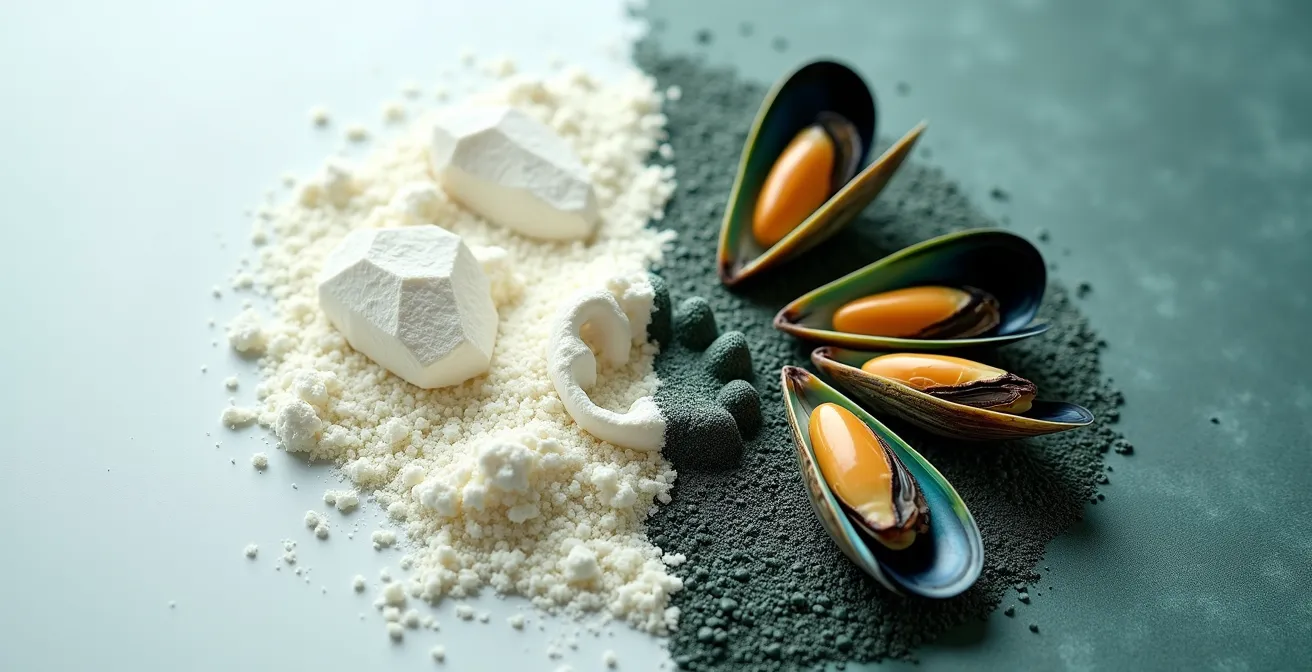
The effectiveness of a joint supplement depends less on the ingredient and more on its specific biological mechanism and your dog’s needs.
- Glucosamine/Chondroitin acts as a slow-release cartilage “building block” with low oral bioavailability, requiring loading doses.
- Green-Lipped Mussel (GLM) functions primarily as a potent, multi-modal anti-inflammatory, offering faster symptomatic relief.
Recommendation: Use GLM for active inflammation and rapid comfort, and consider long-term, high-quality glucosamine for structural support, especially in non-inflammatory cases.
As a dog owner, watching your loyal companion become stiff, slow, and reluctant to play is a deeply painful experience. In the search for a solution, you’re faced with an overwhelming aisle of joint supplements, dominated by two key players: the traditional Glucosamine/Chondroitin combination and the increasingly popular Green-Lipped Mussel (GLM). Most advice simply presents them as interchangeable options, leaving you to wonder which bottle to actually put in your cart.
The conventional wisdom often frames glucosamine as the default choice, a foundational element for joint health. Meanwhile, GLM is positioned as a natural alternative. This simplistic view misses the crucial point and is the reason many owners try supplement after supplement with disappointing results. The truth is, these two ingredients are not in direct competition; they fulfill fundamentally different pharmacological roles within the joint.
But what if the key to effective joint support wasn’t choosing one *over* the other, but understanding *when* to use each one based on its scientific mechanism of action? This guide abandons the “A vs. B” debate. Instead, from a veterinary pharmacist’s perspective, we will dissect their distinct pathways—from bioavailability and speed of action to their core function as either a structural “building block” or a potent anti-inflammatory agent. Understanding this difference is the only way to make an evidence-based decision that truly helps your dog.
This article will provide a clinical framework to navigate these choices. We will explore the science behind how these supplements are absorbed, why some require specific dosing strategies, and how to identify a high-quality product in an unregulated market. We’ll also address related practical questions, from preventative care in puppies to supportive therapies for senior pets.
Contents: Glucosamine vs. Green Lipped Mussel for Canine Joints
- Why Chondroitin Needs Loading Doses to Work Effectively?
- Injectable Adequan vs. Oral Chews: Which Reaches the Joint Faster?
- Turmeric and Black Pepper: Why the Combination Matters for Inflammation?
- When to Start Joint Supplements for Large Breed Puppies?
- The “Proprietary Blend” Trap: Avoiding Under-Dosed Supplements
- Conservative Management for Dysplastic Puppies: Can You Avoid Surgery?
- How to Massage a Senior Cat With Stiff Hips?
- Is Orthopedic Foam Necessary for Dogs Under 5 Years Old?
Why Chondroitin Needs Loading Doses to Work Effectively?
The common instruction to “double the dose” for the first month of using a glucosamine and chondroitin supplement isn’t a marketing gimmick; it’s a pharmacological necessity rooted in a concept called bioavailability. Chondroitin sulfate is a large, complex molecule that is a primary structural component of cartilage. When given orally, it is poorly absorbed by the gastrointestinal tract. The body must break it down, absorb the smaller pieces, and then use those pieces to synthesize new cartilage components within the joint.
This process is inefficient and slow. The “loading dose” strategy is designed to saturate the system, overcoming this low bioavailability to build up a therapeutic concentration of these building blocks in the joint tissues. Without this initial high dose, the small amount absorbed daily might be insufficient to outpace the ongoing cartilage degradation, leading to no visible improvement. Clinical trials support this delayed effect; one key study found that dogs with osteoarthritis treated with a glucosamine/chondroitin product showed significant improvements, but not until day 70 of consistent treatment.
Think of it like trying to fill a leaky bucket with a slow-dripping faucet. The loading dose turns the faucet on full blast to get the water level up quickly, while the smaller “maintenance dose” is just enough to keep it topped up. This slow, structural support mechanism contrasts sharply with ingredients that provide more direct anti-inflammatory effects.
Injectable Adequan vs. Oral Chews: Which Reaches the Joint Faster?
The challenge of oral bioavailability leads directly to the next clinical question: is there a way to bypass the digestive system entirely? This is precisely the principle behind injectable polysulfated glycosaminoglycan (PSGAG), sold under the brand name Adequan. While oral supplements deliver the raw materials for cartilage, Adequan delivers a semi-synthetic version of these building blocks directly into the bloodstream and muscle tissue.
By bypassing the gut, its bioavailability is near 100%. This means the active ingredient reaches the synovial fluid and cartilage in high concentrations within hours, not weeks. It can then directly inhibit the enzymes responsible for cartilage breakdown and stimulate the production of new, healthy joint fluid. This stark difference in delivery mechanism and speed of action is a perfect illustration of pharmacokinetics in action.

The choice between these two delivery methods is a clinical trade-off between convenience, cost, and speed of efficacy. While oral chews are easy to administer at home, their effect is slow and dependent on a much lower absorption rate. Injectables require veterinary administration but offer a far more rapid and potent chondroprotective effect, as detailed in the comparison below.
This table summarizes the critical differences, highlighting how the route of administration dictates the supplement’s ultimate effectiveness.
| Characteristic | Injectable (Adequan) | Oral Supplements |
|---|---|---|
| Bioavailability | Near 100% | 4.8-5% (chondroitin) |
| Time to Joint | Hours | 2-6 weeks for effect |
| Administration | Veterinary injection | Daily at home |
| Cost | Higher per dose | Lower daily cost |
| Convenience | Requires vet visits | Owner administered |
Turmeric and Black Pepper: Why the Combination Matters for Inflammation?
The concept of enhancing bioavailability isn’t unique to glucosamine. In herbal medicine, it’s a core principle. For instance, curcumin, the active compound in turmeric, is a potent anti-inflammatory but is notoriously difficult for the body to absorb. When combined with piperine (from black pepper), its absorption can increase by up to 2000%. This principle of using a “helper” ingredient to boost the main one is a common strategy.
However, some ingredients possess a naturally high potency and unique composition that doesn’t require such enhancement. This is where Green-Lipped Mussel (GLM) enters the picture as a powerful anti-inflammatory. Unlike single-compound supplements, GLM is a complex, whole-food source containing a matrix of beneficial components, including a rich profile of omega-3 fatty acids. Crucially, GLM contains Eicosatetraenoic Acid (ETA), a rare omega-3 that exerts a more potent anti-inflammatory action than the EPA and DHA found in fish oil. This multi-modal attack on inflammation pathways makes it a very effective option for providing rapid comfort.
Because GLM and other supplements like turmeric work on inflammation, combining them with each other or with prescription NSAIDs requires a careful, methodical approach to avoid gastrointestinal upset. A veterinarian should always be consulted, but a safe general strategy includes:
- Start with one anti-inflammatory supplement for 2-4 weeks to establish a baseline response.
- If adding a second supplement (e.g., GLM to a turmeric product), introduce it at half the recommended dose initially.
- Monitor closely for any signs of GI upset, such as decreased appetite, loose stools, or vomiting.
- If sensitivity occurs, try giving the supplements at different meal times.
- Never combine multiple anti-inflammatory supplements with a prescribed NSAID (like carprofen or meloxicam) without explicit veterinary guidance.
When to Start Joint Supplements for Large Breed Puppies?
The question of when to start joint support is a debate between a proactive and a reactive approach. Many owners wait until they see visible signs of stiffness, but by then, arthritic changes may already be well underway. Data shows the insidious nature of osteoarthritis, as studies show arthritis affects an estimated 20% of dogs over one year of age, a number that skyrockets to 80% in dogs over eight. For large and giant breeds genetically predisposed to conditions like hip and elbow dysplasia, early support is not just beneficial; it’s a cornerstone of preventative medicine.

While traditional glucosamine is often reserved for adult or senior dogs, the safety profile of Green-Lipped Mussel makes it an excellent choice for early intervention. Its primary mechanism is reducing low-grade inflammation, which is a key factor in the development and progression of joint disease. By managing this inflammation from a young age, it’s possible to protect the developing cartilage and delay the onset of clinical arthritis.
This proactive use is supported by veterinary authorities. As the American Kennel Club notes, the safety of GLM makes it suitable for dogs of all ages:
GLM is safe for dogs of all ages; there is not a minimum age restriction. Because of its safety profile, giving GLM from a young age can be beneficial to maintaining healthy joints and delaying the onset of arthritis.
– American Kennel Club, Green-Lipped Mussels: Can They Help Your Dog’s Joints?
For breeds like Labradors, German Shepherds, and Golden Retrievers, initiating a high-quality GLM supplement after they are weaned can be a sound investment in their long-term mobility and comfort.
The “Proprietary Blend” Trap: Avoiding Under-Dosed Supplements
The single greatest challenge in choosing any supplement is navigating the unregulated market. Unlike pharmaceuticals, nutraceuticals are not held to the same strict standards of efficacy and label accuracy. A label might list impressive ingredients like “Green-Lipped Mussel” or “Chondroitin Sulfate,” but the actual amount included could be therapeutically useless. The most common way manufacturers hide these low doses is through the use of a “proprietary blend.”
This term allows a company to list a group of ingredients without disclosing the specific amount of each one. Since ingredients must be listed by weight, a blend could be 99% inexpensive filler and only 1% the expensive active ingredient you’re paying for. The scale of this problem is staggering; independent research sponsored by Nutramax Laboratories revealed that a shocking 84% of 23 joint supplements tested failed to meet their own label claims. This makes it imperative for owners to become savvy label-readers.
As a veterinary pharmacist, my primary advice is to arm yourself with knowledge. A quality supplement company will be transparent, providing clear, specific milligram (mg) amounts for each active ingredient and investing in third-party verification. Don’t be swayed by flashy marketing; turn the bottle over and scrutinize the label.
Action Plan: How to Identify a Quality Joint Supplement
- Look for the NASC Seal: The National Animal Supplement Council (NASC) Quality Seal indicates the manufacturer complies with rigorous quality control and labeling standards.
- Demand Specific Amounts: Check that all key active ingredients (e.g., Glucosamine HCl, Chondroitin Sulfate, GLM) are listed with their exact mg amounts, not as part of a proprietary blend.
- Check the Ingredient Order: Ingredients are listed in descending order by weight. Ensure the active ingredients you want are at the top of the list, not buried after flavorings and fillers.
- Research the Brand’s Reputation: Choose brands that are transparent, conduct and publish clinical research, and are frequently recommended by veterinarians for their consistency and quality control.
- Ask for Third-Party Analysis: The most reputable companies will have their products tested by an independent lab and can provide a Certificate of Analysis (COA) to prove the product contains what the label claims.
Conservative Management for Dysplastic Puppies: Can You Avoid Surgery?
A diagnosis of hip or elbow dysplasia in a young puppy can be devastating, often accompanied by the daunting prospect of expensive and invasive surgery. However, surgery is not always the immediate or only answer. Conservative management is a multi-faceted approach aimed at managing pain, preserving joint function, and improving quality of life, with the goal of delaying or even avoiding the need for surgical intervention.
This strategy is a holistic program that includes several key components: weight management to reduce stress on the joints, controlled low-impact exercise (like swimming or leash walks) to maintain muscle mass, and physical therapy. At the core of this medical management is the strategic use of anti-inflammatory agents. While prescription NSAIDs are often used for flare-ups, long-term use of a potent nutraceutical like Green-Lipped Mussel can be a cornerstone of the daily regimen.
By providing consistent, powerful anti-inflammatory effects, GLM helps to reduce the chronic pain and inflammation that drives the progression of arthritis secondary to dysplasia. This not only makes the puppy more comfortable but also enables them to participate more fully in the physical therapy and exercise that are crucial for building supportive muscle. The timeline for seeing results is generally consistent, as veterinary studies show GLM provides noticeable mobility improvements within 4-6 weeks. While it cannot change the underlying bone structure, effective conservative management can allow many dysplastic dogs to live long, comfortable lives without ever needing surgery.
How to Massage a Senior Cat With Stiff Hips?
While much of the focus on joint health is on dogs, our feline companions suffer from arthritis in silence at an astonishingly high rate. For these senior cats, a multi-modal approach combining nutritional support and physical therapy can provide immense relief. While oral supplements can be challenging, it is worth noting the perspective of some nutrition experts.
Green lipped mussels are often more palatable for cats than glucosamine chews.
– Pooch and Mutt, Benefits of Green Lipped Mussels for dogs
Alongside dietary changes, gentle massage is a powerful tool for easing stiffness, improving circulation, and strengthening the bond with your aging cat. The key is to be slow, patient, and attentive to their signals. Start when the cat is already relaxed and calm, perhaps sleeping in a favorite sunny spot. Never force the interaction.

Begin by simply petting your cat along their back, avoiding the sensitive hip area at first. Use long, slow strokes. As they relax, you can gradually move your attention to the large muscles of their hind legs and the area around the hips. Use the flat pads of your fingers to apply gentle, circular pressure. Watch for any signs of discomfort—tail flicking, skin twitching, or trying to move away—and stop immediately if you see them. The goal is gentle kneading, not deep pressure. A warm compress applied to the area for a few minutes before the massage can also help to relax the muscles and increase blood flow, making the session even more beneficial.
Key Takeaways
- Mechanism over Ingredient: Choose Glucosamine for long-term structural “building block” support and Green-Lipped Mussel (GLM) for rapid, potent anti-inflammatory relief.
- Bioavailability is King: Oral supplements like chondroitin are poorly absorbed, requiring loading doses, whereas injectables (Adequan) or highly potent ingredients like GLM offer more direct and faster action.
- Read the Label, Not the Marketing: Avoid “proprietary blends.” Demand specific milligram (mg) amounts for each active ingredient and look for the NASC Quality Seal to ensure you’re buying a therapeutic product.
Is Orthopedic Foam Necessary for Dogs Under 5 Years Old?
The need for an orthopedic bed is determined by a dog’s physical requirements, not their age. While we often associate these supportive beds with senior, arthritic dogs, they offer significant preventative benefits for younger dogs, especially certain types. Considering that most dogs rest or sleep for 12-14 hours per day, the surface they lie on has a profound and cumulative impact on their joint health. For young dogs, an orthopedic bed is less about treating existing pain and more about providing optimal support to prevent future issues.
This is particularly critical for two groups of dogs under five: large and giant breeds prone to developmental joint diseases like dysplasia, and highly athletic or working dogs. For a 100-pound puppy, a cheap, poly-fil bed offers zero support, allowing their joints to rest at unnatural angles and placing pressure on elbows and hips. A true orthopedic foam distributes their weight evenly, protecting their vulnerable, growing joints. Similarly, for a canine athlete, an orthopedic bed is part of their recovery equipment, helping to soothe sore muscles and support joints after intense activity.
However, not all “orthopedic” foams are created equal. The type of foam should be matched to the dog’s specific needs. Memory foam offers excellent pressure relief for bony dogs, while cooling gel foam can be a lifesaver for dogs that run hot. The following table provides a guide to choosing the right support.
| Dog Profile | Egg-Crate Foam | Memory Foam | Cooling Gel Foam |
|---|---|---|---|
| Young Athletic Dogs | Good – Better air circulation | Moderate – May retain heat | Best – Recovery + cooling |
| Large Breeds (Prone to Dysplasia) | Fair – Less support | Best – Maximum joint support | Good – Support + comfort |
| Senior Dogs with Arthritis | Poor – Insufficient support | Best – Pressure point relief | Good – If heat sensitive |
| Dogs That Run Hot | Best – Maximum airflow | Poor – Heat retention | Good – Temperature regulation |
Ultimately, making an informed choice for your dog’s joint health requires moving beyond marketing claims and looking at the science. By understanding the distinct roles of structural building blocks like glucosamine and potent anti-inflammatories like Green-Lipped Mussel, you can tailor a supplement strategy to your dog’s specific clinical needs and provide targeted, effective support to keep them comfortable and active for years to come. For a personalized plan, the next logical step is to discuss these findings with your veterinarian to select the ideal product and dosage for your dog.