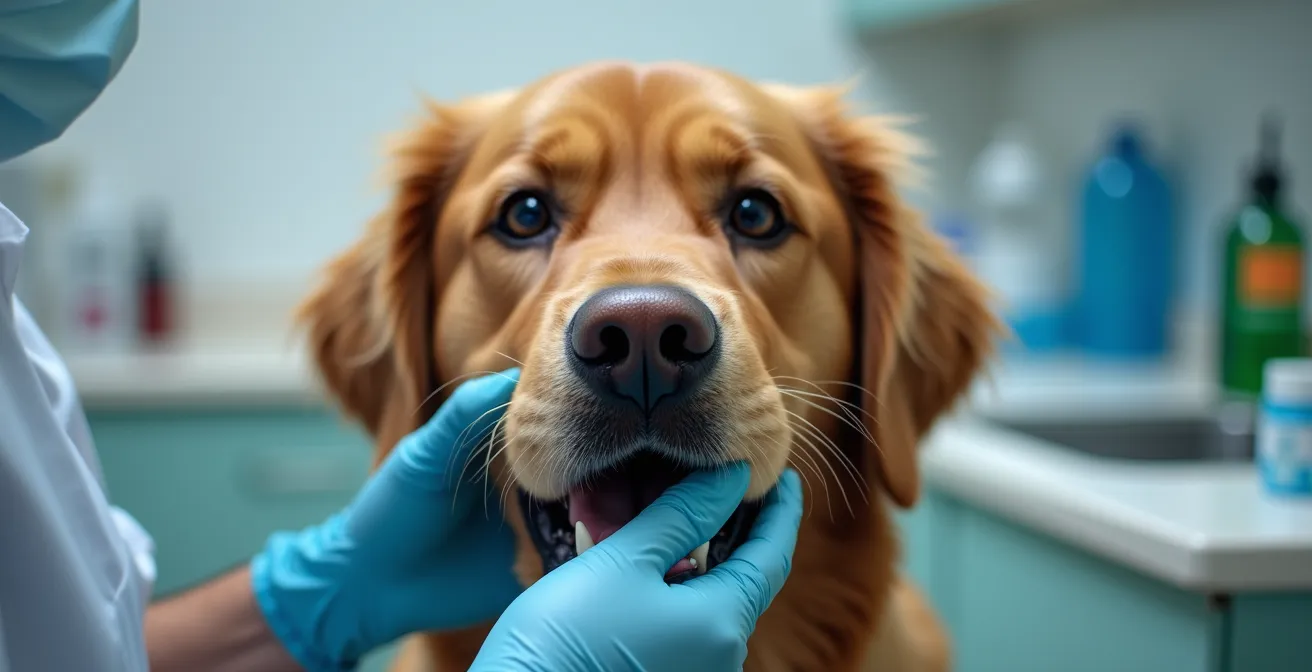
Contrary to popular belief, “doggy breath” is not normal; it is a critical warning sign of periodontal disease actively seeding bacteria into your pet’s bloodstream and damaging internal organs.
- The real danger isn’t visible tartar, but the invisible biofilm of bacteria under the gumline which causes systemic inflammation.
- “Anesthesia-free” cleanings are a cosmetic fallacy, leaving the subgingival disease untouched and creating a false sense of security while organs remain at risk.
Recommendation: Shift from reactive problem-solving to proactive prevention. Implement daily brushing and demand comprehensive, anesthetized dental procedures to protect not just the mouth, but your dog’s entire body.
As a veterinary dentist, the most dangerous phrase I hear from well-meaning owners is, “Oh, he just has doggy breath.” This common misconception is a deadly one. That foul odor you’ve learned to tolerate is not a quirky canine trait; it’s the exhaust fume of a disease process that is silently attacking your dog’s kidneys, liver, and heart. The bad breath, or halitosis, is a late-stage alarm for a problem that has been brewing for months, or even years. Many owners believe the issue is the yellow or brown tartar they can see, but this is a critical misunderstanding.
The true enemy is an invisible, organized colony of bacteria—a biofilm—thriving in the oxygen-deprived space between the tooth and the gum. This is the engine of periodontal disease. From this hidden trench, bacteria and their inflammatory by-products enter the bloodstream with every chew and every heartbeat, a process known as bacteremia. This constant bacterial seeding triggers a low-grade, chronic inflammatory response throughout the body, placing immense strain on vital organs. The smell you notice is the result of this bacterial activity, a sign that the infection is already well-established.
This article will dismantle the myths surrounding your dog’s oral health. We will move beyond the cosmetic issue of visible tartar and expose the direct pathway from subgingival bacteria to systemic organ damage. We will dissect why “anesthesia-free” procedures are a dangerous illusion and why certain popular chew toys do more harm than good. My goal is to reframe your entire perspective: to see dental care not as an aesthetic chore, but as one of the most powerful, life-extending medical interventions you can provide for your companion.
This guide provides a clear path to understanding the real threats and implementing effective, science-backed strategies. Below is a summary of the critical topics we will cover to empower you to protect your pet’s overall health.
Summary: Why Bad Breath Is a Systemic Health Crisis for Your Dog
- Why Bacteria Under the Gumline Is More Dangerous Than Visible Tartar?
- How to Brush a Resistant Cat’s Teeth Without Getting Scratched?
- Water Additives vs. Brushing: Can Liquids Really Replace Friction?
- The Slab Fracture Risk: Why Antlers Break More Teeth Than They Clean
- When Is a Non-Anesthetic Dental Cleaning a Waste of Money?
- Why “Anesthesia-Free” Dentistry Is a Dangerous Cosmetic Scam?
- Why Daily 2-Minute Body Scans Catch Tumors Early?
- Standard Care or Specialist: Who to Trust for Chronic Issues?
Why Bacteria Under the Gumline Is More Dangerous Than Visible Tartar?
The greatest threat to your dog’s health is the one you cannot see. While owners focus on the visible, mineralized tartar (calculus) on the tooth’s crown, this is largely a cosmetic issue. The real damage originates from the living, organized biofilm of plaque hidden below the gumline. This subgingival plaque is a sticky, invisible film of bacteria that adheres to the tooth root. It triggers gingivitis—inflammation of the gums—which is the body’s first response. If left unchecked, this inflammation allows the bacteria to destroy the very structures that anchor the tooth in place, a condition called periodontitis. This process is tragically common; veterinary research shows that over 80% of dogs have periodontal disease by age 2.
Gingivitis is reversible. Periodontitis is not. Once the supporting bone and ligaments are lost, they are gone forever. The bacteria thriving in these deep periodontal pockets don’t stay in the mouth. The inflamed, bleeding gum tissue provides a direct superhighway into your dog’s bloodstream. This constant “bacterial seeding” forces the immune system into a state of chronic, body-wide inflammation. The American Veterinary Medical Association warns of the consequences, stating that plaque and tartar below the gumline are profoundly damaging, leading to infection that can harm the jawbone and its supporting tissues. This systemic link is not theoretical; it is a documented reality.
This is why the concept of “just scraping the tartar off” is so dangerous. It addresses the symptom, not the cause, and leaves the pathogenic bacteria to continue their destructive work unseen. As the American Veterinary Medical Association points out, this invisible threat has severe consequences far beyond the mouth.
Other health problems found in association with periodontal disease include kidney, liver, and heart muscle changes.
– American Veterinary Medical Association, Pet Dental Care Guidelines
These organs act as filters for the blood, and when they are constantly bombarded with bacteria, they become inflamed and damaged. The foul smell is the first sign that this systemic invasion is already underway.
How to Brush a Resistant Cat’s Teeth Without Getting Scratched?
While this article focuses on dogs, the principles of oral health apply equally to our feline friends, who are often more resistant to handling. The idea of brushing a cat’s teeth can seem impossible, but a patient, cooperative care approach can transform the experience from a battle into a bonding activity. The key is to abandon force and instead build positive associations through tiny, incremental steps. You are not trying to achieve a full-mouth, two-minute scrub on day one. Your initial goal is simply to have your cat voluntarily tolerate the presence of a toothbrush near its face.
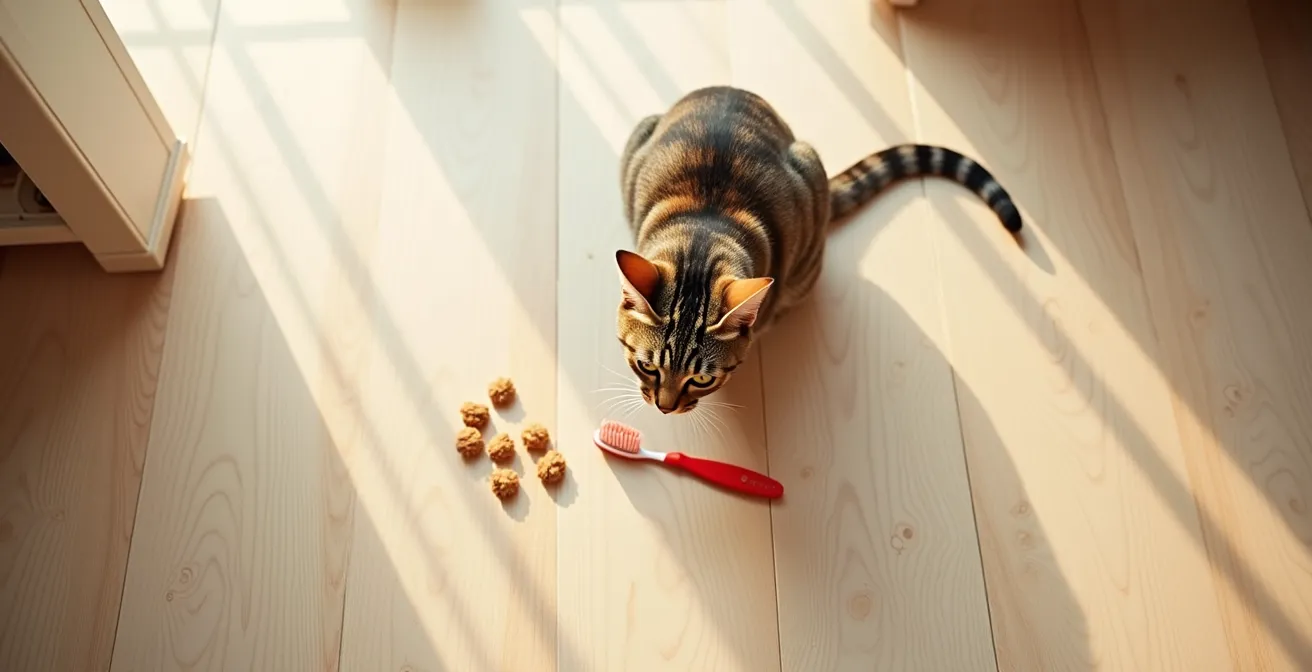
The process starts with scent and taste. Use a veterinary-approved toothpaste with a flavor cats enjoy, like poultry or fish. Let them lick it off your finger as a treat. Then, introduce the toothbrush by simply leaving it near their food bowl for a few days so it becomes a normal part of their environment. Reward any curiosity—a sniff, a head-rub—with a high-value treat. The goal is to make the toothbrush predict good things. Only after the cat is comfortable with these steps should you gently try touching the brush to their cheek, then for a split second to their teeth, always followed by an immediate reward.
This training method, visualized below, prioritizes the cat’s comfort and agency, turning a stressful task into a cooperative one.
A crucial tip for success is to focus on the most important areas. The outer surfaces of the upper carnassial teeth (the large, three-rooted teeth in the back) accumulate the most tartar. A quick, 10-second brush on just these teeth daily is far more effective than a weekly, full-mouth wrestling match. Success is not a perfect cleaning; it is consistent, low-stress removal of daily plaque buildup.
Water Additives vs. Brushing: Can Liquids Really Replace Friction?
In our quest for convenient solutions, the allure of water additives is strong. The promise is simple: just add a few drops to your pet’s water bowl for a healthier mouth. While some of these products can offer a supplemental benefit, it is a dangerous fallacy to believe they can replace the single most effective tool we have: mechanical friction. Periodontal disease is caused by an organized biofilm of plaque. This sticky, complex structure is physically attached to the tooth surface. A liquid simply cannot disrupt or remove this established colony effectively.
Think of it like trying to wash a greasy pan with just a stream of water. Without the mechanical action of a sponge or brush, the grease remains. Brushing works because it physically breaks apart and sweeps away the biofilm before it can mineralize into hard tartar or cause gum inflammation. Water additives, at best, work chemically to help slow down new plaque formation or reduce the bacterial load in the saliva. They do not, and cannot, remove existing plaque hidden under the gumline.
The Veterinary Oral Health Council (VOHC) is an independent organization that evaluates the efficacy of pet dental products. While they have awarded their Seal of Acceptance to some water additives, their primary message is clear. As the VOHC states, “Daily use of products that have been awarded the VOHC Seal will help to keep your pet’s teeth clean,” but they are part of a larger strategy, not a standalone solution. The gold standard remains daily brushing.
The following table, based on VOHC-recognized principles, clarifies the role and effectiveness of common dental care methods. It highlights that while some products are helpful supplements, nothing replaces the gold standard of daily brushing.
| Method | Mechanism | Effectiveness | VOHC Approval |
|---|---|---|---|
| Daily Brushing | Mechanical removal | Gold standard – removes biofilm | Not applicable |
| Water Additives | Chemical disruption | Supplemental only | Some products approved |
| Dental Chews | Mechanical scraping | Helps with visible plaque | 70+ products approved |
The Slab Fracture Risk: Why Antlers Break More Teeth Than They Clean
Owners often provide hard chews like antlers, bones, and hard nylon toys with the best intentions, believing they are helping to scrape tartar off their dog’s teeth. In reality, they are setting their pets up for a painful and expensive dental emergency: the slab fracture. This occurs when a large, flat piece of the tooth shears off, often exposing the sensitive pulp cavity inside. The most commonly fractured teeth are the large upper fourth premolars (carnassial teeth), which bear the brunt of a dog’s chewing force.
The problem is simple physics: the tooth is harder than bone, but the antler or weight-bearing bone is harder than the tooth. When a dog bites down with immense force, something has to give. Unfortunately, it’s often the tooth. A fractured tooth with an exposed pulp is not just painful; it’s an open door for infection to travel directly into the root and jawbone, leading to an abscess. The idea that these chews “clean” teeth is a dangerous myth; any minor cleaning benefit is vastly outweighed by the catastrophic risk of fracture.
Case Study: The Antler-Induced Carnassial Fracture
A common scenario in our clinic involves a dog presenting with sudden facial swelling or reluctance to eat. A veterinary partner case notes that after a dog was given deer antlers to chew on, it developed a fractured right upper fourth premolar with pulp exposure. The report stresses a critical warning: “Deer antlers, bones of any type, dried Yak milk, and nylon toys must be avoided because they can break teeth, exposing the tooth’s nerves.” Treatment for such an injury requires either a root canal or surgical extraction, both complex procedures performed under general anesthesia.
So, what is safe? As veterinary dentists, we advise following the “Knee Cap Rule.” It is a simple, effective guideline to prevent these devastating injuries.
Action Plan: Selecting Safe Dental Chews
- Apply the Knee Cap Rule: If you wouldn’t want to be struck hard on your own kneecap with the object, do not give it to your dog to chew.
- Avoid Danger Items: This includes all real bones (cooked or raw), deer or elk antlers, hard nylon toys, and dried Yak milk chews.
- Look for the VOHC Seal: Choose dental chews that have been reviewed by the Veterinary Oral Health Council for safety and effectiveness. These products are designed to bend or break easily.
- Choose the Right Size: Always select chews that are appropriate for your dog’s size and weight to prevent choking hazards.
- Supervise Chewing: Never leave your dog unattended with any chew toy. This allows you to intervene if they try to swallow a large piece.
When Is a Non-Anesthetic Dental Cleaning a Waste of Money?
Non-anesthetic dental cleaning, often marketed as a “safe” and “natural” alternative, is appealing to owners worried about anesthesia. However, from a medical standpoint, it is almost always a waste of money because it fails to address the actual disease. This procedure is purely cosmetic. It involves using a hand scaler to scrape visible tartar from the crowns of the teeth on a fully awake animal. While the teeth may appear whiter afterward, the procedure does nothing to treat the pathogenic bacteria and inflammation lurking below the gumline, which is the entire point of a dental cleaning.
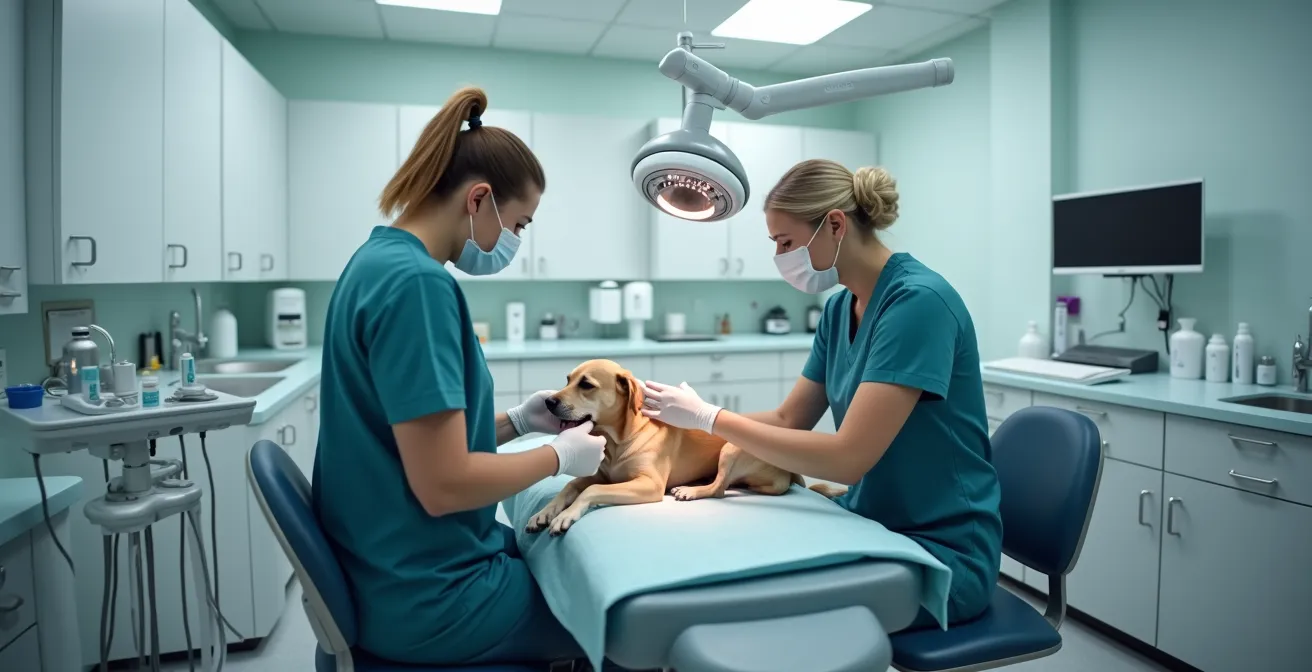
An awake animal will not tolerate the instruments needed for a thorough subgingival cleaning, probing of periodontal pockets, or taking dental X-rays. Without X-rays, it is impossible to evaluate the two-thirds of the tooth that exists below the gumline. This means that painful tooth root abscesses, bone loss, and other serious pathologies are completely missed. The procedure creates a dangerous false sense of security for the owner, who believes their pet’s oral health has been managed when, in fact, the disease has been allowed to progress unchecked.
Research published in Frontiers in Veterinary Science demonstrates this diagnostic gap with stark numbers. The study found that 86.6% of dogs had periodontitis when examined under anesthesia, compared to only 67.7% identified during a conscious exam. This means a significant portion of active, painful disease is missed without proper diagnostics under anesthesia. As the American Animal Hospital Association (AAHA) guidelines state, “General anesthesia with intubation is necessary to properly assess and treat the companion animal dental patient.” There is no substitute. A proper procedure involves scaling, polishing, probing, and full-mouth radiographs in a controlled, clinical setting.
Paying for a procedure that ignores the source of the disease is not just ineffective; it’s a financial waste that delays the essential treatment your pet actually needs, allowing silent organ damage to continue.
Why “Anesthesia-Free” Dentistry Is a Dangerous Cosmetic Scam?
Moving beyond the ineffectiveness, it’s important to label anesthesia-free dentistry for what it is: a dangerous cosmetic scam. The practice preys on an owner’s legitimate fear of anesthesia while providing a service that has no therapeutic value. It is the illusion of medical care, not the reality. The term “dentistry” itself is misleading, as no actual dental assessment or treatment can be performed on an awake, moving, and often stressed animal.
The core of the scam lies in conflating visible tartar with periodontal disease. Tartar is the mineralized, dead remnant of plaque. The disease is the living bacteria attacking the gums and bone. Removing the visible tartar without addressing the subgingival infection is like painting over a mold-infested wall without treating the underlying leak. It looks better, but the structure continues to rot beneath the surface. This cosmetic “fix” gives owners a false sense of accomplishment, delaying the proper, anesthetized procedure their pet desperately needs. During this delay, the periodontal disease progresses, bone loss worsens, and the chronic bacterial seeding of vital organs continues unabated.
The practice is not endorsed by any major veterinary organization. The American Veterinary Dental College, the American Veterinary Medical Association, and the American Animal Hospital Association have all issued statements against it. They emphasize that a comprehensive oral health assessment and treatment (COHAT) is impossible without anesthesia. A case study on the topic clearly outlines the limitations, noting that anesthesia-free cleanings are not a substitute for proper dental procedures and only focus on the visible part of the tooth, ignoring the disease under the gums. The entire business model is built on a fundamental misunderstanding of what dental disease actually is.
Worse, the process can be terrifying for the animal and can cause injury. Using sharp instruments in the mouth of a conscious animal risks traumatizing the soft tissues or causing the pet to inhale bacteria-laden tartar. It teaches the pet that having its mouth handled is a frightening experience, making future at-home care and veterinary exams more difficult. It’s a procedure that offers no medical upside and significant potential downsides, both physically and behaviorally.
Why Daily 2-Minute Body Scans Catch Tumors Early?
After discussing the importance of professional care, the power to protect your pet’s health returns to your hands—specifically, through a daily, two-minute check. While a full “body scan” is beneficial, the most high-yield part of this routine is the oral assessment. The mouth is a window to the body’s overall health, and subtle changes can be the earliest indicators of both local and systemic disease. By making a quick oral check part of your daily petting or grooming routine, you become the first line of defense in early detection.
You are not expected to be a veterinarian, but you are the expert on what is “normal” for your pet. Your goal is simply to notice any changes from one day to the next. This quick scan involves gently lifting the lips and looking for new lumps, bumps, or areas of discoloration. Is there a broken tooth you hadn’t seen before? Are the gums a healthy pink, or are they red, pale, or even purple? Does your pet flinch or pull away when you touch a certain area? Noticing these changes early can be the difference between a simple intervention and a complex, advanced disease. As noted veterinary dental specialist Dr. Brenda L. Mulherin confirms, a veterinarian can spot signs of major systemic issues just by looking in the mouth, including kidney disease, autoimmune disorders, and clotting problems.
Combining this visual check with observation of your pet’s behavior creates a powerful diagnostic tool. A pet that suddenly starts chewing on only one side of its mouth, drops food, or becomes reluctant to play with its favorite chew toy is often communicating oral pain. Use this checklist as a daily guide:
- Gum Color: Gums should be a consistent bubblegum pink. Look for areas that are bright red (inflammation), pale white (potential anemia), or have a bluish/purple tint (poor circulation).
- Lumps and Bumps: Gently run your finger along the gums and lips. Any new swellings could be an early sign of an oral tumor or abscess.
- Tooth Integrity: Visually scan for any broken, chipped, or loose teeth. Pay special attention to the large chewing teeth in the back.
- Eating Habits: Observe your pet at mealtime. Is there any hesitation, one-sided chewing, or dropping of food?
- Reluctance to Touch: Note any new sensitivity or head shyness when you try to touch your pet’s face or mouth.
- Drooling or Bleeding: A sudden increase in drool, especially if it’s bloody or ropey, warrants immediate investigation.
Key Takeaways
- Bad breath is a sign of active periodontal disease, which seeds bacteria into the bloodstream and damages the kidneys, liver, and heart.
- The goal of oral care is to remove the invisible, pathogenic biofilm under the gumline through mechanical friction (brushing), not just the visible tartar.
- Anesthesia-free cleanings are a cosmetic and dangerous illusion of health that allows the real disease to progress unchecked.
Standard Care or Specialist: Who to Trust for Chronic Issues?
For routine preventive care and minor issues, your general practice veterinarian is your most important partner. They are trained to perform comprehensive oral health assessments and treatments (COHATs), including cleaning, polishing, and simple extractions. However, when oral disease becomes advanced, chronic, or complex, the expertise of a board-certified veterinary dentist (a Diplomate of the American Veterinary Dental College, or DAVDC) becomes crucial. Knowing when to ask for a referral can save your pet from prolonged pain and ineffective treatments.
A general practitioner receives basic dental training in veterinary school. A DAVDC, in contrast, completes an additional 3-4 years of rigorous, specialized training exclusively in dentistry and oral surgery after becoming a veterinarian. This makes them the definitive experts for complex cases such as root canals to save fractured teeth, advanced periodontal surgery to treat severe bone loss, jaw fracture repairs, and the diagnosis and treatment of oral tumors. If your pet has a chronic condition like feline stomatitis (a severe, painful inflammation of the entire mouth) or has undergone previous dental procedures that failed to resolve the issue, a specialist’s evaluation is warranted.
Certain pets are at higher risk for severe dental issues and may benefit from a specialist’s oversight earlier. For instance, the largest study of its kind found that extra-small breeds under 6.5 kg are five times more likely to develop periodontal disease than giant breeds due to tooth crowding and genetic predisposition. For these high-risk animals, a specialist can create a more aggressive and effective long-term management plan.
The following table outlines the key differences between a general practice veterinarian and a specialist, helping you understand who to trust for different levels of oral health needs.
| Provider | Training | Best For | When to Refer |
|---|---|---|---|
| General Practice Vet | Basic dental training in vet school | Routine cleanings, simple extractions, prevention | Advanced periodontitis, fractures needing root canal |
| DAVDC Specialist | 3+ years additional training post-vet school | Complex surgeries, root canals, oral tumors | Chronic stomatitis, jaw fractures, failed treatments |
Frequently Asked Questions on Pet Dental Care
Why can’t dental X-rays be taken without anesthesia?
X-ray sensors must be placed precisely inside the mouth at specific angles, and the animal must remain completely still for a clear image. Even the slightest movement, such as breathing, can make the radiograph blurry and non-diagnostic. Anesthesia is essential for patient safety, comfort, and the ability to obtain the images needed to evaluate the 60% of the tooth structure that is hidden below the gumline.
What percentage of dental disease is missed without anesthesia?
A significant amount. Because two-thirds of each tooth is below the gumline, it is impossible to assess or treat pathology in this area on a conscious animal. Studies show that dental X-rays taken under anesthesia reveal clinically significant problems in over 25% of dogs and 40% of cats that appeared to have normal mouths on visual inspection alone. Without anesthesia and radiographs, abscesses, bone loss, and retained roots go completely undetected.
Is removing visible tartar enough to treat dental disease?
No, it is not. This is a critical misunderstanding. Visible tartar (calculus) is primarily a mineralized deposit and is not the direct cause of periodontal disease. The disease is caused by the living biofilm of bacteria that resides in the space between the tooth and the gum. Simply scraping off the visible tartar provides a cosmetic improvement but leaves the active infection untouched, allowing the disease and its systemic consequences to progress.